Tuesday, 12 June 2012

Puzzle #113: Easy as Japanese Sums

I encountered this puzzle type the first time when test solving Serkan Yurekli's puzzle set for last year's 24 hour puzzle championship. I really liked them, although they caused more trouble than you'd expect for their size. Even though the puzzle idea is very similar to Japanese Sums puzzles, the Latin Square component in this genre makes solving a lot different though. Only later I found that the genre also existed on Naoki Inaba's website.
This is the first time I tried to create one myself. I like how it turned out. It's moderately difficult.

Rules for Easy as Japanese Sums

This puzzle uses the digits 1-5.


Rules: Easy as Japanese Sums

This genre was invented by Naoki Inaba

Place the digits in the given range once in every row and column. The numbers on the outside indicate the sum of the first digits seen from that side till encountering an empty square.
The example uses the digits 1-3.


Friday, 8 June 2012

European Championship Football

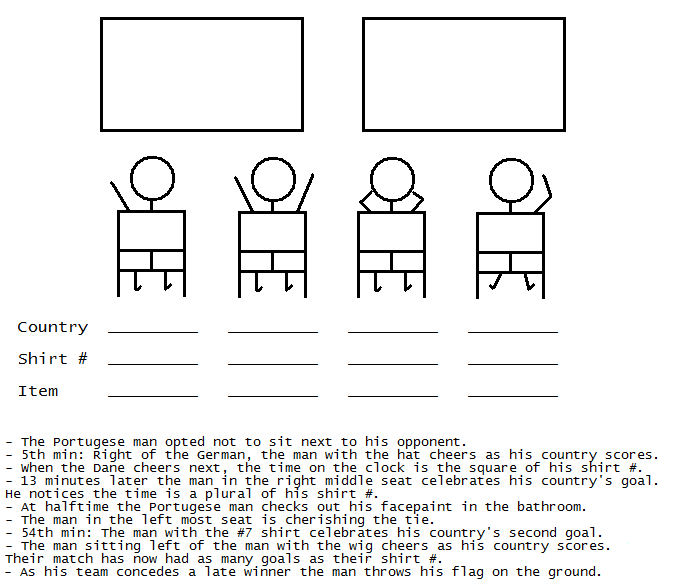
A while back at a Dutch championship we had a round inspired by the World Football Championship that had started that weekend, so I've written a few puzzles using the teams in each group. They're not very hard. One of them is a simple score deduction puzzle. The standings are purely fictional, nothing intended. The second is a logic puzzle, which includes the game scores. I hope you like my awesome drawing. The third is a path puzzle using the country names. The fourth is a Four Snails puzzle using the country names.

Group A: Final standings

Part of the final standings of group A are given. Fill out the rest and deduce the match results. For those not knowledgable of football, a win gives you 3 points, a tie gives you 1 point, a loss gives you 0 points.
G = Matches played, W = Matches won, T = Matches tied, L = Matches lost, P = points score, GF = Goals scored, GA = Goals conceded.


Click to enlarge
Group B: Logiquiz

Sunday 17th of June, 20:45. A Dutchman, German, Portugese and Dane have come together to watch their group's final matches. They're each wearing their countries shirt with a different number. They also brought another item to dress themselves up. Figure out who sat where, what number they had and what item they brought.
All clues are given in chronological order.


Click to enlarge

Group C: Country path

Draw a path from the first letter to the last letter of each country in order. The path doesn't rouch or cross itself. Different paths can't touch or cross eachother, except in a cell with a letter. If two paths both go through a cell with a letter they have to both go straight through it.


Click to enlarge
Group D: Four Snails

Write all countries in one of the four spirals. Write the letters in order from the opening inwards. No letter may repeat in any row or column.


Thursday, 7 June 2012

Puzzle #112: LITS; Inversed

Today's puzzle is a variant on the LITS genre. I don't remember seeing it before. Constructing it went smoothly, although there were some points at the end where it caused trouble to keep it unique. Hope you all like it.

Rules for LITS

Colour some squares to form a single contiguous wall. The wall has no 2x2 coloured areas anywhere. In each blackbordered region a shape of 4 orthogonally connected squares remains empty. Identical shapes in different regions can't touch eachother by a side. Rotations and reflections are considered the same shape.


Wednesday, 6 June 2012

Croatian Puzzle Set

I had been asked to write a puzzle set for a competition in Zagreb last weekend. I wrote a set of puzzles which was a mix of Dutch and Japanese, familiar and unfamiliar, classic and simple variations. There's a lot of puzzle types in here that I havent actually posted on my blog before. The timing of the set was set at 75 minutes, which was longer than the fastest testing. But I have learned from earlier experiences that testing times don't always measure up to the actual test solving. I've added the scores for each puzzle, which equal to 2 points per minute. I think it worked out well, with a mix of easier and harder puzzles. If anyone actually solved them in copetition, I'd love to hear about it.

So here's 14 puzzles in a single post, the most I have done so far. I hope this makes up a bit for the hiatus of a month before. It would of course be easiest to just upload the PDF, but blogspot doesn't seem to offer that option. So instead this post will have all puzzles below.

Tuesday, 5 June 2012

Puzzle #111: Tapa; Magnetic

This variant was my favourite in constructing during the whole TVC practise series. This was because I was able to do the most with it. I have always loved Magnets puzzles. The first time I encountered them in the Dutch magazine Breinbrekers, I instantly liked how the logic worked. Somehow it just clicked for me. I always have fun constructing them as well. You can have fun with them, especially if you leave out clues like in these puzzles I put on PuzzlePicnic: #1242 and #2160. The combination with Tapa makes for a whole different way of construction. But I liked them best where the Magnets clues lead to the most deductions, instead of the Tapa part.
I think the puzzle worked out well. I wanted to make a 111 themed puzzle and I think it worked out well. It's made in a 11x11 grid. There is one single 111 Tapa clues. It is almost perfectly themed with the magnets clues as well. Each side has 6 1 clues. Just couldn't get the columns set as a three 1 clues for both plus and minus. But I like how it turned out in the end.

Rules for Tapa

Follow regular Tapa rules. Additionally the grid is made up of magnetic and non-magnetic plates. The Tapa wall is made up of non-magnetic plates. Each magnetic plate has a positive (+) and negative (-) side. Sides with the same symbol can't be orthogonally adjacent. The numbers outside the grid indicate how many of the indicated symbol appears in that row or column.


Click to enlarge

Saturday, 2 June 2012

Puzzle #110: Star Battle; Clone

This week's puzzle making has been one big stretch of it-just-will-not-work. About every puzzle I tried to make, wouldn't work the way I wanted. When you add to that a bit (or a lot) of stubbornness and I end up restarting a lot of designs and constantly coming to the same conclusion and having to restart.
This puzzle hasn't been any different. I had a certain idea but every time I tried to execute it, I would be forced to break the opening and thus had to restart. So eventually I made it slightly different and an easier version of it. This is the result. I like the opening. I haven't fully checked if there are other ways to open it up, but I like where the intended one is located and how it runs the rest of the puzzle. The puzzle isn't easy, but I wouldn't say overly challenging. Just keep track well in all grids and you should be able to solve it.

Rules:

Place 3 stars in every row, column and boldly marked area. All grids have the same solution. You'll need to use all grids to get to the solution.


Click to enlarge

Wednesday, 30 May 2012

Puzzle #109: Camping

Yesterday's puzzle was scrapped at the last moment. the puzzle was not unique as I had made a flaw in the opening, so the whole puzzle didn't work anymore. There was really no saving it. I didn't want to just make a quick puzzle and instead moved the posting up a day.

This weekend I won my first LMI monthly puzzle test. I hadn't expected it when I finished it, with how disappointing the last 40 minutes went. In the first 80 minutes I had brushed off all puzzles besides the two "no numbers" genres. I thought it would be best to try to solve both No Number Field puzzles and leave the easy loop for the end. But after really struggling through that easy one, I quickly switched to the loop. The easy one I liked, although I struggled with it a little. I managed about half the second No Numbers Loop in the last 10 minutes. I made a mistake and it took me over 10 tries afterwards to discover what I was doing wrong.
Through Saturday it became clear though that I wasn't the only one who struggled with a few of the puzzles. In the end the top mostly solved the same puzzles, with the big difference being that I did manage to solve the second Synchronised Maze.

Today's puzzle is very old school to me. It was a standard puzzle in Breinbrekers when I first started buying the magazine. It has some similarities to Tents and Trees. The name of the puzzle was "Huisje, Boompje, Beestje" which is a Dutch saying that literally translates to "little House, little Tree, little Animal". The puzzle layout featured a house, a tree and a heart. Because the saying doesn't really translate to English in a way that it's applicable to a puzzle type, I changed the idea a bit. Instead it's represented by a camping ground.
When I first got the magazine this puzzle type always broke me up. I hardly ever managed to solve the puzzles. Then when I first started making puzzles, I tried making one of these. And all of the sudden I was able to solve them. It was the first time I noticed that trying to design a puzzle helps with solving a puzzle type.
There are 2 puzzles. One is a small easy one to help learn a few of the tricks involved. The second one is a normal sized puzzle. It's harder, but completely logically solvable. Hope you guys enjoy them.

Rules for Camping

Easy Puzzle


Hard Puzzle


Click to enlarge

Rules: Camping


Place a number of tents, trees and caravans in the grid. Each tree has a tent and a caravan orthogonally connected to it. No two equal symbols can touch eachother, not even diagonally. The numbers on the outside indicate how many of each symbol are in that row or column.


Thursday, 24 May 2012

Puzzle #108: Not Alone

While creating the Black and White Matchmaker as a practise puzzle, I discovered an interesting logic deduction regarding the "Not Alone" puzzle type, which I thought could lead to an interesting puzzle and severely reduce the amount of clues necessary to make it unique. So I tried it and brought it down to only 10 clues. I'm not convinced this is the minimum, but it's far fewer than I thought at first. At first the puzzle reminded me of the Binary puzzles, which are now also published here in a seperate booklet, which I find a boring puzzle type. But this rule is actually far more interesting that those puzzles. This one was pretty fun to create. I wonder how it will be perceived as difficulty. If you realise the one logic deduction I exploited here, it shouldn't be too hard. When you don't realise it, I don't know how people will feel about it.

Rules:

Fill the grid with black or white circles so that each row or column has the same amount of black circles and white circles. One circle of a color can't be sandwiched by circles of the other color horizontally or vertically.
An array of two or more circles of a same color may be sandwiched by circles of the other color  horizontally or vertically.


Wednesday, 23 May 2012

No Number Practise: Black and White Matchmaker

This weekend is the No Numbers test at Logic Masters India. It is written by Ko Okamato (Xevs). It contains  only puzzles without numbers in the grid, Most types are new to everyone, although I have come across Synchronised Maze before. It might not be my best performance as some of the types are a bit prone to error. The 2 "No numbers" puzzles have to be approached very carefully as it's easy to accidentally leave a number in when you make a small transcription (No Numbers Field) or reading (No Numbers Loop) error. Prasanna created practise puzzles for the other puzzle types, which can be found here, here and here.

I decided to make a Black and White Matchmaker as practise. I've never been any good at these matchmaker type puzzles. I tend to just avoid them unless it's the only one left. In this test it's over a quarter of the points, so probably wise to attempt. Also it contains the most familiar puzzle types. So I figured it would be worth a try to design one so I could find some easy ways to exclude certain types from certain puzzle grids. I've put in a few of ways I found in the grids. The puzzle turned out okay, but with a bit more effort I could have probably made the puzzles overlap in a few more genres.

I've put all puzzles in a single image with a table to match the puzzle types. I also have all puzzle grids as a seperate image. If it would be preferred that I post them all seperately, I can do that as well.

General Rule

There are 6 puzzle grids given with black and white circles and 5 puzzle types. Match each type to one puzzle grid and solve it under that rule. One of the grids won't be used. Certain grids might be solvable under multiple rules, but it's only possible to match them in one way so all 5 rules can be solved in a seperate grid.

Puzzle Types

Masyu:
Draw a single loop that runs horizontally and vertically though every cell with a circle. In cells with black circles, the loop must make a 90-degree turn and go straight in both neighboring cells. In cells with white circles, the loop must go straight and makes a 90-degree turn in at least one of neighboring cells.

Black & White:
Fill the grid with black or white circles so that all of the circles with same color will be connected vertically or horizontally. Circles with same color can't form a 2x2 square.

Sun & Moon:
Draw a single loop that runs horizontally and vertically through every cell in the grid once. The loop can't make turns between cells with circles of the same color, and makes just one 90-degree turn between cells with circles of different colors.

Not alone:
Fill the grid with black or white circles so that each row or column has the same amount of black circles and white circles. One circle of a color can't be sandwiched by circles of the other color horizontally or vertically.
An array of two or more circles of a same color may be sandwiched by circles of the other color  horizontally or vertically.

Signal loop:
Draw a single loop that runs horizontally and vertically through every cell except cells with black circles. The loop goes straight in cells with white circles.


Click to enlarge

Tuesday, 22 May 2012

Puzzle #107: Blind Spot

Here's another genre taken from Naoki's website. Although I think I've seen it before somewhere else as well. It just seem familiar from a few years ago. So possibly it featured on a WPC at one point.
 The first puzzle I made I liked a lot, except I thought it was a bit too hard as the first one on my blog. So I made another one, which was much easier. But I figured I need something a little bit more challenging to post. So I made a third one, which fell a bit in between both puzzles. And instead of posting just one, I'm going to post all 3. If you solve the example and then the first 2 puzzles in order, you should gradually get all the insights to also solve the third puzzle.

Rules for Blind Spot

Easy Puzzle


 Medium Puzzle


 Hard Puzzle


Rules: Blind Spot

This genre was developed by Naoki Inaba

Place an arrow for all four directions (up, down, left right) once in every row and column. No arrow points at another arrow. Black walls block the view of an arrow.

Saturday, 19 May 2012

Puzzle #106: Killer Sudoku With Hidden Cages

This puzzle was inspired by a question raised on a sudoku forum if the Sunday Telegraph's Killer Sudoku With Hidden Cages was also solvable without the constraint that the number was always in the top left cell of the cage. It was never succesfully answered as those killers are probably meant to be solved that way. The Top Left cell constraint is a very powerful one, so it would probably not be unique. From here I figured it might be interesting to try to design a puzzle without that constraint. I'm guessing it's been done before, but I can't directly recall any of them.
I really like how the puzzle turned out. It looks nice and solves really smoothly. The opening probably isn't the most obvious one though. I don't think it's overly hard, but most of my Sudokus turn out a bit on the harder side. I think it's just something that automatically happens when I create Sudoku variants as I like to exploit and explore the opportunities a variant offers. Hope you all enjoy it.


Rules for Sudoku

In this Killer Sudoku the cages are hidden. Each cell with a clue number is part of a seperate cage. Each cage consists of orthogonally connected cells. The number indicates the sum of the digits in those cells. No digit can repeat within a cage. Cages consist of at least 2 cells. No two cages can overlap.


Thursday, 17 May 2012

Puzzle #105: Quattro Stagioni (Corral, Nurikabe, Tapa LITS)

I have made a bunch of puzzles for friends for various reasons. Mostly for special occasions. I usually try to theme them in a certain way. This is mostly just based on the way the givens are oriented. For this puzzle though I had the fortune to get three handy numbers to work with, namely 2, 3 and 7. The numbers were handy to build into most genres, so I attempted to use them as best as I could. This puzzle is built up of four quadrants that each belong to a different genre. I thought a while about a good fourth genre to add as Nurikabe, Tapa and LITS have a similar general puzzle idea behind it. I couldn't come up with a good fourth genre that used this type of clue. So I cheated a bit by using corral-like clues, within the same puzzle structure. I think the puzzle worked out well, not overly difficult but still interesting.

Quattro Stagioni

General Rule:
Colour some cells to form a single contiguous shape. The shape doesn't form any 2x2 squares anywhere.

Left Top: "Corral"
The numbers in this section are all part of the shape. The numbers indicate how many cells that are part of this shape can be seen from this shape in horizontal and vertical direction, not including the cell itself. The numbers can't see past white cells. [Note: This section doesn't work like normal Corral. The clue type doesn't include the cell itself. Also there's no loop constraint.]

Right Top: Nurikabe
The numbers in this section each indicate a seperate island of orthogonally connected white cells. The numbers indicate the size of the island they are part of. All remaining cells in this section not part of an island belong to the shape. The islands can cross the border of this section.

Left Bottom: Tapa
The numbers in this section indicate how many consecutive cells are to be coloured around it. If there is more than one number in a cell, then each section of consecutive cells must be seperated by at least one empty cell.

Right Bottom: LITS
In this section colour 4 orthogonally connected cells in every boldbordered region. Two identical shapes in different regions can't touch eachother by a side. Rotations and reflections are considered the same shape.


Click to enlarge

Tuesday, 15 May 2012

Puzzle #104: Yajilin

I had a pretty good weekend solving sudokus. I finished 13th in the Swiss championship, finishing all puzzles within the set 2 hours. I knew I wouldn't at all be close to the top solvers, so just happy I finished all. I had a lot of trouble with the half squares sudoku and messed up the thermometers on the first try. Although when I recognised my mistake I could just use the second option and the solve was far easier than purely logical.
My Sudoku 8x8 solve leaves me with a bit of mixed feelings. On the one hand I equaled my best performance in an LMI Sudoku test, on the other hand I screwed up in both parts and could have possibly gotten my first top 10 finish. In part A I made a few transposition errors in the Foursome Sudoku, leading to digits in the wrong place and thus having to restart even though the grids I had solved at that point were correct. In part B I wasted my first 20 minutes breaking the Skyscraper, Irregular without regions and Irregular Cube and only finishing the Cube in the end. When I finally got going, I managed to brush off 10 more puzzles in the remaining 44 minutes, but it could have all been far better. But in the end I did as well as I had hoped for both tests.

Now about today's puzzle. On May 10th there was a sudden spike of blog visits, which coincided with the arrival of my latest Akil Oyunlari magazine. This issue featured 4 Yajilin and 4 Tapa puzzles by my hand. Most visits to my blog that day featured my Yajilin pages. So from that I'm guessing people liked them and wanted to try some more. I do think that my Yajilin puzzles on my blog have generally been well received, so I decided to post another one for that reason today. This one is a bit larger than my normal ones, but not as big or challenging as my previous oversized Yajilin. I do think it's again a nice layout of givens, so enjoy.

Rules for Yajilin


Click to enlarge


Friday, 11 May 2012

Puzzle #103: X Sums Sudoku

It's been a while since I've posted. This is mainly just through lack of inspiration on my part. I hadn't written any puzzles for the last month or so.  I recently wrote a bunch again and that went off pretty well, so I'm going to start posting puzzles again.

If you like Sudokus, this weekend can be an enjoyable one for you. With 2 Sudoku tests running, there is plenty to solve. Firstly there's the 8x8 Sudoku Contest on Logic Master India. This competition has 2 seperately solvable parts to it. Both parts have a variety of different 8x8 sudokus in it. One part with regular 2x4 nonets. In the second part the puzzles all have an abnormal layout, either irregular cages, or differently placed 2x4 cages.
There's also the Swiss Sudoku Championship hosted on Logic Masters Deutschland. This is a collection of mostly well known variants. It has a halved squares sudoku in it, which featured in its own round at the WSC in Hungary last year.

This Sudoku will feature in the LMI test. It's an interesting genre, which has some overlap with my own Frameless Sudoku. This idea though needs far fewer clues to get unique though. I am not sure if the puzzle in the championship will also look like this, but I think it's nicer by leaving clues out.

X sums sudoku

Fill in the whole grid with numbers 1-8 so that each number appears exactly once in every row, column and blackbordered area. Numbers outside the grid indicate the sum of first X-numbers in corresponding direction. Number X is always the first number in corresponding direction. F.E. - if the first number in row is 5, the outside number indicates the sum of first 5 numbers in that row.


Tuesday, 3 April 2012

TVC XII Recap

So, result-wise this was my worst performance of the series with a 17th place. I think I solved pretty well during the test though. I wasted some time on the large Compass and large Twilight, which I just couldn't crack. The Twilight Tapa was a bit sad as when I resolved it I noticed I had forgotten to put down one simple cross, which set the whole second half of the puzzle in motion. Thus I should have been able to do it. But overall I solved in good speed, no real breaking points and was overall happy with my performance. This was of course till I saw the results and had 12/16 marked correct. I had forgotten to colour one duplicate symbol in the Sweeper Tapa, I had forgotten to colour the 21 clue in the left bottom at the end of my solve even though I had concluded it depicted the white cells around it. I ahad lso messed up the way to enter the key for the Tapa-like Loop. The first one I did completely the wrong way, but I got the points for it because they were all +1. Somehow for the large one, I only did the first segment of A wrong but the rest correct. This of course led to a mix of correct and incorrect numbers and thus I didn't get the points. I had at least solved it correctly on paper.
I think this practise kit helped myself best in preparing out of all 4 tests. There were a few puzzle types for which I hadn't completely figured out how they would look or feel. Making them helped me a lot. I think it definitely increased my Wired Tapa solving, which I found surprisingly fun to solve. Also the Tapa-Like Loop puzzles were a lot easier when I figured out a few tricks from the genre while making them. I think my Twilight also should have helped well for the test puzzles.

Overall I finished 4th, which seems appropriate I think. But I do think this normalised system with best 3 out of 4 isn't 100% perfect. Because if I hadn't made the small solving and answer key mistakes, I would have beaten Hideaki comfortably in this test and would have thought it might have been good to beat him for 3rd place as I did exactly what I had needed to do. Except because Palmer beat everyone by a mile, this whole test wouldn't have counted as everyone's normalised score is very low. And I don't think it accurately depicts the difference between all players. Really it now only compared everyone to Palmer as he was just better than the rest. I feel that if you take Palmer out of the equation in all tests, that you might see a bunch of shifts in the leader board as TVC XII would be far more influential than it is now. Nyuta and EKBM did particularly well compared to many in this test, but only got a normalised score of 720 and 685 to show for it, which seems a bit unfair. It might be better to do something similar to the CTC, where not only the highest score sets the mark but a group of the best scorers. That way it could lead to a better representation overall for all players. I'm not sure of this and can't really run the numbers very quickly on what the results would be, but I'd be interested to see though if someone feels like it.

I'll also talk a little bit about the CTC here. I finished 5th overall. I had a bit of a false start in the first 2 weeks with a lot of errors. Halfway through it became clear that Palmer was running away with this one. Hideaki and Nyuta settled into a comfortable 2nd and 3rd and there was a group of 5 players who formed a subtop, which included me at 8th place. This was kind of the point where I thought 4th place was the highest possible, which I had talked to Zoltan a bit about. I started in 8th place and slowly made my way up. Then there was a week of harder puzzles, through which I made my way pretty well and in which Hideaki and Nyuta dropped some points and all of the sudden 3rd place became a possibility. I made it to 5th place behind Zoltan, who came agonisingly close to taking 3rd place, but eventually had to concede 4th. Sadly it wasn't to me as Psyho overtook me on the same day I overtook Zoltan. Two days before the end I had a bad solve and lost all chances on 3rd place. Psyho came pretty close to getting 3rd, but made a mistake on the last day. I just missed out on getting 4th though. If there is another CTC next year, I will know I'll have a pretty good chance of reaching the top 3 as long as I stay a bit more mistake free as I really made far too many mistakes. Or if the penalty for mistakes isn't so big.

Okay, enough talk. I still have one Tapa puzzle for you all. It's a Tapa Tapa, which didn't match the rules. I really liked this puzzle. It worked out well. I know not all cities can be defined, but the Tapa Wall is unique though, which I think should be good enough.

Rules for Tapa

Tapa Tapa

Follow regular Tapa rules. Additionally each train represents a city. The shortest possible distance between certain cities are given. The shortest distance is the shortest of all routes traveling horizontally and vertically along the Tapa wall that touches 2 cities (diagonal touching is enough).
[Note: There is no clue restriction on the cities, the wall can touch them any way possible]


Sunday, 1 April 2012

Double Trouble #6: Heyawake (wacky) and Regional Yajilin

It's been a while since I have done one of these. I had been trying to play around with Ripple Effect/Heyawake and Ripple Effect/Regional Yajilin, except those never came off the ground much. It didn't feel that nice as I had to overload the Ripple Effect puzzles with uneccesary clues to get the other puzzles unique. So I thought that maybe Heyawake and Regional Yajilin might work as they can have a comparable amount of necessary clues. I found it a bit hard to make it work with rectangular regions, so I gave irregular reginos a try and that turned out a lot better. They're both not the hardest puzzles, but I like how they turned out.

Rules for Heyawake

Rules for Regional Yajilin

So firstly this puzzle have be solved as a Heyawake (wacky) puzzle. Opposed to normal Heyawake the puzzle has irregular rooms. The white area still can't span over two or more boundaries, even if they belong to the same room. This one is probably the easiest Heyawake on my blog.
Secondly it can be solved as a Regional Yajilin puzzle. It's not too hard, but it has some trickier steps than the Heyawake, but these are more because of the genre type.


Rules: Regional Yajilin

This genre was developed by Naoki Inaba.

Colour some squares, so that a single closed loop can be drawn through all remaining cells. The loop run horizontally and vertically through the centers of the cells. It can't touch or cross itself. No two black cells can share a border. The grid is split up into different regions. A number in a region indicates the amount of cells that need to be coloured in it.