Tuesday, 28 August 2012

Puzzle #126: Tapa; Mastermind: Tapa/Knapp Daneben Tapa

At first I was trying to make a Knapp Daneben Tapa that looks exactly like a normal Tapa. That wasn't as easy as I hoped it would be. So I changed my approach and added the Mastermind component to it. This made it far easier to construct. The puzzle itself is pretty tough though.

Rules for Tapa

Tapa Mastermind:
The gray numbers between corresponding rows represent Mastermind clues. The numbers indicate how many squares in the same position are coloured in both grids.

Knapp Daneben Tapa:
Follow regular Tapa rules. Additionally all given digits are wrong. They are all either 1 higher or 1 lower than the given value. This means a 1 can possibly turn into a 0.


Click to enlarge

Thursday, 23 August 2012

Puzzle #125: Ripple Effect

Here's another Ripple Effect puzzle. It's been a while since I posted one. this is mostly caused by the fact that I've been writing Ripple Effect puzzles for Breinbrekers as well. It's not always easy to find good openings for clueless grids. It also helps to not make any errors. The construction took a while as I had made a mistake very early on and didn't notice after finishing the puzzle on my fifth try. Took me another four attempts to fix that mistake correctly. But in the end I think the puzzle worked out well. I have used a similar opening before. It's moderately hard, as most my Ripple Effect puzzles are.

Rules for Ripple Effect


Tuesday, 21 August 2012

Puzzle #124: Doppelblock

I'm back again to posting. Hopefully for a while. The Olympics were the main contributing factor to me not posting. I spend most my free time watching the Olympics. I didn't really find the time to create puzzles then.

Today we have three Doppelblock puzzles. It's originally from Naoki Inaba, I'm going with the German name from crocopuzzle. Simple name, but it sounds nice. Serkan Yurekli gave it an English name in Smashed Sums, but I didn't particularly like that name.
When I first saw this genre on crocopuzzle, I liked it. Although crocopuzzle regularly has this small minimal puzzle that is a bit annoying to solve as it's too had to discover the logical path. The larger ones are always nicer, but tend to have givens in the middle. This makes them a bit less elegant to me. It feels a bit similar as givens in skyscraper grids.
I think the puzzles worked out well. Nothing too difficult, but something to keep you busy for a little while. This puzzle type will also appear in the UK Puzzle Championship over the upcoming weekend, so it will be nice practise in this genre for those competing. It was merely a coincidence though. I had made these puzzles before the instruction booklet came out.

Rules for Doppelblock


Easy Puzzle


Medium Puzzle


Hard Puzzle


Rules: Doppelblock

This genre was developed by Naoki Inaba,

Colour 2 squares black in every row and column. Fill the remaining white squares with the digits 1~N, so that each digit appears once in every row and column. N equals the size of the grid minus 2 (e.g. for the example N = 3). The numbers on the outside indicate the sum of the digits in between the 2 black squares in that row or column.


Tuesday, 24 July 2012

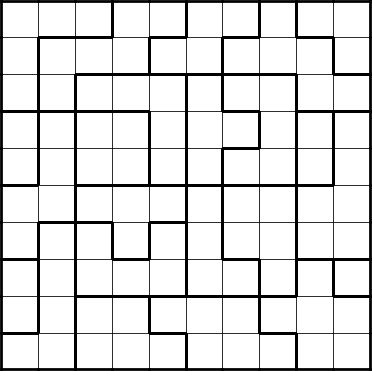
Puzzle #123: Parquet

Here's again one of Naoki Inaba's genres. It has some similarities to the Windows genre, which featured in the WPC, which can also be found on Naoki Inaba's website. It's known as conect on his website, but I don´t find that a very nice name. I changed it to Parquet as the grids reminded me of the Parquet Sudokus.
The puzzle worked out really nicely in my opinion, utilising all rules as well as possible on a 10x10 grid.

Rules for Parquet


Rules: Parquet

This genre was developed by Naoki Inaba.

Colour one of two regions in every blackbordered 2x2 area to form a single contiguous shape. This shape doesn't have any 2x2 coloured sections anywhere. Also this shape doesn't form any loops anywhere.


Thursday, 19 July 2012

LMI Practise : Logirace

A recent comment on my blog mentioned how Loop genres feature prominently on my blog. It's somewhat true as I am better at finding interesting things to do with loop genres. This weekend happens to be a puzzle test on Logic Master India named Logirace. This test features nothing but loop genres. Half of them are Nikoli Loop genres(Corral, Country Road, Masyu, Slitherlink and Yajilin), 3 less familiar genres (Dutch Loop, Tapa Loop and Dotted Loop) and 2 that are new to me(Border Loop and Comet). I figured I'd try to make a few examples of the less familiar ones. Some puzzles worked out better than others. I didn't like working with some of the genres so much. Hard to get them unique and nice. Especially the Comet and Dotted Loop have issues of there being a unique solution a lot in construction. But I think each puzzle will help a bit in preparing for the test, if that's what you're interested in. Otherwise just solve them for fun. It's what puzzling is really about.


You can find the puzzle below. If you want to see smaller examples, check the instruction booklet.

Tuesday, 10 July 2012

Puzzle #122: Shakashaka

I haven't seen how the Nikoli puzzles of this genre tend to look like, but I expect mine are a bit different. I prefer to keep the amount of clues as low as possible and make the open areas resolve themselves. I figure my puzzles tend to be on the harder side because of that. I like how it turned out. I was planning on doing a 1-2 antisymmetric clue pattern, except the 3 forced itself and I liked how the puzzle went till that point. So this is how it ended up.

Rules for Shakashaka


Thursday, 5 July 2012

Puzzle #121: Heyawake; Symmetry

I had first seen this variant on Mathgrant's blog. I thought it worked nicely. So I figured I'd give it a go too. It wasn't the easiest to start as Symmetry is always a weakness for me when solving. It doesn't really register with me too well, usually. But then I got the idea to bring back the Antisymmetry label, which I had added to Puzzle #1, but hadn't used since. I always like to build in some kind of antisymmetry in the givens of my puzzles, except it somehow had never come back in any of my puzzles for my blog. So for this puzzle rotationally symmetrical cages with clues have the opposite clues given. This doesn't hold for cages without givens. It would have been cool if it did, but I think that would be awfully difficult to accomplish.
I think the puzzle worked out in the end. The one cell pairs were to fix uniqueness issues, which didn't really bother the solving path. Enjoy.

Rules for Heyawake

Follow normal Heyawake rules. Additionally, this puzzle has no numbers as clues. Instead the clues indicate if a room has 180 degree rotational symmetry or not. An S indicates that the room has 180 degree rotational symmetry. An A indicates that the room does not have 180 degree rotational symmetry.


Tuesday, 3 July 2012

Puzzle #120: Line of Sight

I still enjoy making these puzzles. It's not the easiest to create openings, so they end up somewhat similar. But once you get going, it's really fun to play around with. This puzzle is of medium difficulty. I've made a few harder ones, but still some trickier points.

Rules for Line of Sight


Saturday, 30 June 2012

Puzzle #119: Magnets; Construction

I've said before I liked Magnets puzzles. So I've tried to experiment with them a bit. The Tapa inclusion worked really nicely. For this one I went another way.
I came across the Tateyoko puzzle on Naoki Inaba's website. Here the goal is to divide the grid into Domino regions. An O on a border indicates that the lengths of the sides touching there are the same length. An X on a border indicates that the lengths of the sides touching there are of a different length. I then realised, basically you are building Magnets puzzle grids. So I figured it would be worth trying to combine them.
I first started with a 10x10 grid and found a bit of a start. But I realised this way it would turn out far too hard. So I scaled it down to an 8x8 puzzle. It's still not particularly easy, but it's more doable than the 10x10 opening. I'd advice getting some practise with the Tateyoko part of the puzzle by going to the link given above.

Rules for Magnets

Follow normal Magnets rules. Additionally in this puzzle, the domino regions in which the magnets go aren't given yet. Instead you have to construct them. Some borders between domino regions are already given. If there is an O on a border, it indicates the lengths of the sides touching there are of equal length. If there's an X on a border, it indicates the lengths of the sides touching there are of unequal length.


Rules: Magnets

The grid is divided into domino regions. Place some magnets into these regions. Each magnet consists of a + pole and a - pole. Equal poles aren't allowed to touch by a side. The numbers on the outside indicate how many of each symbol are located in that row or column.


Thursday, 28 June 2012

Puzzle #118: Pentopia

This is the first 12x12 Pentopia puzzle I've made that only has 10 clues. Most of my puzzles have 12 given clues. That just seems the total that's mostly needed to make the puzzle unique. Just like that most my 10x10 Yajilin puzzles use 10 clues. The opening to this puzzle is tricky, but after that it shouldn't cause too many problems.

Rules for Pentopia


Click to enlarge

Tuesday, 26 June 2012

Puzzle #117: Masyu; In and Out

There's been a few Masyu variants done with optional Black and White circles. Here's another one, with a extra twist. The twist is taken from the Castle Wall genre. I think the puzzle worked out nicely. The optional quality makes the puzzle a bit trickier. Maybe the next time I'd make the puzzle a bit bigger, to make the twist play out more.
I know I've been making more variants the last few weeks. That's why I've added an extra tag for all puzzle variants and hybrids to find them easier on the blog. I've left the variant tag off the Sudokus as every Sudoku is a Sudoku variant. If people think I should also add it to them, I will.

Rules for Masyu

Follow normal Masyu rules. Additionally, not every black and white circle has to be visited by the loop. If a black circle isn't visited, it will be located outside the loop. If a white circle isn't visited, it will be located inside the loop.


Rules: Masyu

This genre was developed by Nikoli.

Draw a single closed loop connecting the centres of cells horizontally and vertically. The loop
doesn't touch or cross itself anywhere. The loop runs through all black and white circles. The loop
turns in every black circle and goes straight through both adjacent squares. The loop goes straight
through every white circle and turns in at least one of both adjacent squares.


Saturday, 23 June 2012

Puzzle #116: Tapa; Borderline

This a variant I thought of myself. I checked the TVC booklet and it didn't appear in it. So as far as I know it's original. It is a simple variant that I had attempted before. I couldn't make it work then. I think I wanted to make it too difficult then and couldn't get it to work. This one worked out. It's still tricky though. This one has all clues on a border between 2 cells. I do think it's just as easily possible to put the clues on nodes between four cells. I figured having to choose between 2 cells for the first one is difficult enough.

Rules for Tapa

Use standard Tapa rules. Additionally, each Tapa clue is located on a border between multiple cells. This Tapa clue belongs in one of these cells. Determine which cell the clue belongs in and solve the puzzle.


Thursday, 21 June 2012

Puzzle #115: Regional Akari

I've never really been a fan of Akari puzzles. The easy ones I find just go too quickly to really enjoy. The harder ones I feel like I'm just using trial and error. That's mostly why I haven't really made many of them. When I saw the regional variant on Naoki Inaba's site, I figured I'd give this a try in construction. I think it turned out okay. Nothing too difficult.

Rules for Regional Akari


Rules: Regional Akari

This genre was developed by Naoki Inaba.

Place one lightbulb in each blackbordered region, so that every cell in the grid is illuminated by at least one lightbulb. Lightbulbs illuminate all cells they can see in a horizontal and vertical direction. Black cells block their sight. No two lightbulbs can illuminate eachother.


Tuesday, 19 June 2012

Double Trouble #7: Liar Loop and Maxi Loop

I guess this twin isn't very surprising. I did create the Liar Loop genre from the Maxi Loop genre. It has been the hardest one to acchieve so far though. I had attempted this a few times already, but it always lead nowhere. For this one I finally found a solid opening, that lead to good progress in both genres. Finishing it succesfully took some effort though. The puzzles both turned out well and I like the way clues keep helping in both genres.

Rules for Liar Loop

Rules for Maxi Loop

This puzzle can be solve as a Liar Loop puzzle. This one is the harder of the two puzzles. But that's mostly because Liar Loop is inheritently hard. It's a bit of a challenge to create really easy ones.
This puzzle can also be solved as a Maxi Loop puzzle. It's a bit easier than the Liar Loop puzzle. Main reason for this, is that I couldn't avoid using 1 clues for the Liar Loop puzzle.


Thursday, 14 June 2012

Puzzle #114: Corral; Crates

I liked the Crates variation when I first saw it on Palmer's blog. I didn't like the red numbers so much though. That's why I preferred the one puzzle without red numbers. Last year's USPC also featured a Corral Crates puzzle without red numbers. So my puzzle also doesn't contain any red numbers.
This puzzle originally didn't start out as a crates puzzle, except the five 17s and the antisymmetric pairs of 7's and 10's on the outside made a valid corral loop very difficutl to acchieve. I constantly ran into the problem of having no possible valid loop when designing. So I tried to switch to a Corral Crates design instead. It did make the opening a bit harder. I edited out a harder spot in the middle, but kept the opening in as I had already found it a nice way to make the five 17s work in earlier design attempts.

Rules for Corral

In this puzzle there can be isolated loops on the inside the bigger loop. These isolated sections always form a 1x1 square. Different loops don't touch eachother, not ever by a corner. These isolated loops block the sight of the numbers.


Click to enlarge