Monday, 14 April 2014

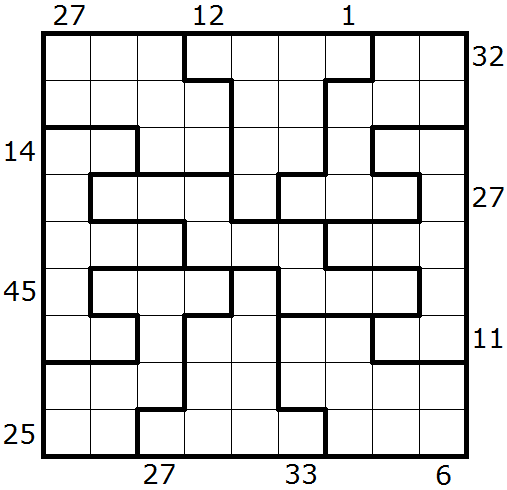
Rules: Catloop

Draw a single closed loop through the grid by connecting the centres of cells horizontally and vertically. Numbers on the outside indicate how many cells are used by the loop in that row or column.

This puzzle is a variant on Catwalk. In this puzzle type you draw a path from the given beginning and end point instead of a loop.

Rules: Araf

Divide the grid into some regions, formed by orthogonally adjacent squares. Each region should contain exactly two given numbers. The size of each region should be a value (in unit squares) strictly between the two numbers inside that region. Its size can't be equal to either of the numbers in the region.

Saturday, 5 April 2014

14th 24 Hour Puzzle Championship

This year I wrote a set of puzzles together with Hns Eendebak. I was a bit tight on time with a holiday and other championships that I wasn't sure if I'd be able to write everything in time. I still ran a bit late getting everything together but it was in time for the championship.
This year's championship was won by Peter Hudak. Nikola Zivanovic and Zoltan Horvath finished second and third.
There were 30 competitors total in this year's championship, of which 29 did our set. The set was a bit on the long side this year with the Michael Mosshammer from Austria being the top scorer with 695 points. It would have been better if the top scorer had about 100-150 points more. The set contained 24 puzzles in total, so I should have probably cut 2 puzzles in the end.
In this post I will be adding all the puzzles I wrote. You can find the complete set and all other sets here. If you need to see the instruction booklets for any of the set you can find them in this forum post.

Puzzles can be found below.

Sunday, 30 March 2014

Puzzle #166: Domino Extra

The last puzzle are two Domino Extra puzzles. I'd written two at the start, but they ended up testing too hard. So I wrote a third one that was much easier than these ones to be included in the WPC set. They have a similar opening, but should both still be fun to solve.

Rules:

Divide the grid along the grid lines so that each given pair of numbers appears in exactly one shape.


Saturday, 29 March 2014

Puzzle #165: Blind Spot

Today the second puzzle that wasn't used in the WPC. This is a Blind Spot puzzle. It's actually a size smaller than the puzzle used at the WPC, which was 7x7. But I actually think this was the harder of the two puzzles. That's why the larger puzzle was used in the WPC. I like writing these puzzles, but I think they can be tricky to solve as the logic is a bit unfamiliar compared to other Latin square type puzzles.

Rules for Blind Spot


Friday, 28 March 2014

Puzzle #164: Gemini Loop

I was going through my puzzle files and realised I had a few unused puzzles that I had written for the WPC 2013. One of each type was used, but for certain types I'd written a few just to have a choice depending on how they tested. I had posted two sets of puzzles before, that I had originally written for the WPC, but these puzzle types were rejected. These puzzles were the following Yajilin and Pentopia puzzles.
Today's puzzle is a Gemini Loop puzzle. I think it's a nice puzzle but I selected the other one for the WPC as I thought that one solved a bit nicer.

Rules:

Draw a single closed loop through all squares in the grid by connecting them horizontally and
vertically. The loop doesn't touch or cross itself. Cells with the same letter all have the same
appearance as to how the loop passes through it. Cells with different letters have a different appearance.


Friday, 14 March 2014

Puzzle Competitions: ZeKa 2014

Last weekend was the ZeKa competition in Croatia. It featured both a individual and a team competition this year. The individual competition was won by Goran Vodopija; Marko Obradović and Dragan Tolomanoski finished second and third respectively . The team competition was won by Dragan Tolomanoski, Bojana Vojnović and Vanja Fornazar.
I provided one of the Team rounds this time. The theme of the round was Imposters. The round consisted of four classic puzzle types. Each type had 4 puzzles, where one of the puzzles was an Imposter. It wasn't actually solvable as that puzzle type, but was solvable under a different set of rules. The rules of this puzzle was provided. The imposters weren't designed to be logically deduced, but purely intended to break down under the original rules.
The four puzzle types were LITS, with Double Back as imposter; Shikaku, with Corral as imposter; Skyscrapers with Haido as imposter; Slitherlink, with Turning Fences as imposter. Two of these combinations have appeared on my blog as a Double Trouble puzzle. One of them appeared as such on Grant Fikes' blog. The other is probably possible as a Double Trouble puzzle, but haven't tried that yet.

Puzzles can be found below or in the following PDF.

Thursday, 13 March 2014

Rules: Shikaku

Divide the grid in a number of non-overlapping rectangles along the grid lines. Numbers in the grid indicate the size of the rectangle they are in. No rectangle can contain more than one number.


Monday, 3 March 2014

Puzzle #163: Turning Fences

The LMI Marathon puzzle that was solved during the competition was actually the second version. In the first version I put in some stuff that came naturally to me for this genre, but stumped the test solvers. That's why there was an easier second version, which still took a relatively long time for the test solvers. That was why I added the Tutorial on my blog, just so people would realise the basics that I had figured out when designing these puzzles.
Here is the first puzzle I wrote. There are a few similarities to the second puzzle as I kept the bits that were solved quickly in the first test solve in the puzzle. It has the same layout as the second puzzle. For those who hadn't figured out the layout, the givens are in the shape of 25 letters that spell out TURNING FENCES LMI MARATHON 3 in an inward clockwise spiral. The 3 shape is made up completely of 3's.

Enjoy, but take some time to get through it logically.

Rules for Turning Fences


Click to enlarge

Monday, 17 February 2014

Tutorial: Turning Fences

This week the LMI Puzzle Marathon will start. It will run from February 21st till March 2nd. For this event I have written a Turning Fences puzzle. To prepare people a bit for a more unknown genre, I will write a tutorial about the logic behind the genre. It won't be complete, but it should be enough to tackle the upcoming puzzle. In the next days there will also be a few practise puzzles. You can also practise some of the puzzles already on my blog, but most of these are logically harder than the puzzle in the actual test. For those who happen to own Akil Oyunlari Issue #75, there are also 4 of these puzzles by my hand in there. They are logically a bit more friendly.

Tutorial below.

Saturday, 28 December 2013

Daily League Sudoku #40: Inside Skyscraper Sudoku

Today's puzzle is a Skyscraper Sudoku variant. This is a more Logic Puzzle variant of Sudoku. I normally would represent this as a Regional variant of Skyscraper puzzles. The Sudoku part doesn't often come forward as much as the Skyscraper part during the solve. But as I always like Skyscraper Sudokus, I figured I'd make one too. This variant sometimes has all possible arrows given, but I prefer it without this rule. A lot of the smaller numbers end up being unnecessarily given an arrow there, although the negative information is also fun to use. I just prefer it this way.
I had set up this opening a few weeks ago, but I was not able to finish the puzzle successfully. After a few more tries, I came up with this puzzle. I was originally intending to make the clue arrangement symmetric, but as you can't just put a clue everywhere that caused some problems. This was the point where the puzzle ended up being unique. I liked the way it solved at the end, with a somewhat tricky step to finish the puzzle. So that's why I settled for this one. I had a little trouble finding a satisfying layout, but I think this one should do. If someone has a suggestion that could work better, I might change the image. Having said that, enjoy the puzzle.

Rules for Sudoku

In this Sudoku each digit indicates the height of a Skyscraper. Digits in cells with arrows indicate the number of buildings that can be seen in the direction of the arrow from that cell. Taller buildings block the view of smaller buildings.


Saturday, 21 December 2013

Daily League Sudoku #39: Palindrome Killer Sudoku

Today's Sudoku is themed around today's date. As the date is a palindrome, the choice of Sudoku was easy. I chose for the combination with Killer Sudoku as I could use 21 and 12 easily in that variant.
The puzzle has a somewhat complicated opening. But I hope that people will understand where to look considering the choice of combined variants. If not, I guess there's very little to get in this one. But when the opening's finished, the solve should solve without much problems.I'm still happy with the Sudoku overall. I think the 21/12 layout of cages looks really nice and the way the palindrome resolves the obvious non-uniqueness worked out really well. I hope people will feel the same. Enjoy.


Instead of given numbers, you now have a few dashed cages. The number in a cage indicates the sum of the digits in the cage. Digits can't be repeated in any dashed cage. Additionally, digits along a grey line must form a palindromic sequence.


Click to enlarge

Sunday, 15 December 2013

Daily League Sudoku #38: Parity Count Sudoku

This week's Sudoku is an Odd/Even Sudoku variant. I'm pretty sure I have seen this idea before. I have no idea where or what is was called then. So I just gave it my own name.
I always like Sudokus that use parity constraints, which require you to basically build an Odd/Even Sudoku. I made a puzzle that required this before, namely my Battenburg Sudoku. In this one you actually have to solve the Sudoku to set up the whole Odd/Even Sudoku grid. I think because of the interaction between Sudoku and parity rule, this idea is a bit more interesting. I don't think the puzzle is overly difficult. The opening shouldn't be too hard, but there's a few sticking points in the middle in figuring out which numbers go in certain grey cells. I had fun designing it. I sacrificed symmetry a bit as the left top square being grey helped make it unique and I preferred that over giving extra givens. I hope people enjoy it.

Rules for Sudoku

In this Sudoku digits in grey cells indicate how many digits of the opposite parity appear in the cells touching it.


Saturday, 7 December 2013

Daily League Sudoku #37: Non-Consecutive Sudoku

This week again something familiar. I had a different puzzle ready, but I sadly realised my intended opening made no sense. I had adjusted two digits, which I thought didn't affect the opening, but on a resolve I realised they did. I will give that one another go later, but I didn't really have the time to fix it today. So instead here is a Non-Consecutive Sudoku.
I always enjoy solving Non-Consecutive Sudokus. I think writing them is a lot trickier though. I think it doesn't really suit the way I like to write Sudokus or puzzles in general. I think the puzzle solves nicely, but it won't be one of my more memorable Sudokus. But as I promised a more easy Sudoku this week, I think this one will at least keep that promise. Enjoy :).

Rules for Sudoku

In this Sudoku consecutive digits can't be orthogonally adjacent.


Saturday, 30 November 2013

Daily League Sudoku #36: Sum Relations Sudoku

I have seen puzzles similar to this before, except in a Killer Sudoku format. In those puzzles the relations are given between different cages. Here the relation is between the sums of adjacent cells on either side of the symbol.
This is again a harder puzzle. I don't know exactly how hard it is, but there's definitely no progress to be made if you don't understand the opening. I wasn't expecting to be able to make this variant without any givens. But I managed to create an opening that works without any givens. I think it's a nice and interesting opening. The middle is probably a bit easier, but I think the end is again a little bit harder, but worked out nicely in my opinion. I'll think about making something easier again next week, but I can't exactly promise that. When I find an interesting opening, I just run with it. And interesting is generally hard. Enjoy this puzzle though.


In this Sudoku, the symbols indicate the relation between the sums of the 2 cells on either side of the symbol.


Saturday, 23 November 2013

Daily League Sudoku #35: Rank Killer Sudoku

This week a puzzle type taken from Richard Stolk's V2V test at Logicmasters India. I had planned on posting this type earlier, but my attempts at making one never got anything useful. So I made other puzzle types instead, that worked out easier. But this one seemed to work well.
This puzzle is again a harder one. I had posted a few easier ones in the last few weeks. This type has again some room for me to be a bit more creative with the opening. There's a few steps that combine Killer Sudoku and Rank Sudoku to start this one off. They are still all logical steps, but it takes a bit more effort to figure them out. I still think it is an enjoyable puzzle.

As a reminder all Daily League puzzles are also solvable at SudokuCup.

Rules for Sudoku

The sum of digits inside each dashed cage is given at the upper left cell of the cage. A digit 'N' in a circle means that the digit in the cell is the Nth smallest number in the corresponding cage. Digits cannot repeat within a cage.


Click to enlarge


Saturday, 16 November 2013

Daily League #34: Arrow Sudoku

This week a more familiar variant. Arrow Sudoku has been around for a while now and there's been many nice puzzles made. I hope this one is also enjoyable.
I decided to go for a similar layout as my Renban Sudoku I made a while back for the league. I thought it would work well with Arrow Sudoku too. I was able to give fewer givens though as the arrow already forces some placement because of the direction. I shortly considered making a directionless Arrow Sudoku, where the circle could be at either end, but this layout wasn't very friendly for that variant. At first I had a harder variant of this Sudoku, but it took me too long to solve it myself while knowing the openings because the middle and end ran a lot on very complex interactions between the arrows that I really couldn't justify logically. So I revamped it a little to make it more solvable. The harder opening is still in this puzzle but it is no longer needed to solve the puzzle as there's a more friendly path through the puzzle.

Rules for Sudoku

In this Sudoku a number of arrows are given with a circle at the end. The digit in a circle is equal to the sum of the digits along its arrow. Digits may repeat along an arrow as long as they don't break any Sudoku rules.


Saturday, 9 November 2013

Daily League Sudoku #33: Hi-Lo Product Frame Sudoku

This week another variation on the Hi-Lo Frame Sudoku. It's a fun variant you can always play around with. This time it's products instead of sums. It leaves for fewer options and thus allows fewer clues.
Outside clues and empty grids are always my favourite Sudokus to construct. It's generally a bit of a struggle to get them to turn out unique or even create an opening. This one was a bit of a struggle to get unique as my final clue had to settle about 35 cells. There were a few options that got pretty close but would end up having no solution. This was the only one I could find that settled the uniqueness issue. There was a second option that I thought had worked, but then I realised the clue didn't actually have to be in that configuration and thus there were many more solutions. The puzzle itself is not overly hard as the clues give you a lot of information from the start and the clue I used for uniqueness is already helpful far earlier than it was in my construction.

Rules for Sudoku

In this Sudoku, the numbers on the outside indicate the product of the highest and lowest digit in the first three cells of that row or column when looking from that side.


Daily League Sudoku #32: N-Sums Sudoku and Quad Max Difference Sudoku

This post is just preceding this week's Sudoku. I hadn't made blogposts of my previous 2 Sudoku. The first one was made en route to Beijing for the WSC/WPC. I had no access to Facebook or BlogSpot there, so I wasn't able to make any posts. The second one I was not at home and managed to sneak in some time to make a quick Facebook post with the image, which all is a little bit faster than making posts on my blog.
The first puzzle is a variant on the X-Sums Sudoku, of which I have made a few. The variant is a bit more limiting as now not every row and column necessarily has a valid clue. This is caused by the fact that a number N has to appear in position N to become a valid clue. The construction took a while as I wanted to keep the symmetric layout and sometimes I wasn't able to make the layout symmetric as there was no longer a clue available. There are a few clues that aren't necessary for uniqueness in this puzzle, but they don't hinder the solving path and make it overall a little bit easier. I think people don't mind that my Sudokus are made a bit easier in general.
The second puzzle is a simple variant with differences. It has more given numbers than I would have wanted, but it wouldn't be unique otherwise. I wanted to make a puzzle which had a single instance of every possible Quad Difference clue possible. This of course forced one of the clues to be in a specific position as otherwise there's be no unique solution available. Which is why I went for this layout. I don't think this one is overly hard. There's a few key points in the solve where you have to use the right clues.

Rules for Sudoku

N-Sums Sudoku:
Clues outside the grid indicate the sum of the first N digits seen in that row or column from that side. The digit N is always indicated by the Nth digit seen from that side. In other words, it is always the last digit in the summed set of digits.


Quad Max Difference Sudoku:
In this Sudoku, numbers on grid points indicate the maximum difference between the four digits surrounding it. Each difference must appear at least once around each clue.


Saturday, 5 October 2013

Daily League Sudoku #31: WSC Jigsaw Sudoku

The post is coming from Las Vegas this time. I made this puzzle poolside relaxing in the sun after making my way to part of the WSC instruction booklet. The example in the booklet of this puzzle isn't that challenging, so I figured I'd give a more instructive one. The logic in placement is solid and the remaining solve shouldn't be very hard. I think this is doable within 15 minutes. I don't have a B or C version.
I hope it's a fun puzzle and maybe some help for the upcoming WSC. See all of you who are going there in a few days.

Recap of the last Daily League week:
Sunday: Product or Outside Sudoku by Seungjae Kwak
Monday: No Ten Sudoku by Jakub Hrazdira
Tuesday: Monopoly Untouch Sudoku by Prasanna Seshadri
Wednesday: Extra Regions Sudoku by Bastien Vial-Jaime
Thursday: Arrow Sudoku by Rishi Puri
Friday: Killer Sudoku by Tom Collyer
Saturday: Odd-Even View Sudoku by Hall Hur

Sunday: Simple Math Variation Sudoku by Seungjae Kwak
Monday: Diagonal Sudoku by Karel Tesar
Tuesday: Consecutive Sudoku by Prasanna Seshadri
Wednesday: Point to Next Sudoku by Bastien Vial-Jaime
Thursday: Pyramid Sudoku by Rishi Puri
Friday: Killer Sudoku by Benz Liang

Daily League PDFs:
Week 37

Rules for Sudoku

In this Sudoku, place the given Jigsaw pieces in the grid and solve the resulting Expanded Sudoku. The pieces can't be rotated or reflected and they can't overlap eachother. In an Expanded Sudoku some of the rows and columns expand over empty space.


Click to enlarge