Round 6 had puzzles that were all combinations of different types of puzzles. There were some interesting ideas, but I doubt many of these will be seen more often again in future puzzle sets.
There's a few puzzles in here that I'm pretty happy with. The Starwacky puzzle is a nice solve. Snail on Snake worked out pretty well because it didn't need any extra given numbers, except for the head and tail. Galaxies and Tetrominoes is my favourite in the set, because it really forces the two types to work together.
The other puzzles should also be nice to solve.
Showing posts with label Nurikabe. Show all posts
Showing posts with label Nurikabe. Show all posts
Saturday, 24 November 2018

Monday, 7 March 2016
UKPA Open 2016: Individual Round
The UKPA Open 2016 was held in Croydon on February 27th-28th. Tom Collyer was the winner of the Sudoku competition, with Mark Goodliffe finishing in second and Heather Golding in third. Neil Zussman won the Puzzle competition, with Tom Collyer finishing in second and Steve Barge in third.
I contributed an individual round for the puzzle event and a team round. This post will contain all puzzles from the individual round. The team round will be posted in a separate post.
Puzzles can be found below.
Monday, 8 February 2016
Puzzle #177: Nurikabe; Domino
This is the fifth practise puzzle for this year's UKPA Open.
This section came about because I wanted to include some common types, while still falling within the theme. I was familiar with three variants of common type that required division into polyominos. So this was easily collected.
I haven't seen that many Domino Nurikabes, so my first go was just checking out what I could do with the genre. The opening was pretty quickly set up. The middle and end game was where it gets tricky. It all works out logically, but it's not too obvious on first sight. It took a while to get the wall to behave properly.
Rules for Nurikabe
In this Nurikabe, you must be able to partition the stream into non-overlapping dominoes.


This section came about because I wanted to include some common types, while still falling within the theme. I was familiar with three variants of common type that required division into polyominos. So this was easily collected.
I haven't seen that many Domino Nurikabes, so my first go was just checking out what I could do with the genre. The opening was pretty quickly set up. The middle and end game was where it gets tricky. It all works out logically, but it's not too obvious on first sight. It took a while to get the wall to behave properly.
Rules for Nurikabe
In this Nurikabe, you must be able to partition the stream into non-overlapping dominoes.
Example

Puzzle

Tuesday, 15 April 2014
Polish Puzzle Championships 2014: Individual Round
Last weekend were the Polish Sudoku and Puzzle Championships. The Championship was also open to International solvers this year. The playoffs would feature the best 4 solvers, while having at least two Polish solvers.
The Sudoku playoffs featured Tiit Vunk, Jakub Ondrousek, Jan Mrozowski and Krystian Swiderski. Jakub Ondrousek finish first in the playoffs, followed by Krystian Swiderski, Tiit Vunk and Jan Mrozowski, making Krystian Swiderski the new Polish Sudoku champion. Full results can be found here.
The Puzzle playoffs featured Przemysław Dębiak, Matus Demiger, Zoltan Horvath and Tomasz Stróżak. The final results remained almost the same with Przemyslaw Dębiak finishing first, followed by Zoltan Horvath, Matus Demiger and Tomasz Stróżak. Full results can be found here.
I contributed a set for the Puzzle Championships for the individual round and wrote a team round together with Zoltan Horvath.
You can find all puzzles of the Championships in the following link: Sudoku Rounds + Team Round, Puzzle Rounds. My puzzle set is round 4. This post will feature all the puzzles from my individual round. Tomorrow I will post the Team round puzzles with a special surprise.
Last year's set was a bit on the difficult side, so I tried to think of a way to rectify that this year. I decided to write 2 puzzles per type, one smaller/easier one and a larger/harder one. I didn't want to make any too difficult. I selected 10 varying types of puzzles. I was hoping to average about 1.5 minutes per puzzle on the smaller ones and about 4.5 minutes per puzzle on the larger ones. I had the set tested by Prasanna Seshadri, James McGowan and Stefan Gaspar. The smaller puzzles made that average pretty well, but the larger puzzles were more inching towards 5-5.5 average and all of them had some outliers. I couldn't really decide well which puzzles to cut so I sent in the whole set and let them know that they could leave out a puzzle type if necessary. During their testing 3 of the larger puzzles seem to have cause some problems as they went up in score. I think the set will have worked well none-the-less for all solvers with the easier puzzles to work with as well, but I'd love to hear some feedback form those who were there.
Puzzles can be found below.
The Sudoku playoffs featured Tiit Vunk, Jakub Ondrousek, Jan Mrozowski and Krystian Swiderski. Jakub Ondrousek finish first in the playoffs, followed by Krystian Swiderski, Tiit Vunk and Jan Mrozowski, making Krystian Swiderski the new Polish Sudoku champion. Full results can be found here.
The Puzzle playoffs featured Przemysław Dębiak, Matus Demiger, Zoltan Horvath and Tomasz Stróżak. The final results remained almost the same with Przemyslaw Dębiak finishing first, followed by Zoltan Horvath, Matus Demiger and Tomasz Stróżak. Full results can be found here.
I contributed a set for the Puzzle Championships for the individual round and wrote a team round together with Zoltan Horvath.
You can find all puzzles of the Championships in the following link: Sudoku Rounds + Team Round, Puzzle Rounds. My puzzle set is round 4. This post will feature all the puzzles from my individual round. Tomorrow I will post the Team round puzzles with a special surprise.
Last year's set was a bit on the difficult side, so I tried to think of a way to rectify that this year. I decided to write 2 puzzles per type, one smaller/easier one and a larger/harder one. I didn't want to make any too difficult. I selected 10 varying types of puzzles. I was hoping to average about 1.5 minutes per puzzle on the smaller ones and about 4.5 minutes per puzzle on the larger ones. I had the set tested by Prasanna Seshadri, James McGowan and Stefan Gaspar. The smaller puzzles made that average pretty well, but the larger puzzles were more inching towards 5-5.5 average and all of them had some outliers. I couldn't really decide well which puzzles to cut so I sent in the whole set and let them know that they could leave out a puzzle type if necessary. During their testing 3 of the larger puzzles seem to have cause some problems as they went up in score. I think the set will have worked well none-the-less for all solvers with the easier puzzles to work with as well, but I'd love to hear some feedback form those who were there.
Puzzles can be found below.
Monday, 14 April 2014
Puzzle #167: Araf, Nurikabe, Capsules, Catloop
Last weekend were the Polish Sudoku and Puzzle Championships. I wrote a set of puzzles for the championships and helped create a team round with Zoltan Horvath. Today I will be posting the puzzles that didn't make it to the championships. Most of them were too hard for their intended purposes. I will also be posting the puzzles that appeared on the championships later this week.
Three of the puzzle types were from the individual rounds and one is from the team rounds.
The Araf puzzles were the first ones I had written of this type. I still had to get used to construction a bit. When I do that I tend to make the puzzles a bit harder, just to see what's possible. The smaller one isn't too hard, but still a bit harder than intended.
The Nurikabe puzzle isn't actually very hard, but I changed it as I saw an aesthetically nicer version of this puzzle. That one was also a bit easier than this puzzle, which I didn't mind.
The Capsules puzzle was really too hard. It was the first puzzle I'd written for the championships and I hadn't totally finalised my intentions then and thus went a bit overboard on difficulty.
The Catloop puzzle was written for the team round. It is a silly name play on the Catwalk puzzles, which was again a renaming of the Meander puzzle type to give a fun visual theming on the website. I think this type is also known under many other names. The first puzzle is an easy puzzle, while the second is a hard puzzle. I had written the second one first and after feed back written two easier puzzles. One of them went to the team round and the other one was left over. I think this was actually the easier of the two puzzles.
Puzzles can be found below.
Three of the puzzle types were from the individual rounds and one is from the team rounds.
The Araf puzzles were the first ones I had written of this type. I still had to get used to construction a bit. When I do that I tend to make the puzzles a bit harder, just to see what's possible. The smaller one isn't too hard, but still a bit harder than intended.
The Nurikabe puzzle isn't actually very hard, but I changed it as I saw an aesthetically nicer version of this puzzle. That one was also a bit easier than this puzzle, which I didn't mind.
The Capsules puzzle was really too hard. It was the first puzzle I'd written for the championships and I hadn't totally finalised my intentions then and thus went a bit overboard on difficulty.
The Catloop puzzle was written for the team round. It is a silly name play on the Catwalk puzzles, which was again a renaming of the Meander puzzle type to give a fun visual theming on the website. I think this type is also known under many other names. The first puzzle is an easy puzzle, while the second is a hard puzzle. I had written the second one first and after feed back written two easier puzzles. One of them went to the team round and the other one was left over. I think this was actually the easier of the two puzzles.
Puzzles can be found below.
Tuesday, 17 September 2013
Czech Team Puzzle Championship
In the weekend of 7-8 September, the Czech Sudoku and Puzzle Teams Championships were held. The championship was held in Brno. The teams competed in a number of team and individual rounds over the weekend. The Sudoku event was won by the team of Michaela Bieliková, Matúš Demiger, Zuzana Hromcová and Jakub Ondroušek. The puzzle event was won by the Hungarian team of Zoltan Horvath, Pal Madarassy, Major Boglár and Zoltan Nemeth. Full results can be found here.
All Sudokus and puzzles of the championship can be found here. I also provided some of the Sudokus and puzzles for that event. This post will contain all my puzzles.
All my puzzles featured in a single round, together with 2 other puzzles. I hadn't written these puzzles to be a complete round and just wrote a number of different puzzles. It was Karel's idea to use them all together. I chose to write a number of common puzzle types, a number of uncommon and a number of variants of common types. So it's a good mix of puzzles to be featured in a single round. They are mostly puzzle types I had written before, so I knew what to do with them. I'm happy how they turned out and think it was a good mix of easy and hard puzzle.
Puzzles can be found below.
All Sudokus and puzzles of the championship can be found here. I also provided some of the Sudokus and puzzles for that event. This post will contain all my puzzles.
All my puzzles featured in a single round, together with 2 other puzzles. I hadn't written these puzzles to be a complete round and just wrote a number of different puzzles. It was Karel's idea to use them all together. I chose to write a number of common puzzle types, a number of uncommon and a number of variants of common types. So it's a good mix of puzzles to be featured in a single round. They are mostly puzzle types I had written before, so I knew what to do with them. I'm happy how they turned out and think it was a good mix of easy and hard puzzle.
Puzzles can be found below.
Thursday, 21 March 2013
UK Puzzle Championship 2013
Today my puzzles for the UK puzzle championships. The UK Puzzle and Sudoku championships were held last weekend. Tom Collyer won the UK Sudoku championship and Neil Zussman won the UK Puzzle championship. My puzzles were the last individual round of the championship. It featured a relay, with 9 puzzles that have to be solved in order. Each puzzle solution would in some way transfer to the next, so that this puzzle would become solvable. I will be posting all puzzles and relay tags below, but to see how everything works, you can check the instruction booklet for this round here.
The original idea for this round came from the 2003 WPC in Arnhem. I have made a round like this before for another online competition. I used similar relays in that round as well. As that round wasn't done on time, I wasn't sure how many of these relays would work on time. Some relays are good without time, but things like copying the shapes of a Fillomino solution are very annoying in my mind for a speed contest.
The first puzzles I wrote were the Snake and Nurikabe puzzles, as I had used the Snake to Nurikabe relay before and liked it. I wrote a Snake puzzle with few clues, so that I could easily write a puzzle that had these clues inside the grid, which could then be transferred to the side. I then opted writing a Kakuro puzzle as the opening puzzle, as most solvers are familiar with that. With this the first 3 puzzles were all types that most people in the puzzling community have done multiple of. The next part of the design was getting from Nurikabe somehow back to number clues. I then found the combination Yin Yang/Hiroimono, which I thought was a nice transition, with a few less familiar puzzles. I did have to figure out how to properly write Hiroimono puzzles without any given clues as I had never done that before. From here I opted to write a Doppelblock puzzle. It was easiest to write this puzzle without any repeating clues as this would make the relay the smoothest. It was a bit hard to get it right, as some clues are just more conductive in this puzzle type. I was planning on writing a Minesweeper puzzle next, and figured I could easily relay it to any puzzle type. That's why I chose to write a Magnets next, which could transfer to a Battleships puzzle. I wrote a Magnets puzzle with missing clues, which I have written many of. I chose a smaller size as they are generally viewed as hard to many people. I had to make sure the remaining clues were under 20 as that's the max number of ship segments a standard Battleships puzzle has. It worked out perfectly and the Battleships construction was really easy to finish. When I went back, I couldn't get the Minesweeper in a way that the relay to it and from it was nice. That's why I tried a number of other puzzle types. Then I tried Country Road, which caused an odd design experience. I tried to write them normally, except I couldn't get it so it would transfer to the already written Magnets puzzle, so that's why I changed it around. I first marked a bunch of empty squares so that it would transfer properly to the Magnets puzzle, and then reversely engineered the regions so a solvable valid puzzle would exist which has those empty squares in those places. I think the result is nice and I doubt anyone would expect it was designed that way from the solve. I thought 9 puzzles would be enough, even though I had originally planned on making 10 puzzles. I just think some of the relays would take more time than others, so I thought this would make a long enough round for the championship.
The puzzles can be found below.
The original idea for this round came from the 2003 WPC in Arnhem. I have made a round like this before for another online competition. I used similar relays in that round as well. As that round wasn't done on time, I wasn't sure how many of these relays would work on time. Some relays are good without time, but things like copying the shapes of a Fillomino solution are very annoying in my mind for a speed contest.
The first puzzles I wrote were the Snake and Nurikabe puzzles, as I had used the Snake to Nurikabe relay before and liked it. I wrote a Snake puzzle with few clues, so that I could easily write a puzzle that had these clues inside the grid, which could then be transferred to the side. I then opted writing a Kakuro puzzle as the opening puzzle, as most solvers are familiar with that. With this the first 3 puzzles were all types that most people in the puzzling community have done multiple of. The next part of the design was getting from Nurikabe somehow back to number clues. I then found the combination Yin Yang/Hiroimono, which I thought was a nice transition, with a few less familiar puzzles. I did have to figure out how to properly write Hiroimono puzzles without any given clues as I had never done that before. From here I opted to write a Doppelblock puzzle. It was easiest to write this puzzle without any repeating clues as this would make the relay the smoothest. It was a bit hard to get it right, as some clues are just more conductive in this puzzle type. I was planning on writing a Minesweeper puzzle next, and figured I could easily relay it to any puzzle type. That's why I chose to write a Magnets next, which could transfer to a Battleships puzzle. I wrote a Magnets puzzle with missing clues, which I have written many of. I chose a smaller size as they are generally viewed as hard to many people. I had to make sure the remaining clues were under 20 as that's the max number of ship segments a standard Battleships puzzle has. It worked out perfectly and the Battleships construction was really easy to finish. When I went back, I couldn't get the Minesweeper in a way that the relay to it and from it was nice. That's why I tried a number of other puzzle types. Then I tried Country Road, which caused an odd design experience. I tried to write them normally, except I couldn't get it so it would transfer to the already written Magnets puzzle, so that's why I changed it around. I first marked a bunch of empty squares so that it would transfer properly to the Magnets puzzle, and then reversely engineered the regions so a solvable valid puzzle would exist which has those empty squares in those places. I think the result is nice and I doubt anyone would expect it was designed that way from the solve. I thought 9 puzzles would be enough, even though I had originally planned on making 10 puzzles. I just think some of the relays would take more time than others, so I thought this would make a long enough round for the championship.
The puzzles can be found below.
Tuesday, 19 March 2013
Polish Puzzle Championships 2013
This week is a week full of puzzles on my blog. That is because the last two weekends there were two championships to which I contributed puzzles. Today I will post all puzzles from the Polish Puzzle Championship and Thursday will feature my puzzles for the UK Puzzle Championship.
The Polish Sudoku and Puzzle Championships were held in the weekend of 9 and 10 of March. Jan Mrozowski became the Polish Sudoku Champion. Przemysław Dębiak won the Polish Puzzle Championship. The puzzles for the Polish Sudoku Championship can be found here; the puzzles for thePolish Puzzle Championship can be found here. My puzzles were round 5 of the Puzzle championship. I also found a video of the Polish Puzzle Championship on Serkan Yurekli's blog. In the beginning you can see puzzlers working on my puzzle set. The end is the finals.
For the Polish Championship I employed a copycat theme. The puzzles came in pairs and each pair of puzzles had a similarity in the layout. Most of these types are very closely related in the puzzle type. The only pair that really isn't very close to the other were the Star Battle and Heyawake. I was happy to see that the puzzles were printed on bordering pages in the puzzle booklet, so solvers might notice the similarity.
The idea somewhat accidentally happened. I had made an easy Akari puzzle and wanted to make a harder regional Akari and opted to make one with the same black squares. When I finished those I wondered if I could keep doing that and went with a Liar Loop/Maxi Loop combo as that seemed most easily acchieved. And I'm pretty comfortable designing those, so made two with the same regions. The next puzzles I made were the Capsules and Ripple Effect puzzles, I posted earlier which ended up testing too hard. I really like constructing Ripple Effect puzzles, but clearly not that skilled at making them competition difficulty. I looked through my Double Trouble collection and thought Turning Fences and Slitherlink should be easily made look similar. I chose the same clue positions and about half the clues are the same. I already had 4 Loop puzzles, so that was all of those I could put in. I made a Tapa and Nurikabe with the same clue positions. I at first tried to also make the Nurikabe clues to be the sum of the Tapa clues, but that didn't prove to be very fruitful. I then started doodling a bit and made a Small Regions Star Battle and wondered what type I could use these cages for. I eventually settled on Heyawake as that would allow me to add some clues and see where it goes. The regions were still very restrictive on the Heyawake genre, but managed to push it out with just 2013 as clues. Lastly I needed some Magic Square genres. I thought first about doing Skyscraper/Haido, but figured with multiple similar types, maybe I should try a more different type. So I made a Skyscraper puzzle, to which I added a number of clues to turn it into an Easy as Japanese Sums puzzle. I felt I was somewhat missing a division type puzzle, but I couldn't find a nice way to make 2 that fit into the theme. And when I had the puzzles tested it seemed like there was enough to fill the hour slot already.
I also wrote a LITS puzzle to be used for the finals, except that one wasn't used. It willbe posted at the end of this post.
Puzzles can be found below.
The Polish Sudoku and Puzzle Championships were held in the weekend of 9 and 10 of March. Jan Mrozowski became the Polish Sudoku Champion. Przemysław Dębiak won the Polish Puzzle Championship. The puzzles for the Polish Sudoku Championship can be found here; the puzzles for thePolish Puzzle Championship can be found here. My puzzles were round 5 of the Puzzle championship. I also found a video of the Polish Puzzle Championship on Serkan Yurekli's blog. In the beginning you can see puzzlers working on my puzzle set. The end is the finals.
For the Polish Championship I employed a copycat theme. The puzzles came in pairs and each pair of puzzles had a similarity in the layout. Most of these types are very closely related in the puzzle type. The only pair that really isn't very close to the other were the Star Battle and Heyawake. I was happy to see that the puzzles were printed on bordering pages in the puzzle booklet, so solvers might notice the similarity.
The idea somewhat accidentally happened. I had made an easy Akari puzzle and wanted to make a harder regional Akari and opted to make one with the same black squares. When I finished those I wondered if I could keep doing that and went with a Liar Loop/Maxi Loop combo as that seemed most easily acchieved. And I'm pretty comfortable designing those, so made two with the same regions. The next puzzles I made were the Capsules and Ripple Effect puzzles, I posted earlier which ended up testing too hard. I really like constructing Ripple Effect puzzles, but clearly not that skilled at making them competition difficulty. I looked through my Double Trouble collection and thought Turning Fences and Slitherlink should be easily made look similar. I chose the same clue positions and about half the clues are the same. I already had 4 Loop puzzles, so that was all of those I could put in. I made a Tapa and Nurikabe with the same clue positions. I at first tried to also make the Nurikabe clues to be the sum of the Tapa clues, but that didn't prove to be very fruitful. I then started doodling a bit and made a Small Regions Star Battle and wondered what type I could use these cages for. I eventually settled on Heyawake as that would allow me to add some clues and see where it goes. The regions were still very restrictive on the Heyawake genre, but managed to push it out with just 2013 as clues. Lastly I needed some Magic Square genres. I thought first about doing Skyscraper/Haido, but figured with multiple similar types, maybe I should try a more different type. So I made a Skyscraper puzzle, to which I added a number of clues to turn it into an Easy as Japanese Sums puzzle. I felt I was somewhat missing a division type puzzle, but I couldn't find a nice way to make 2 that fit into the theme. And when I had the puzzles tested it seemed like there was enough to fill the hour slot already.
I also wrote a LITS puzzle to be used for the finals, except that one wasn't used. It willbe posted at the end of this post.
Puzzles can be found below.
Thursday, 17 May 2012
Puzzle #105: Quattro Stagioni (Corral, Nurikabe, Tapa LITS)
I have made a bunch of puzzles for friends for various reasons. Mostly for special occasions. I usually try to theme them in a certain way. This is mostly just based on the way the givens are oriented. For this puzzle though I had the fortune to get three handy numbers to work with, namely 2, 3 and 7. The numbers were handy to build into most genres, so I attempted to use them as best as I could. This puzzle is built up of four quadrants that each belong to a different genre. I thought a while about a good fourth genre to add as Nurikabe, Tapa and LITS have a similar general puzzle idea behind it. I couldn't come up with a good fourth genre that used this type of clue. So I cheated a bit by using corral-like clues, within the same puzzle structure. I think the puzzle worked out well, not overly difficult but still interesting.
General Rule:
Colour some cells to form a single contiguous shape. The shape doesn't form any 2x2 squares anywhere.
Left Top: "Corral"
The numbers in this section are all part of the shape. The numbers indicate how many cells that are part of this shape can be seen from this shape in horizontal and vertical direction, not including the cell itself. The numbers can't see past white cells. [Note: This section doesn't work like normal Corral. The clue type doesn't include the cell itself. Also there's no loop constraint.]
Right Top: Nurikabe
The numbers in this section each indicate a seperate island of orthogonally connected white cells. The numbers indicate the size of the island they are part of. All remaining cells in this section not part of an island belong to the shape. The islands can cross the border of this section.
Left Bottom: Tapa
The numbers in this section indicate how many consecutive cells are to be coloured around it. If there is more than one number in a cell, then each section of consecutive cells must be seperated by at least one empty cell.
Right Bottom: LITS
In this section colour 4 orthogonally connected cells in every boldbordered region. Two identical shapes in different regions can't touch eachother by a side. Rotations and reflections are considered the same shape.
Quattro Stagioni
General Rule:
Colour some cells to form a single contiguous shape. The shape doesn't form any 2x2 squares anywhere.
Left Top: "Corral"
The numbers in this section are all part of the shape. The numbers indicate how many cells that are part of this shape can be seen from this shape in horizontal and vertical direction, not including the cell itself. The numbers can't see past white cells. [Note: This section doesn't work like normal Corral. The clue type doesn't include the cell itself. Also there's no loop constraint.]
Right Top: Nurikabe
The numbers in this section each indicate a seperate island of orthogonally connected white cells. The numbers indicate the size of the island they are part of. All remaining cells in this section not part of an island belong to the shape. The islands can cross the border of this section.
Left Bottom: Tapa
The numbers in this section indicate how many consecutive cells are to be coloured around it. If there is more than one number in a cell, then each section of consecutive cells must be seperated by at least one empty cell.
Right Bottom: LITS
In this section colour 4 orthogonally connected cells in every boldbordered region. Two identical shapes in different regions can't touch eachother by a side. Rotations and reflections are considered the same shape.
 |
| Click to enlarge |
Saturday, 31 December 2011
Puzzle #78: Nurikabe; No Repeat.
Happy New Years Samoa and New Zealand.
I am almost 100% sure people aren't reading my blog there, but as they are the first, I figured i'd include them.
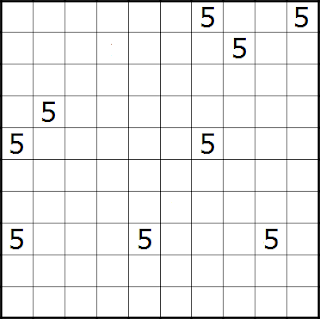
I don't think there is much of a surprise that this puzzle incorporates pentominos. I've always liked pentomino based puzzles. I think it is because the logic puzzles allow me to actually pack all 12 pentominos. This was one simple puzzle that stumped me a lot when I was young.
At first this was going to be a Shape Nurikabe, which Thomas Snyder used in his 20/10 Decathlon. Except I ran into the problem that it is pretty hard to fit 12 pentominos in a grid and create a valid Nurikabe grid. As I didn't manage to even create a valid grid, I changed the puzzle a bit. Instead I just went for no 2 islands having the same shape. this made things easier for me. The puzzle is of medium difficulty.
Also, if someone has a good suggestion for a name, I'm completely open for it.
5. Nurikabe; No Repeat
Determine for each cell if it's part of the stream or an island. Each number is part of a single island of horizontally and vertically connected cells, which size is equal to that number. Islands can't touch eachother horizontally or vertically. The cells not part of an island form the stream. The stream is a single connected area, which doesn't cover any 2x2 areas anywhere.
Additionally, no 2 islands have the same shape. Rotations and reflections are considered the same shape.
I am almost 100% sure people aren't reading my blog there, but as they are the first, I figured i'd include them.
I don't think there is much of a surprise that this puzzle incorporates pentominos. I've always liked pentomino based puzzles. I think it is because the logic puzzles allow me to actually pack all 12 pentominos. This was one simple puzzle that stumped me a lot when I was young.
At first this was going to be a Shape Nurikabe, which Thomas Snyder used in his 20/10 Decathlon. Except I ran into the problem that it is pretty hard to fit 12 pentominos in a grid and create a valid Nurikabe grid. As I didn't manage to even create a valid grid, I changed the puzzle a bit. Instead I just went for no 2 islands having the same shape. this made things easier for me. The puzzle is of medium difficulty.
Also, if someone has a good suggestion for a name, I'm completely open for it.
5. Nurikabe; No Repeat
Determine for each cell if it's part of the stream or an island. Each number is part of a single island of horizontally and vertically connected cells, which size is equal to that number. Islands can't touch eachother horizontally or vertically. The cells not part of an island form the stream. The stream is a single connected area, which doesn't cover any 2x2 areas anywhere.
Additionally, no 2 islands have the same shape. Rotations and reflections are considered the same shape.

Saturday, 19 November 2011
Puzzle #53: Word Nurikabe
I also wanted to put in some puzzles with letters. But I generally have a lot of trouble designing puzzles with words. I tried putting in some word search and scrabble like puzzles, but they just didn't come out in any pleasing way. So i thought of using words in other genres I could work with. Nurikabe ended up being a nice choice. The trick of course was to make sure that the letters couldn't be all directly assigned to a word, because then the number of the island would be instantly known and it wouldn't be any different than a normal Nurikabe.
The design ended up really nice, with the word choice being related to the event and the puzzle.
Rules for Nurikabe
In this puzzle the number clues are replaced by letters and the islands by words. The words that have to be placed are listed on the side. Each word has one letter given. The words have to be placed so that they can be read by moving horizontally and vertically along the squares. check the example below in case something isn't clear.

The design ended up really nice, with the word choice being related to the event and the puzzle.
Rules for Nurikabe
In this puzzle the number clues are replaced by letters and the islands by words. The words that have to be placed are listed on the side. Each word has one letter given. The words have to be placed so that they can be read by moving horizontally and vertically along the squares. check the example below in case something isn't clear.
 |

Rules: Nurikabe
This genre is developed by Nikoli.
Determine for each cell if it's part of the stream or an island. Each number is part of a single island of horizontally and vertically connected cells, which size is equal to that number. Islands can't touch eachother horizontally or vertically. The cells not part of an island form the stream. The stream is a single connected area, which doesn't cover any 2x2 areas anywhere.

Determine for each cell if it's part of the stream or an island. Each number is part of a single island of horizontally and vertically connected cells, which size is equal to that number. Islands can't touch eachother horizontally or vertically. The cells not part of an island form the stream. The stream is a single connected area, which doesn't cover any 2x2 areas anywhere.

Subscribe to:
Posts (Atom)