Tuesday, 1 November 2011

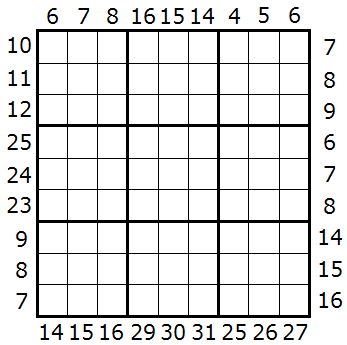
Puzzle #47: Tapa; Hungarian

Last Tapa variant was considered an easy puzzle, but I don't think this one will be seen as such. This type I like a lot, but constructing them has caused me a lot of trouble. It's far harder to not run into impossibilities Tapa-wise as you have a set number of cells in each row and column. Normally the problem is uniqueness, here it is just having the possibility of a solution and then still having to worry about uniqueness. This one worked out well though. This variant will also appear at the WPC, which isn't overly surprising as the idea came from one of the constructers for the WPC.

Rules for Tapa

In this variant you are to place the digits 1-6 instead of colouring squares. The digits will appear once in every row and column. The clues indicate the sum of the connected sections of digits around it. Different sums are seperated by at least one empty square. As in normal Tapa, the digits don't form a 2x2 square anywhere.


Monday, 31 October 2011

Puzzle #46: Line of Sight

Rules for Line of Sight

Not much to say about this design. It look nice and solves nice. It's a bit tricky, but not overly so. Just enjoy.


Sunday, 30 October 2011

Puzzle #45: Pentopia

Rules for Pentopia

The booklet for the World Puzzle Championships came out today. As this genre will feature at the championship I'm posting another one. The puzzle in the championship is probably a bit bigger than mine as it will have all pentomino pieces in it (as the rules seem to indicate). Even though 12 by 12 grids are the standard size for pentomino puzzles, they don't work very well for this genre to fit all 12 in as you eliminate a lot of space with the clue type. Also thought it was somewhat funny that the example was the same one I made for my LMI-test.


Saturday, 29 October 2011

Puzzle #44: Liar Loop

Rules for Liar Loop

This genre idea developed when playing around with Maxi Loop puzzles and discovering how areas sometimes have very little options for the loop to run through and disallowing a certain value would also force the loop a certain way. This eventually led to the attempt to make puzzles with only disallowed values. And a new genre is born.
The puzzle is a bit tricky, but it's partly caused because the way of thinking is different than normal.


Rules: Liar Loop

This genre was developed by myself.

Draw a closed loop through all squares by running horizontally and vertically. The loop doesn't touch or cross itself. The numbers in a boldly marked area indicate that the loop never runs through this many cells consecutively. Whenever it passes through the area it always runs through either more or less cells than the given number.

Friday, 28 October 2011

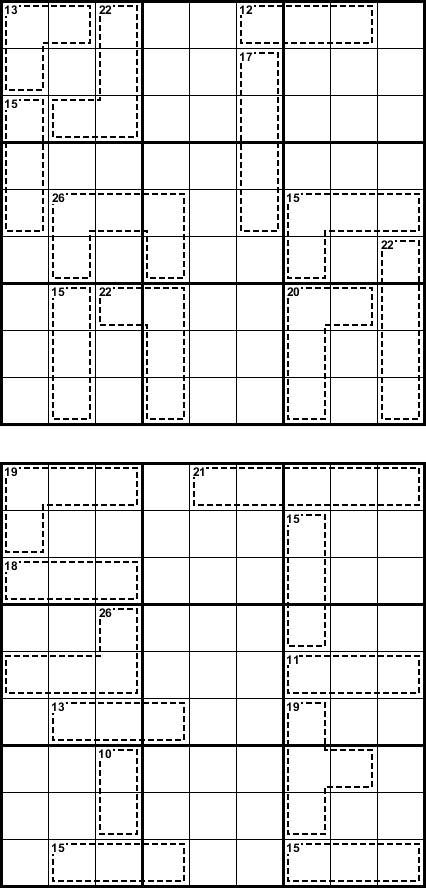
Puzzle #43: Twin Killer Sudoku

I've always liked Twin Killer Sudokus. Part of the reason for that might be because the puzzles of this type I see are usually made by Richard Stolk, who always manages to do beautiful and interesting things with Sudokus.  I prefer them if they don't have both grids completely covered with cages as you can see the design in those puzzles a bit better than in others.
For this puzzle I think it should be clear what the cages should read. I like how it worked out, but I guess as with most of my sudokus they are on the harder side.

Rules for Sudoku

Normal Sudoku rules. Additionally the numbers in the dotted cages represent the sum of the digits in that cage. No digit is repeated within a cage. Both grids have the same solution.


Thursday, 27 October 2011

Puzzle #42: Tapa; Islands

When trying to design these I started to noticed how a whole bunch of clue options become obsolete as they would break the rules. I have a feeling that because of this (almost) all Tapa Island puzzles can be turned into a cryptic variant without messing up uniqueness.

Rules for Tapa

The clues work as normal Tapa with the addition that each clue cell is part of an island of horizontally and vertically connected empty cells. At least one of the clue numbers indicates the size of the island this cell belongs to. No two islands can touch eachother horizontally or vertically and no island contains more than one clue cell.


Wednesday, 26 October 2011

Puzzle #41: Country Road/Land and Sea

I liked the first one I made of these, so figured I'd give this combo another try. I think this one is a bit trickier than the previous one, but that could also be caused by the fact that this one took a lot more effort to get to work out in a way that I liked.
I haven't been able to combine Land and Sea with any other genre satisfactorily. I like it here because it replaces a clue type completely while in others it just comes over as merely an addition.

Rules for Country Road

Rules for Land and Sea

This one solves as a normal Country Road puzzle, with the addition that the loop can't run through more than 2 white squares consecutively.

[Edit: Fixed a uniqueness issue. Somewhat major, but quite easily fixed luckily]


Tuesday, 25 October 2011

Puzzle #40: Maxi Loop

Rules for Maxi Loop
People seemed to like this genre from the first puzzle. So I've toyed around with it again. The finish of this puzzle is a bit trickier that the previous one. The next ones I might try to make bigger or mix up the sizes a bit. All areas being the same size does look nicer, but maybe also limits the difficulty. I'll find out when I try it out.

Monday, 24 October 2011

Puzzle #39: Heyawake

Rules for Heyawake

After a busy weekend, I'm back with a puzzle. I knew I wouldn't be able to keep up posting a puzzle every day, but I kept at it for as long as I could.
I think I'm getting a bit better with creating Heyawake puzzles. This is still not the easiest Heyawake, but I think it has more standard deductions in them than my last one. There's a bit more number work in this one. Hope you enjoy it.


Friday, 21 October 2011

Puzzle #38: Yajilin

Rules for Yajilin

When I make larger puzzles, I seem to find new things to put in. But the only new things I seem to be able to find on larger scale are hard steps I wouldn't have room for on a small scale. I think that's why I'm not much a fan of large Slitherlink puzzles as you can't really put anything in them that doesn't fit on a smaller scale. As my previous Castle Wall puzzle, this one is also a tough one to crack.
I did something silly with the clue placement, which I didn't realise at first. I wasn't 100% sure how to handle the corners, so I basically made it clear at the start what to do with them.

Thursday, 20 October 2011

Puzzle #37: Ripple Effect

Rules for Ripple Effect

I am still finding enough interesting patterns to make these puzzles without any given clues. I managed to raise this one to a 7 cell area. That would probably be easier if I made them larger. omehow I'm not sure if people would look forward to larger Ripple Effect puzzles that have no clues.


Wednesday, 19 October 2011

Puzzle #36: Island

Rules for Island

I've been busy the last few days and haven't had time to really construct something for this blog. Here's another Island puzzle. I haven't had any comments really on the type. I still enjoy constructing them, so they'll most like keep appearing. For this pattern the number 5 seemed a good number to orient the design around.


Monday, 17 October 2011

Puzzle #35: Slitherlink; No Touch


These shifted square clue patterns I always like. I've employed it in many puzzle types. It doesn't work for everything as it always leaves a lot of room. With this type it works really well, as the clues give extra information for many of the unclued squares. I think this one worked out well, although the left bottom is tricky.

Rules for Slitherlink

As an extra rule, none of the given clues share a border with a square that has the same value. This only goes for the given clues, not the remaining squares.

Sunday, 16 October 2011

Puzzle #34: Frameless Sudoku

This is so far the only genre I have made, that have also been made by other people. I like to see them from other people. They will also have a different feel from when you made them yourself. Also more fun if you don't know exactly how the puzzle is set up.
It's not that uncommon for puzzle types that people like only to made by its developer though. If you only look at Naoki Inaba's website and then try to find the puzzle ideas he thought of somewhere else. Very few of those are found anywhere else.
This puzzle I wanted to see if I could make all triplets of given sums to be consecutive. It worked out nicely even though the opening is a bit tricky to figure out.

Rules for Sudoku

The numbers on the outside indicate the sum of the first digits encountered in that row or column from that side. The amount of digits can differ from sum to sum and can be only one digit.

Saturday, 15 October 2011

Puzzle #33: Maxi Loop

I make a lot of loop puzzles. Loop puzzles just come more naturally to me. This was actually an idea I had been working with before, till I also found it on Naoki's website. There's 2 more ideas I saw there that I had actually tried to work with myself. Both ideas I couldn't really get to work properly, but Naoki proved me wrong and his puzzles in those genres are actually very nice. So I might give them another go some time.
This puzzle isn't as challenging as the last one. So you can relax a bit more this with one.

Rules: Maxi Loop

This genre was developed by Naoki Inaba.

Draw a closed loop through all cells by connecting the centers horizontally and vertically. The loop can't cross or touch itself. The numbers in the boldly marked area indicate the highest amount of cells that the loop goes through consecutively in that area.

Friday, 14 October 2011

Puzzle #32: Castle Wall

Rules for Castle Wall

I don't generally makes puzzles larger than the standard 10 by 10 grids. I like to put tricky steps in puzzles and in larger puzzle they can get lost for people. Castle Wall has more widespread constraints and in a larger grid you can do things that wouldn't fit in a smaller grid. This is a tricky puzzle, which uses two techniques a lot. I haven't done enough Castle Wall puzzles to see how often they appear in other puzzles.
If people didn't know yet, clicking the image gives you the image in the original size. The size discrepancy is a bit bigger in this puzzle.

Thursday, 13 October 2011

Double Trouble #5: Slitherlink and Turning Fences

This combination of puzzles took the longest to get to work out of all Double Troubles so far. I couldn't get the end to work for most my tries. Maybe it didn't help that I was stubborn in wanting to use a preset layout. It's easier if I just place clues where they are needed.
These Turning Fences I haven't really seen many of. The only time that really comes to mind is a WPC. I'm thinking it was in Borovets, but not too sure. I just came to use it again recently and I figured it should be possible to make them looking like normal Slitherlink, so figured it might also be possible for one to actually be a Slitherlink.

Rules for Slitherlink

Rules for Turning Fences

So firstly it can be solved as a Slitherlink puzzle. this puzzle has its easy and hard parts.It still seems pretty typical for the style and difficulty I like to make them.
Secondly it can be solved as a Turning Fences puzzle. This one is about the same difficulty as the Slitherlink puzzle but as its the first on this blog it might feel harder.


Rules: Turning Fences

Draw a closed loop by connecting dots horizontally and vertically. The numbers in the grid indicate the amount of turns taken on the four dots around it.