Thursday, 27 September 2012

Puzzle #132: Complimentary Hexa Sudoku

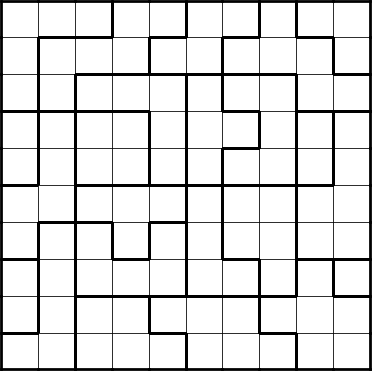
Before the Sudoku craze Hexa number place was my favourite variant. I like how it didn't have all numbers in every row and the 3 direction configuration led to some fun interactions. I haven't really seen many of these in a while though as most people have gotten to writing Sudoku variations in standard grids. I recently tried to write some again and this is one of the results.
I combined this puzzle with a variant I saw while test solving the Hungarian Sudoku Championship. Those were my favourite sudoku puzzles I tested. I thought it worked well together in a Honeycomb grid.

Rules:

Place the digits 1~9 in every cell, so that no digit is repeated in any row in any of the three directions. When a dot is given between three cells, it means that two of the digits add to the third digit. Not all dots are given.


Click to enlarge


Tuesday, 25 September 2012

Puzzle #131: Masyu: Not Alone and No Touch

The reason there are two puzzles today is because I started designing the Not Alone Masyu and noticed that the same placement actually also makes a nice opening for a No Touch Masyu. So after completing the Not Alone Masyu I also used the opening to make a No Touch Masyu.
The Not Alone variation is based on the Not Alone genre. It uses similar logic as the alternating Masyu variation, where the loop has to alternate between black and white circles. In this type the loop isn't allowed to alternate between white and black circles. In other words, every circle is preceded or followed by at least one circle of the same colour. I think it works nicely in this puzzle and decreases the amount of circles necessary.
The No Touch variant was seen first on Palmer Mebane's blog. It has seen some appearance in other people's blogs and the Indian Puzzle Championship as well. It was mere coincidence that I spotted that the opening worked just as nicely for this variant. I couldn't just let it go and worked with the same opening to create a second puzzle. I think it worked out well.

Rules for Masyu

Not Alone Masyu:
Follow regular Masyu rules. Additionally the loop may never alternate between black and white circles. In other words, every circle is preceded or followed by at least one circle of the same colour.


No Touch Masyu:
Follow regular Masyu rules. Additionally, no two unused squares may share a border.


Saturday, 22 September 2012

Hungarian Puzzle Championship: Doppelblock

The last set of puzzles I provided to the Hungarian Puzzle Championship were four Doppelblock puzzles. They featured in the non-classics round.
I've recently started to construct these puzzles and having fun with them. It's one of the few suggestions I had for the non-classics round and this one fitted in best. As this is an uncommon genre I didn't have to put much difficult in but could keep the puzzles fairly standard.
The first puzzle is a 6x6 puzzle based around larger numbers. The placement of the black squares can be derived without placing any numbers. Nothing challenging about this puzzle.
The second puzzle is a 6x6 puzzle built around the number 0. The black square placement is a bit trickier than the first puzzle. Overall it shouldn't cause much problems though.
The third puzzle is a 7x7 puzzle. The increased size of the puzzle is mainly what makes the puzzle trickier. I like how the puzzle worked out. Especially the 2 column finish was really nice.
The last puzzle is an 8x8 puzzle. The clues are split between odd and even clues for rows and columns. The puzzle has a very narrow opening, which makes the solve tricky. I really think though that the logic and layout worked out very well.
Overall I think these four puzzles showed very well what's possible with this genre. So far I have limited to 8x8 puzzles, but I'm going to try to extend it to 9x9 and bigger as well. But I'm not sure if its possible to create them without giving clues in the grid as well.

Rules for Doppelblock

Puzzles can be found below.

Thursday, 20 September 2012

Hungarian Puzzle Championship: Star Battle

Today will feature 4 Star Battle puzzles I contributed to the Hungarian Puzzle Championship. The Star Battle puzzles also featured in the Classics round.
Designing Star Battle puzzles in the 10 minute time limit is easier than Kakuro puzzles, because the average solving time for a Star Battle puzzle is much lower than a Kakuro puzzle. So puzzles don't have to be overly easy to have a solving time of 1-2 minutes for the best solvers.
For the two easier puzzles I wanted two different types of openings.Most Star Battle puzzles employ one of these two openings. The first one is the easiest of the two. It revolves around a single star that can be directly placed. From there the puzzle quickly resolves.
The second puzzle has a different standard opening, although maybe in a not so standard place. I do think it stands out among the other areas. This puzzle resolves a bit slower than the first puzzle as it has a few key points in the middle of the solve to make progress.
The third puzzle has the type of opening I like to do. At first sight, neither of the standard openings seem to apply but with a simple deduction one appears. It's a bit harder in this puzzle to keep making progress as there are a few key deductions that have to be made in order.
The fourth puzzle has a more atypical opening. I've used a similar one before in my other Star Battle puzzles. The opening doesn't stand out instantly but it should be clear how it works none-the-less. I think this puzzle is the hardest because it employs the most obscure opening and the way to make progress afterwards is hardest among the four puzzles.
I've added a fifth puzzle that wasn't used in the championship, but I constructed for it though. It was actually the first puzzle I constructed, using three cages that spell out HUN, that was meant as the hardest puzzle of the four. But after making three others I found it was too hard to be included in a set of three other puzzles, I made an extra one that is a bit easier to solve. To solve this one you need to see how different cages work together far more than the other puzzles. This makes the solve far trickier than any of the other four puzzles.

Rules for Star Battle

Puzzles can be found below.

Rules: Star Battle

Place 2 stars in every row, column and black bordered area. The stars can't touch eachother, not even diagonally.

The example uses only 1 star.


Tuesday, 18 September 2012

Hungarian Puzzle Championship: Kakuro

At the request of Zoltan Horvath I contributed some puzzles to the Hungarian Puzzle Championship held this weekend. I will post all puzzles this week. The general requirements were 2-4 puzzles for a solving time of 10-15 minutes. The test consisted of a classics and non-clasics round. Today we start with Kakuro, which was featured in the classics round.
I've always liked writing Kakuro puzzles, but I generally tend to write difficult puzzles. So my first goal was to write 2 easy puzzles with all basic deductions, with openings in multiple places. It took me a while to get that done actually as I automatically tend to put in harder things without thinking about it. I made 2 easy puzzles which turned out well. In hindsight it would have probably been better to make them a bit smaller to make the solving time less. But I figured they'd both fall between 1-3 minutes in solving time for the fastest solvers. The first one was just a simple circular pattern you can almost go in on big haul around the track. The second puzzle was a bit more open pattern, with a few more places where the puzzle can open up. I had the first one tested to see if this was actually enough on the easy path, as I find it hard to actually judge difficulty of Kakuros and it seemed to be okay.
The third puzzle I wrote had a few harder deductions, but the main thing that made it harder is that is has a single opening from which you have to work through the puzzle. It turned out to really not be anything special. It was one of those puzzles I have written many of.
The fourth puzzle I wrote is actually one of my favourite Kakuros I have written ever. It was built around a pattern which employed eight interlocked 8-cell sums. I made them all a different value. Because of the many  larger sums it uses certain techniques which you don't normally encounter much in Kakuro puzzles. It has some similarities in layout and solving to another puzzle I have written before. I think this one turned out better.
During testing of course it again turned out that my judging of Kakuro difficulty was far off the norm and instead of four puzzles, only two of the puzzles were used. Only the second and third puzzle ended up in the championship but I'm still posting all four puzzles in this post.

Rules for Kakuro

Puzzles can be found below

Rules: Kakuro

Fill every cell with a digit from 1-9. Numbers above a diagonal line indicate the sum of the digits in the consecutive white cells immediately to its right. Numbers below a diagonal line indicate the sum of the digits in the consecutive white cells immediately below it. No digit can be repeated within a single sum.


Thursday, 13 September 2012

Double Trouble #8: Skyscrapers and Haido

Haido is a puzzle type that I've recently come across a few times again. It showed up in a recent Skyscrapers contest hosted on Logic Masters Deutschland and the latest Akil Oyunlari magazine. All puzzles I've recently solved were really nice. So I tried making a few and found them more interesting to make than I at first thought they would be. When I saw the results, I thought they all look exactly like normal Skyscrapers puzzles. But they never solve uniquely as a skyscrapers puzzle. Usually they don't even have a valid solution.
So this led me to try to design one that worked as both. I found it hard to find an opening that worked nicely for both. so I cheated a bit with introducing a 6 clue for the skyscrapers puzzle, which is meaningless in the Haido puzzle. I like how they both turned out, although they are challenging.

Rules for Skyscrapers

Rules for Haido

Firstly this puzzle can be solved as a regular Skyscrapers puzzle. This is a hard puzzle.

Secondly it can be solved as a Haido puzzle. It is harder than the skyscrapers puzzle. I haven't solved any that are this difficult.


Rules: Haido

Haido is a genre based on the Skyscrapers genre.

Place the digits in the given range once in every row and column. The digits represent skyscrapers of that height. The clues on the outside indicate that the building of this height is visible in that row or column from that side. Larger skyscrapers block the view of smaller ones.

The example uses the digits 1-4.


Tuesday, 11 September 2012

Puzzle #130: Pentomino Areas

Pentomino puzzles I have slowly grown into. When I first started puzzling, I always had a lot of trouble solving them. In my early Breinbrekers issues, pentomino were the ones that were most often left unsolved. I prefer the placement type pentomino puzzles over the packing type. I've never been very good at packing problems. I've gotten more proficient at pentomino puzzles over time and now usually enjoy them.
Pentomino puzzles were the first type I regularly contributed to Breinbrekers, where I would write 18x18 Battleship-like puzzles, which used all Pentominos twice. I haven't written them in a while though. They take a while to get unique and solvable.
This pentomino type will appear in the upcoming LMI-test Borders & Beyond written by Prasanna Seshadri, which I was a test solver for. The type can sometimes get me stuck badly. The last time that happened was at the Dutch Puzzle Championship in '06, when it was featured in the semifinals and I couldn't get it done and ended up guessing my way through. Luckily I could catch up on the second puzzle and still qualify for the finals then.
This puzzle has a feature I like to use in puzzle types as all areas are the same size, which isn't common in this puzzle type. I have done the same in LITS as well, although there it was only on an 7x7 and 8x8 size.

Rules:

Place all 12 pentominos once in the grid so they don't touch eachother, not even diagonally. Each blackbordered area contains one pentomino.


Click to enlarge

Thursday, 6 September 2012

Puzzle #129: Contact

I've given this genre another go. I think the 1 through 7 theme worked out pretty nicely. The opening of the puzzle is easy, but it gets a bit harder towards the end.
For everyone who's been trying to get to this post yesterday from other blogs, I'm sorry. I accidentally forgot to add the scheduled time.

Rules for Contact


Tuesday, 4 September 2012

Puzzle #128: Expanded Sudoku

I have played around with this idea a bit already before. When it popped up in the US Sudoku Qualifiers under the name Sudoku stairscases, I figured I'd give it another go. I prefer Expanded Sudoku as Sudoku Staircases really only work for one layout. I made the first ones back in early 2010. There'd been other Sudokus with gaps in rows, but I hadn't seen them with the standard 3x3 blocks. My first puzzles are puzzle #1695 and #1703 on PuzzlePicnic. Later on I tried to make them with irregular cages too, namely puzzle #2584 and #2607. The logic in them isn't any harder than any normal Sudoku, but I still think the increased size adds a bit of an extra challenge.
This puzzle isn't any harder than the other puzzle. I like how it looks though. This puzzle has one more challenging step that stayed in the puzzle while maintaining uniqueness.

Rules for Sudoku

In this puzzle the rows and columns continue over empty space.


Thursday, 30 August 2012

Puzzle #127: Easy as ABC; Regional

With this puzzle it is back to old school puzzling for me. Easy as ABC puzzles are one of the first puzzle types I solved. They used to appear as an extra puzzle in Logiquiz magazine. These were my real introduction to logic puzzling. This was before I started buying Breinbrekers. They appeared under the name Letterraam, which is a name for an old tool to help kids learn to read in Dutch. Without these puzzles I would have probably never bought Breinbrekers.
These puzzles uses two common variations on the genre. Firstly they don't use the standard "first seen" clues, but indicate the position of the letter when looking from that side. So A3 means that A is the third letter when looking from that side. This variation makes constructing larger grids much easier as large grids tend to get uniqueness problems in the centre, where your clues don't have any effect. Secondly they have regions that function just like a Sudoku. This helps reduce the number of clues necessary to make it unique.

Rules for Easy as ABC

Fill the letters A~E (A~G in the larger puzzle) once in every row, column and black bordered region. Otherwise follow Easy as ABC rules.

Medium Puzzle


Hard Puzzle

Click to enlarge
 

Tuesday, 28 August 2012

Puzzle #126: Tapa; Mastermind: Tapa/Knapp Daneben Tapa

At first I was trying to make a Knapp Daneben Tapa that looks exactly like a normal Tapa. That wasn't as easy as I hoped it would be. So I changed my approach and added the Mastermind component to it. This made it far easier to construct. The puzzle itself is pretty tough though.

Rules for Tapa

Tapa Mastermind:
The gray numbers between corresponding rows represent Mastermind clues. The numbers indicate how many squares in the same position are coloured in both grids.

Knapp Daneben Tapa:
Follow regular Tapa rules. Additionally all given digits are wrong. They are all either 1 higher or 1 lower than the given value. This means a 1 can possibly turn into a 0.


Click to enlarge

Thursday, 23 August 2012

Puzzle #125: Ripple Effect

Here's another Ripple Effect puzzle. It's been a while since I posted one. this is mostly caused by the fact that I've been writing Ripple Effect puzzles for Breinbrekers as well. It's not always easy to find good openings for clueless grids. It also helps to not make any errors. The construction took a while as I had made a mistake very early on and didn't notice after finishing the puzzle on my fifth try. Took me another four attempts to fix that mistake correctly. But in the end I think the puzzle worked out well. I have used a similar opening before. It's moderately hard, as most my Ripple Effect puzzles are.

Rules for Ripple Effect


Tuesday, 21 August 2012

Puzzle #124: Doppelblock

I'm back again to posting. Hopefully for a while. The Olympics were the main contributing factor to me not posting. I spend most my free time watching the Olympics. I didn't really find the time to create puzzles then.

Today we have three Doppelblock puzzles. It's originally from Naoki Inaba, I'm going with the German name from crocopuzzle. Simple name, but it sounds nice. Serkan Yurekli gave it an English name in Smashed Sums, but I didn't particularly like that name.
When I first saw this genre on crocopuzzle, I liked it. Although crocopuzzle regularly has this small minimal puzzle that is a bit annoying to solve as it's too had to discover the logical path. The larger ones are always nicer, but tend to have givens in the middle. This makes them a bit less elegant to me. It feels a bit similar as givens in skyscraper grids.
I think the puzzles worked out well. Nothing too difficult, but something to keep you busy for a little while. This puzzle type will also appear in the UK Puzzle Championship over the upcoming weekend, so it will be nice practise in this genre for those competing. It was merely a coincidence though. I had made these puzzles before the instruction booklet came out.

Rules for Doppelblock


Easy Puzzle


Medium Puzzle


Hard Puzzle


Rules: Doppelblock

This genre was developed by Naoki Inaba,

Colour 2 squares black in every row and column. Fill the remaining white squares with the digits 1~N, so that each digit appears once in every row and column. N equals the size of the grid minus 2 (e.g. for the example N = 3). The numbers on the outside indicate the sum of the digits in between the 2 black squares in that row or column.


Tuesday, 24 July 2012

Puzzle #123: Parquet

Here's again one of Naoki Inaba's genres. It has some similarities to the Windows genre, which featured in the WPC, which can also be found on Naoki Inaba's website. It's known as conect on his website, but I don´t find that a very nice name. I changed it to Parquet as the grids reminded me of the Parquet Sudokus.
The puzzle worked out really nicely in my opinion, utilising all rules as well as possible on a 10x10 grid.

Rules for Parquet


Rules: Parquet

This genre was developed by Naoki Inaba.

Colour one of two regions in every blackbordered 2x2 area to form a single contiguous shape. This shape doesn't have any 2x2 coloured sections anywhere. Also this shape doesn't form any loops anywhere.


Thursday, 19 July 2012

LMI Practise : Logirace

A recent comment on my blog mentioned how Loop genres feature prominently on my blog. It's somewhat true as I am better at finding interesting things to do with loop genres. This weekend happens to be a puzzle test on Logic Master India named Logirace. This test features nothing but loop genres. Half of them are Nikoli Loop genres(Corral, Country Road, Masyu, Slitherlink and Yajilin), 3 less familiar genres (Dutch Loop, Tapa Loop and Dotted Loop) and 2 that are new to me(Border Loop and Comet). I figured I'd try to make a few examples of the less familiar ones. Some puzzles worked out better than others. I didn't like working with some of the genres so much. Hard to get them unique and nice. Especially the Comet and Dotted Loop have issues of there being a unique solution a lot in construction. But I think each puzzle will help a bit in preparing for the test, if that's what you're interested in. Otherwise just solve them for fun. It's what puzzling is really about.


You can find the puzzle below. If you want to see smaller examples, check the instruction booklet.