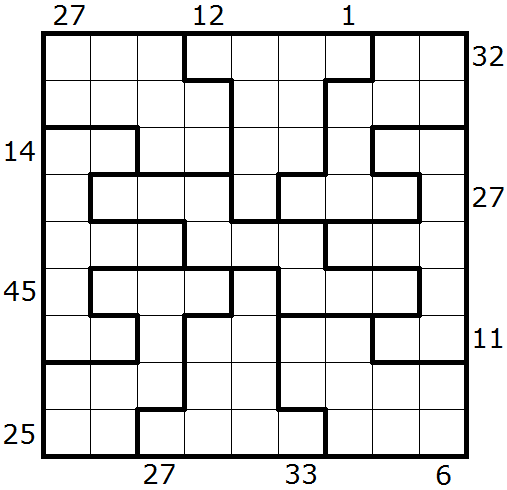
This week the LMI Puzzle Marathon will start. It will run from February 21st till March 2nd. For this event I have written a Turning Fences puzzle. To prepare people a bit for a more unknown genre, I will write a tutorial about the logic behind the genre. It won't be complete, but it should be enough to tackle the upcoming puzzle. In the next days there will also be a few practise puzzles. You can also practise some of the puzzles already on my blog, but most of these are logically harder than the puzzle in the actual test. For those who happen to own Akil Oyunlari Issue #75, there are also 4 of these puzzles by my hand in there. They are logically a bit more friendly.
Tutorial below.
Monday, 17 February 2014

Saturday, 28 December 2013
Daily League Sudoku #40: Inside Skyscraper Sudoku
Today's puzzle is a Skyscraper Sudoku variant. This is a more Logic Puzzle variant of Sudoku. I normally would represent this as a Regional variant of Skyscraper puzzles. The Sudoku part doesn't often come forward as much as the Skyscraper part during the solve. But as I always like Skyscraper Sudokus, I figured I'd make one too. This variant sometimes has all possible arrows given, but I prefer it without this rule. A lot of the smaller numbers end up being unnecessarily given an arrow there, although the negative information is also fun to use. I just prefer it this way.
I had set up this opening a few weeks ago, but I was not able to finish the puzzle successfully. After a few more tries, I came up with this puzzle. I was originally intending to make the clue arrangement symmetric, but as you can't just put a clue everywhere that caused some problems. This was the point where the puzzle ended up being unique. I liked the way it solved at the end, with a somewhat tricky step to finish the puzzle. So that's why I settled for this one. I had a little trouble finding a satisfying layout, but I think this one should do. If someone has a suggestion that could work better, I might change the image. Having said that, enjoy the puzzle.
Rules for Sudoku
In this Sudoku each digit indicates the height of a Skyscraper. Digits in cells with arrows indicate the number of buildings that can be seen in the direction of the arrow from that cell. Taller buildings block the view of smaller buildings.

I had set up this opening a few weeks ago, but I was not able to finish the puzzle successfully. After a few more tries, I came up with this puzzle. I was originally intending to make the clue arrangement symmetric, but as you can't just put a clue everywhere that caused some problems. This was the point where the puzzle ended up being unique. I liked the way it solved at the end, with a somewhat tricky step to finish the puzzle. So that's why I settled for this one. I had a little trouble finding a satisfying layout, but I think this one should do. If someone has a suggestion that could work better, I might change the image. Having said that, enjoy the puzzle.
Rules for Sudoku
In this Sudoku each digit indicates the height of a Skyscraper. Digits in cells with arrows indicate the number of buildings that can be seen in the direction of the arrow from that cell. Taller buildings block the view of smaller buildings.
Saturday, 21 December 2013
Daily League Sudoku #39: Palindrome Killer Sudoku
Today's Sudoku is themed around today's date. As the date is a palindrome, the choice of Sudoku was easy. I chose for the combination with Killer Sudoku as I could use 21 and 12 easily in that variant.
The puzzle has a somewhat complicated opening. But I hope that people will understand where to look considering the choice of combined variants. If not, I guess there's very little to get in this one. But when the opening's finished, the solve should solve without much problems.I'm still happy with the Sudoku overall. I think the 21/12 layout of cages looks really nice and the way the palindrome resolves the obvious non-uniqueness worked out really well. I hope people will feel the same. Enjoy.
The puzzle has a somewhat complicated opening. But I hope that people will understand where to look considering the choice of combined variants. If not, I guess there's very little to get in this one. But when the opening's finished, the solve should solve without much problems.I'm still happy with the Sudoku overall. I think the 21/12 layout of cages looks really nice and the way the palindrome resolves the obvious non-uniqueness worked out really well. I hope people will feel the same. Enjoy.
Instead of given numbers, you now have a few dashed cages. The number in a cage indicates the sum of the digits in the cage. Digits can't be repeated in any dashed cage. Additionally, digits along a grey line must form a palindromic sequence.
 |
| Click to enlarge |
Sunday, 15 December 2013
Daily League Sudoku #38: Parity Count Sudoku
This week's Sudoku is an Odd/Even Sudoku variant. I'm pretty sure I have seen this idea before. I have no idea where or what is was called then. So I just gave it my own name.
I always like Sudokus that use parity constraints, which require you to basically build an Odd/Even Sudoku. I made a puzzle that required this before, namely my Battenburg Sudoku. In this one you actually have to solve the Sudoku to set up the whole Odd/Even Sudoku grid. I think because of the interaction between Sudoku and parity rule, this idea is a bit more interesting. I don't think the puzzle is overly difficult. The opening shouldn't be too hard, but there's a few sticking points in the middle in figuring out which numbers go in certain grey cells. I had fun designing it. I sacrificed symmetry a bit as the left top square being grey helped make it unique and I preferred that over giving extra givens. I hope people enjoy it.
Rules for Sudoku
In this Sudoku digits in grey cells indicate how many digits of the opposite parity appear in the cells touching it.

I always like Sudokus that use parity constraints, which require you to basically build an Odd/Even Sudoku. I made a puzzle that required this before, namely my Battenburg Sudoku. In this one you actually have to solve the Sudoku to set up the whole Odd/Even Sudoku grid. I think because of the interaction between Sudoku and parity rule, this idea is a bit more interesting. I don't think the puzzle is overly difficult. The opening shouldn't be too hard, but there's a few sticking points in the middle in figuring out which numbers go in certain grey cells. I had fun designing it. I sacrificed symmetry a bit as the left top square being grey helped make it unique and I preferred that over giving extra givens. I hope people enjoy it.
Rules for Sudoku
In this Sudoku digits in grey cells indicate how many digits of the opposite parity appear in the cells touching it.

Saturday, 7 December 2013
Daily League Sudoku #37: Non-Consecutive Sudoku
This week again something familiar. I had a different puzzle ready, but I sadly realised my intended opening made no sense. I had adjusted two digits, which I thought didn't affect the opening, but on a resolve I realised they did. I will give that one another go later, but I didn't really have the time to fix it today. So instead here is a Non-Consecutive Sudoku.
I always enjoy solving Non-Consecutive Sudokus. I think writing them is a lot trickier though. I think it doesn't really suit the way I like to write Sudokus or puzzles in general. I think the puzzle solves nicely, but it won't be one of my more memorable Sudokus. But as I promised a more easy Sudoku this week, I think this one will at least keep that promise. Enjoy :).
Rules for Sudoku
In this Sudoku consecutive digits can't be orthogonally adjacent.

I always enjoy solving Non-Consecutive Sudokus. I think writing them is a lot trickier though. I think it doesn't really suit the way I like to write Sudokus or puzzles in general. I think the puzzle solves nicely, but it won't be one of my more memorable Sudokus. But as I promised a more easy Sudoku this week, I think this one will at least keep that promise. Enjoy :).
Rules for Sudoku
In this Sudoku consecutive digits can't be orthogonally adjacent.

Saturday, 30 November 2013
Daily League Sudoku #36: Sum Relations Sudoku
I have seen puzzles similar to this before, except in a Killer Sudoku format. In those puzzles the relations are given between different cages. Here the relation is between the sums of adjacent cells on either side of the symbol.
This is again a harder puzzle. I don't know exactly how hard it is, but there's definitely no progress to be made if you don't understand the opening. I wasn't expecting to be able to make this variant without any givens. But I managed to create an opening that works without any givens. I think it's a nice and interesting opening. The middle is probably a bit easier, but I think the end is again a little bit harder, but worked out nicely in my opinion. I'll think about making something easier again next week, but I can't exactly promise that. When I find an interesting opening, I just run with it. And interesting is generally hard. Enjoy this puzzle though.

This is again a harder puzzle. I don't know exactly how hard it is, but there's definitely no progress to be made if you don't understand the opening. I wasn't expecting to be able to make this variant without any givens. But I managed to create an opening that works without any givens. I think it's a nice and interesting opening. The middle is probably a bit easier, but I think the end is again a little bit harder, but worked out nicely in my opinion. I'll think about making something easier again next week, but I can't exactly promise that. When I find an interesting opening, I just run with it. And interesting is generally hard. Enjoy this puzzle though.
In this Sudoku, the symbols indicate the relation between the sums of the 2 cells on either side of the symbol.

Saturday, 23 November 2013
Daily League Sudoku #35: Rank Killer Sudoku
This week a puzzle type taken from Richard Stolk's V2V test at Logicmasters India. I had planned on posting this type earlier, but my attempts at making one never got anything useful. So I made other puzzle types instead, that worked out easier. But this one seemed to work well.
This puzzle is again a harder one. I had posted a few easier ones in the last few weeks. This type has again some room for me to be a bit more creative with the opening. There's a few steps that combine Killer Sudoku and Rank Sudoku to start this one off. They are still all logical steps, but it takes a bit more effort to figure them out. I still think it is an enjoyable puzzle.
As a reminder all Daily League puzzles are also solvable at SudokuCup.
Rules for Sudoku
The sum of digits inside each dashed cage is given at the upper left cell of the cage. A digit 'N' in a circle means that the digit in the cell is the Nth smallest number in the corresponding cage. Digits cannot repeat within a cage.
This puzzle is again a harder one. I had posted a few easier ones in the last few weeks. This type has again some room for me to be a bit more creative with the opening. There's a few steps that combine Killer Sudoku and Rank Sudoku to start this one off. They are still all logical steps, but it takes a bit more effort to figure them out. I still think it is an enjoyable puzzle.
As a reminder all Daily League puzzles are also solvable at SudokuCup.
Rules for Sudoku
The sum of digits inside each dashed cage is given at the upper left cell of the cage. A digit 'N' in a circle means that the digit in the cell is the Nth smallest number in the corresponding cage. Digits cannot repeat within a cage.
 |
| Click to enlarge |
Saturday, 16 November 2013
Daily League #34: Arrow Sudoku
This week a more familiar variant. Arrow Sudoku has been around for a while now and there's been many nice puzzles made. I hope this one is also enjoyable.
I decided to go for a similar layout as my Renban Sudoku I made a while back for the league. I thought it would work well with Arrow Sudoku too. I was able to give fewer givens though as the arrow already forces some placement because of the direction. I shortly considered making a directionless Arrow Sudoku, where the circle could be at either end, but this layout wasn't very friendly for that variant. At first I had a harder variant of this Sudoku, but it took me too long to solve it myself while knowing the openings because the middle and end ran a lot on very complex interactions between the arrows that I really couldn't justify logically. So I revamped it a little to make it more solvable. The harder opening is still in this puzzle but it is no longer needed to solve the puzzle as there's a more friendly path through the puzzle.
Rules for Sudoku
In this Sudoku a number of arrows are given with a circle at the end. The digit in a circle is equal to the sum of the digits along its arrow. Digits may repeat along an arrow as long as they don't break any Sudoku rules.

I decided to go for a similar layout as my Renban Sudoku I made a while back for the league. I thought it would work well with Arrow Sudoku too. I was able to give fewer givens though as the arrow already forces some placement because of the direction. I shortly considered making a directionless Arrow Sudoku, where the circle could be at either end, but this layout wasn't very friendly for that variant. At first I had a harder variant of this Sudoku, but it took me too long to solve it myself while knowing the openings because the middle and end ran a lot on very complex interactions between the arrows that I really couldn't justify logically. So I revamped it a little to make it more solvable. The harder opening is still in this puzzle but it is no longer needed to solve the puzzle as there's a more friendly path through the puzzle.
Rules for Sudoku
In this Sudoku a number of arrows are given with a circle at the end. The digit in a circle is equal to the sum of the digits along its arrow. Digits may repeat along an arrow as long as they don't break any Sudoku rules.

Saturday, 9 November 2013
Daily League Sudoku #33: Hi-Lo Product Frame Sudoku
This week another variation on the Hi-Lo Frame Sudoku. It's a fun variant you can always play around with. This time it's products instead of sums. It leaves for fewer options and thus allows fewer clues.
Outside clues and empty grids are always my favourite Sudokus to construct. It's generally a bit of a struggle to get them to turn out unique or even create an opening. This one was a bit of a struggle to get unique as my final clue had to settle about 35 cells. There were a few options that got pretty close but would end up having no solution. This was the only one I could find that settled the uniqueness issue. There was a second option that I thought had worked, but then I realised the clue didn't actually have to be in that configuration and thus there were many more solutions. The puzzle itself is not overly hard as the clues give you a lot of information from the start and the clue I used for uniqueness is already helpful far earlier than it was in my construction.
Rules for Sudoku
In this Sudoku, the numbers on the outside indicate the product of the highest and lowest digit in the first three cells of that row or column when looking from that side.

Outside clues and empty grids are always my favourite Sudokus to construct. It's generally a bit of a struggle to get them to turn out unique or even create an opening. This one was a bit of a struggle to get unique as my final clue had to settle about 35 cells. There were a few options that got pretty close but would end up having no solution. This was the only one I could find that settled the uniqueness issue. There was a second option that I thought had worked, but then I realised the clue didn't actually have to be in that configuration and thus there were many more solutions. The puzzle itself is not overly hard as the clues give you a lot of information from the start and the clue I used for uniqueness is already helpful far earlier than it was in my construction.
Rules for Sudoku
In this Sudoku, the numbers on the outside indicate the product of the highest and lowest digit in the first three cells of that row or column when looking from that side.

Daily League Sudoku #32: N-Sums Sudoku and Quad Max Difference Sudoku
This post is just preceding this week's Sudoku. I hadn't made blogposts of my previous 2 Sudoku. The first one was made en route to Beijing for the WSC/WPC. I had no access to Facebook or BlogSpot there, so I wasn't able to make any posts. The second one I was not at home and managed to sneak in some time to make a quick Facebook post with the image, which all is a little bit faster than making posts on my blog.
The first puzzle is a variant on the X-Sums Sudoku, of which I have made a few. The variant is a bit more limiting as now not every row and column necessarily has a valid clue. This is caused by the fact that a number N has to appear in position N to become a valid clue. The construction took a while as I wanted to keep the symmetric layout and sometimes I wasn't able to make the layout symmetric as there was no longer a clue available. There are a few clues that aren't necessary for uniqueness in this puzzle, but they don't hinder the solving path and make it overall a little bit easier. I think people don't mind that my Sudokus are made a bit easier in general.
The second puzzle is a simple variant with differences. It has more given numbers than I would have wanted, but it wouldn't be unique otherwise. I wanted to make a puzzle which had a single instance of every possible Quad Difference clue possible. This of course forced one of the clues to be in a specific position as otherwise there's be no unique solution available. Which is why I went for this layout. I don't think this one is overly hard. There's a few key points in the solve where you have to use the right clues.
Rules for Sudoku
N-Sums Sudoku:
Clues outside the grid indicate the sum of the first N digits seen in that row or column from that side. The digit N is always indicated by the Nth digit seen from that side. In other words, it is always the last digit in the summed set of digits.

Quad Max Difference Sudoku:
In this Sudoku, numbers on grid points indicate the maximum difference between the four digits surrounding it. Each difference must appear at least once around each clue.

The first puzzle is a variant on the X-Sums Sudoku, of which I have made a few. The variant is a bit more limiting as now not every row and column necessarily has a valid clue. This is caused by the fact that a number N has to appear in position N to become a valid clue. The construction took a while as I wanted to keep the symmetric layout and sometimes I wasn't able to make the layout symmetric as there was no longer a clue available. There are a few clues that aren't necessary for uniqueness in this puzzle, but they don't hinder the solving path and make it overall a little bit easier. I think people don't mind that my Sudokus are made a bit easier in general.
The second puzzle is a simple variant with differences. It has more given numbers than I would have wanted, but it wouldn't be unique otherwise. I wanted to make a puzzle which had a single instance of every possible Quad Difference clue possible. This of course forced one of the clues to be in a specific position as otherwise there's be no unique solution available. Which is why I went for this layout. I don't think this one is overly hard. There's a few key points in the solve where you have to use the right clues.
Rules for Sudoku
N-Sums Sudoku:
Clues outside the grid indicate the sum of the first N digits seen in that row or column from that side. The digit N is always indicated by the Nth digit seen from that side. In other words, it is always the last digit in the summed set of digits.
Quad Max Difference Sudoku:
In this Sudoku, numbers on grid points indicate the maximum difference between the four digits surrounding it. Each difference must appear at least once around each clue.

Saturday, 5 October 2013
Daily League Sudoku #31: WSC Jigsaw Sudoku
The post is coming from Las Vegas this time. I made this puzzle poolside relaxing in the sun after making my way to part of the WSC instruction booklet. The example in the booklet of this puzzle isn't that challenging, so I figured I'd give a more instructive one. The logic in placement is solid and the remaining solve shouldn't be very hard. I think this is doable within 15 minutes. I don't have a B or C version.
I hope it's a fun puzzle and maybe some help for the upcoming WSC. See all of you who are going there in a few days.
Recap of the last Daily League week:
Sunday: Product or Outside Sudoku by Seungjae Kwak
Monday: No Ten Sudoku by Jakub Hrazdira
Tuesday: Monopoly Untouch Sudoku by Prasanna Seshadri
Wednesday: Extra Regions Sudoku by Bastien Vial-Jaime
Thursday: Arrow Sudoku by Rishi Puri
Friday: Killer Sudoku by Tom Collyer
Saturday: Odd-Even View Sudoku by Hall Hur
Sunday: Simple Math Variation Sudoku by Seungjae Kwak
Monday: Diagonal Sudoku by Karel Tesar
Tuesday: Consecutive Sudoku by Prasanna Seshadri
Wednesday: Point to Next Sudoku by Bastien Vial-Jaime
Thursday: Pyramid Sudoku by Rishi Puri
Friday: Killer Sudoku by Benz Liang
Daily League PDFs:
Week 37
Rules for Sudoku
In this Sudoku, place the given Jigsaw pieces in the grid and solve the resulting Expanded Sudoku. The pieces can't be rotated or reflected and they can't overlap eachother. In an Expanded Sudoku some of the rows and columns expand over empty space.
I hope it's a fun puzzle and maybe some help for the upcoming WSC. See all of you who are going there in a few days.
Recap of the last Daily League week:
Sunday: Product or Outside Sudoku by Seungjae Kwak
Monday: No Ten Sudoku by Jakub Hrazdira
Tuesday: Monopoly Untouch Sudoku by Prasanna Seshadri
Wednesday: Extra Regions Sudoku by Bastien Vial-Jaime
Thursday: Arrow Sudoku by Rishi Puri
Friday: Killer Sudoku by Tom Collyer
Saturday: Odd-Even View Sudoku by Hall Hur
Sunday: Simple Math Variation Sudoku by Seungjae Kwak
Monday: Diagonal Sudoku by Karel Tesar
Tuesday: Consecutive Sudoku by Prasanna Seshadri
Wednesday: Point to Next Sudoku by Bastien Vial-Jaime
Thursday: Pyramid Sudoku by Rishi Puri
Friday: Killer Sudoku by Benz Liang
Daily League PDFs:
Week 37
Rules for Sudoku
In this Sudoku, place the given Jigsaw pieces in the grid and solve the resulting Expanded Sudoku. The pieces can't be rotated or reflected and they can't overlap eachother. In an Expanded Sudoku some of the rows and columns expand over empty space.
 |
| Click to enlarge |
Thursday, 26 September 2013
TVC XVI Practise
Hello from Vancouver. Currently travelling before the WPC in Beijing. Need to be relaxed when I arrive there. Although maybe adding a small jetlag isn't totally the smartest thing. I was better located in Australia for that.
I wasn't sure if I could post any puzzles this week for the upcoming TVC XVI at Logic Master India.. I wrote a few puzzles on the plane, so I figure I'd share those. I hope they are of some use to people. Hopefully I will be able to compete in the last few days of the CTC and the last TVC. We will see. Everyone have fun at least.
There are four Tapas in this post.
The first puzzle is a Symmetric Tapa. This rule is very influential in the solve, so you really don't need many clues if you place your rectangles smartly. This one has four clues, but really shouldn't be that difficult a solve. I made it 11x11 as that way the rectangles would less likely share an edge if I placed all dots on grid points.
The second puzzle is a Toroidal Tapa. I like this variant. It's a bit trickier to design as you need to set a lot more blocks to make sure you can guide the wall where you want it to. I think this is a genre that can always use some practise, especially with looking around the edges of the grid. This puzzle is 12x12 as I liked this pattern of givens.
The third puzzle is a Transparent Tapa. This is the only genre that hasn't previously appeared on a TVC, so I figured I should at least make one of these. Although people can find a few of them on Prasanna Seshadri's blog. Oddly enough this rule change only means there is one clue that is invalid in normal Tapa. This one is also 12x12. I made an opening and then I noticed it would work more effectively in the corner of the grid. But to make a nice pattern of givens it would be better for the grid to be 12x12.
The fourth puzzle is a Alternative Tapa. This is the hardest of the four puzzles. This is not caused by the variant, as it's not overly influential in the solve. But the normal Tapa bit is pretty challenging and should give you all a bit of a challenge. Although maybe with the CTC you've had enough of those already. This one is 11x11 as it worked nicely with the TVC XVI pattern of letters.
Enjoy and have fun this weekend.
Puzzle can be found below.
I wasn't sure if I could post any puzzles this week for the upcoming TVC XVI at Logic Master India.. I wrote a few puzzles on the plane, so I figure I'd share those. I hope they are of some use to people. Hopefully I will be able to compete in the last few days of the CTC and the last TVC. We will see. Everyone have fun at least.
There are four Tapas in this post.
The first puzzle is a Symmetric Tapa. This rule is very influential in the solve, so you really don't need many clues if you place your rectangles smartly. This one has four clues, but really shouldn't be that difficult a solve. I made it 11x11 as that way the rectangles would less likely share an edge if I placed all dots on grid points.
The second puzzle is a Toroidal Tapa. I like this variant. It's a bit trickier to design as you need to set a lot more blocks to make sure you can guide the wall where you want it to. I think this is a genre that can always use some practise, especially with looking around the edges of the grid. This puzzle is 12x12 as I liked this pattern of givens.
The third puzzle is a Transparent Tapa. This is the only genre that hasn't previously appeared on a TVC, so I figured I should at least make one of these. Although people can find a few of them on Prasanna Seshadri's blog. Oddly enough this rule change only means there is one clue that is invalid in normal Tapa. This one is also 12x12. I made an opening and then I noticed it would work more effectively in the corner of the grid. But to make a nice pattern of givens it would be better for the grid to be 12x12.
The fourth puzzle is a Alternative Tapa. This is the hardest of the four puzzles. This is not caused by the variant, as it's not overly influential in the solve. But the normal Tapa bit is pretty challenging and should give you all a bit of a challenge. Although maybe with the CTC you've had enough of those already. This one is 11x11 as it worked nicely with the TVC XVI pattern of letters.
Enjoy and have fun this weekend.
Puzzle can be found below.
Saturday, 21 September 2013
Daily League Sudoku #30: Toroidal X-Sums Sudoku
This week a combination of two variants I like. X-Sums Sudoku is a genre that works really well with Jigsaw Sudoku, so I figured it would just as well work with Toroidal Sudoku. It's a bit tricky though as it's much easier to overlook that a certain digit already appears in a region. The puzzle is probably on the harder side, but I don't think any of the logic is overly hard. It's just tricky to keep track of everything with the Toroidal regions. I did add a few clues that aren't necessary for uniqueness. But there were clues planned there to keep the symmetry, but the puzzle proved to be unqiue without needing to put any there. They don't really ruin any of the logic, just create a few shortcuts.
Recap of the last Daily League week:
Sunday: Just One Cell Sudoku by Seungjae Kwak
Monday: Diagonally Non-Consecutive Sudoku by Karel Tesar
Tuesday: Arrow Sudoku by Prasanna Seshadri
Wednesday: Skyscraper Sudo-Kurve by Bastien Vial-Jaime
Thursday: Even-Odd Skyscraper Sudoku by Rishi Puri
Friday: Thermo Sudoku by Tom Collyer
Rules for Sudoku
In this Sudoku some of the regions wrap around the edge of the grid. Numbers on the outside indicate the sum of the first X digits in that row or column seen from that side. X is always the first digit in that row or column seen from that side.

Recap of the last Daily League week:
Sunday: Just One Cell Sudoku by Seungjae Kwak
Monday: Diagonally Non-Consecutive Sudoku by Karel Tesar
Tuesday: Arrow Sudoku by Prasanna Seshadri
Wednesday: Skyscraper Sudo-Kurve by Bastien Vial-Jaime
Thursday: Even-Odd Skyscraper Sudoku by Rishi Puri
Friday: Thermo Sudoku by Tom Collyer
Rules for Sudoku
In this Sudoku some of the regions wrap around the edge of the grid. Numbers on the outside indicate the sum of the first X digits in that row or column seen from that side. X is always the first digit in that row or column seen from that side.

Tuesday, 17 September 2013
Czech Team Puzzle Championship
In the weekend of 7-8 September, the Czech Sudoku and Puzzle Teams Championships were held. The championship was held in Brno. The teams competed in a number of team and individual rounds over the weekend. The Sudoku event was won by the team of Michaela Bieliková, Matúš Demiger, Zuzana Hromcová and Jakub Ondroušek. The puzzle event was won by the Hungarian team of Zoltan Horvath, Pal Madarassy, Major Boglár and Zoltan Nemeth. Full results can be found here.
All Sudokus and puzzles of the championship can be found here. I also provided some of the Sudokus and puzzles for that event. This post will contain all my puzzles.
All my puzzles featured in a single round, together with 2 other puzzles. I hadn't written these puzzles to be a complete round and just wrote a number of different puzzles. It was Karel's idea to use them all together. I chose to write a number of common puzzle types, a number of uncommon and a number of variants of common types. So it's a good mix of puzzles to be featured in a single round. They are mostly puzzle types I had written before, so I knew what to do with them. I'm happy how they turned out and think it was a good mix of easy and hard puzzle.
Puzzles can be found below.
All Sudokus and puzzles of the championship can be found here. I also provided some of the Sudokus and puzzles for that event. This post will contain all my puzzles.
All my puzzles featured in a single round, together with 2 other puzzles. I hadn't written these puzzles to be a complete round and just wrote a number of different puzzles. It was Karel's idea to use them all together. I chose to write a number of common puzzle types, a number of uncommon and a number of variants of common types. So it's a good mix of puzzles to be featured in a single round. They are mostly puzzle types I had written before, so I knew what to do with them. I'm happy how they turned out and think it was a good mix of easy and hard puzzle.
Puzzles can be found below.
Czech Team Sudoku Championship
In the weekend of 7-8 September, the Czech Sudoku and Puzzle Teams Championships were held. The championship was held in Brno. The teams competed in a number of team and individual rounds over the weekend. The Sudoku event was won by the team of Michaela Bieliková, Matúš Demiger, Zuzana Hromcová and Jakub Ondroušek. The puzzle event was won by the Hungarian team of Zoltan Horvath, Pal Madarassy, Major Boglár and Zoltan Nemeth. Full results can be found here.
All Sudokus and puzzles of the championship can be found here. I also provided some of the Sudokus and puzzles for that event. This post will contain all my Sudokus.
This is the first time I actually provided Sudokus to a championship. Before the start of the Daily League I didn't really regularly write Sudokus. I think I'm getting a bit better on judging difficulty. I provided 3 easier and 3 harder puzzles. I also wrote an examples for each puzzle type. Two of the examples were also included in the championship. I think from the point values of the puzzles, my judgements of difficulty were pretty accurate.
Puzzles can be found below.
All Sudokus and puzzles of the championship can be found here. I also provided some of the Sudokus and puzzles for that event. This post will contain all my Sudokus.
This is the first time I actually provided Sudokus to a championship. Before the start of the Daily League I didn't really regularly write Sudokus. I think I'm getting a bit better on judging difficulty. I provided 3 easier and 3 harder puzzles. I also wrote an examples for each puzzle type. Two of the examples were also included in the championship. I think from the point values of the puzzles, my judgements of difficulty were pretty accurate.
Puzzles can be found below.
Saturday, 14 September 2013
Daily League Sudoku #29: Different Difference Sudoku
I based this of a puzzle I've seen as an Instructionless Sudoku I've seen before. I don't remember where it was. As I remember it, it was a Sudoku, where in each nth nonet all differences n were marked (e.g. in nonet 1 all differences of 1, in nonet 2 all differences of 2). This puzzle has the same concept, that in each nonet all instances of a particular difference are marked. Except the differences aren't ordered and you have to figure out which nonet corresponds to which difference.
I hope the explanations of the rules are clear. If someone has a better way to formulate them, I'd appreciate it.
I think if you understand how the basics work, it shouldn't be too hard a puzzle. I've written better Sudokus and I think it can be done more elegantly. But overall I like how it turned out. I hope people enjoy it.
Recap of the last Daily League week:
Sunday: Anti-Diagonal Sudoku by Seungjae Kwak
Monday: No Point to Nine Sudoku by Jakub Hrazdira
Tuesday: Slot Machine Sudoku by Prasanna Seshadri
Wednesday: Figures Sudoku by Bastien Vial-Jaime
Thursday: Killer Sudoku by Rishi Puri
Friday: Diagonal Sudoku by Tom Collyer
Daily League PDF's:
Week 32
Week 33
Week 34
Rules for Sudoku
In this Sudoku, adjacent cells in a given 3x3 box containing numbers differing by n are marked. Adjacent cells with no marking must not contain numbers differing by n. The value of n is different for all 3x3 boxes. There is no restriction on adjacent cells contained in different 3x3 boxes.

I hope the explanations of the rules are clear. If someone has a better way to formulate them, I'd appreciate it.
I think if you understand how the basics work, it shouldn't be too hard a puzzle. I've written better Sudokus and I think it can be done more elegantly. But overall I like how it turned out. I hope people enjoy it.
Recap of the last Daily League week:
Sunday: Anti-Diagonal Sudoku by Seungjae Kwak
Monday: No Point to Nine Sudoku by Jakub Hrazdira
Tuesday: Slot Machine Sudoku by Prasanna Seshadri
Wednesday: Figures Sudoku by Bastien Vial-Jaime
Thursday: Killer Sudoku by Rishi Puri
Friday: Diagonal Sudoku by Tom Collyer
Daily League PDF's:
Week 32
Week 33
Week 34
Rules for Sudoku
In this Sudoku, adjacent cells in a given 3x3 box containing numbers differing by n are marked. Adjacent cells with no marking must not contain numbers differing by n. The value of n is different for all 3x3 boxes. There is no restriction on adjacent cells contained in different 3x3 boxes.

Friday, 13 September 2013
TVC XV Practise: Part 3ish
So, I tried today to make puzzles for the remaining three genres of TVC XV, but really nothing useful came out of it. A lot of tried openings, but in the end just a big mess of nothing useful came out of it. I could post something of the messy remnants of what were once good ideas, but I'm going I'm just going to repost the three old puzzles I have already linked in the Introduction. So for those who didn't bother clicking the many links in that post, you can at least get 3 nice puzzles to solve.
I hope everything still helped prepare people for the upcoming weekend. Enjoy and have fun.
Puzzles can be found below.
I hope everything still helped prepare people for the upcoming weekend. Enjoy and have fun.
Puzzles can be found below.
TVC XV Practise: Part 2
I was debating on whether to finish the other 3 types or posting these already, but figured I might as well post them now. I'm having some trouble designing certain variants. Both Double Back and Twopa are tricky to get right. The Twopa came together when I gave up on making the clue layout symmetric. It was just too much trouble. I will try to post the rest later today. I hope these puzzles are useful though.
The first puzzle is an Outside Tapa. I don't think this one is as nice as Serkan's puzzle from TVC VII but I think it's nice none-the-less. The variant isn't as influential in this puzzle, but has some points that should be important for the solve. But a few of the outside clues are purely to settle uniqueness.
The second puzzle is a Total False Tapa. This variant seems to always require a lot of clues. When I was done with the design I actually went out to edit the puzzle a bit, replacing multiple clues with 8's as the actual value of the clue was unnecessary, meaning that an 8 would work just as well. I think it makes the puzzle a bit nicer a solve. I think the end of the solve it trickiest.
The third Puzzle is a Twopa. It's a really tricky type to design, but I don't think the solve is particularly challenging. The main problem here is that you can't just add clues wherever you want as it might not work for both puzzles or it might not solve differently for both puzzles. But at least neither of the puzzles is solvable completely without solving the other grid.
Puzzles can be found below.
The first puzzle is an Outside Tapa. I don't think this one is as nice as Serkan's puzzle from TVC VII but I think it's nice none-the-less. The variant isn't as influential in this puzzle, but has some points that should be important for the solve. But a few of the outside clues are purely to settle uniqueness.
The second puzzle is a Total False Tapa. This variant seems to always require a lot of clues. When I was done with the design I actually went out to edit the puzzle a bit, replacing multiple clues with 8's as the actual value of the clue was unnecessary, meaning that an 8 would work just as well. I think it makes the puzzle a bit nicer a solve. I think the end of the solve it trickiest.
The third Puzzle is a Twopa. It's a really tricky type to design, but I don't think the solve is particularly challenging. The main problem here is that you can't just add clues wherever you want as it might not work for both puzzles or it might not solve differently for both puzzles. But at least neither of the puzzles is solvable completely without solving the other grid.
Puzzles can be found below.
Wednesday, 11 September 2013
TVC XV Practise: Part 1
Here are the first 4 practise puzzles for TVC XV. I will try to get the other 6 ready for tomorrow, but it can be that this week the practise puzzles come in three instalments. As always certain types cause more issues to construct than others. Especially the Twopa is pretty annoying to construct. I also had some trouble getting the No-Islands started, but I think that one turned out nice.
The first puzzle is a Hexa Tapa. I expect the puzzle in the contest to be a larger puzzle. I think in smaller size they really aren't generally very interesting, so I somewhat expect Serkan to go big and do something nice with it. I don't think this puzzle is too hard, but it isn't too bad. The two 1s on the outside were clues I'd have rather left out, but were necessary for uniqueness.
The second puzzle is a Tapa Skyscrapers. And I guess it's appropriate it's second as it's all 2s. I actually made the Kakuro-Style first and figured I could do the same with this genre. I think this one is the nicer of the two puzzles. It was at least fun to construct.
The third puzzle is a Kakuro-Style Tapa. It has the same inside clues as the Tapa Skyscrapers. I spend ages trying to construct this one, but I couldn't get it out the way I wanted it. People who are familiar with my constructing, know that I'm not all too happy with those 2 inside squares. I just liked how the opening worked and after many tries this was the nicest way to finish it.
The fourth puzzle is a No-Islands Tapa. I had some trouble getting this one started. It also took a little while to get all the constraints in correctly, so my first few tries I would realise too late that I had already broken a constraint or two. If you want to know which constraints, look a bit at the Cave/Corral/Bag genre; that should give you some ideas.
Puzzles can be found below.
The first puzzle is a Hexa Tapa. I expect the puzzle in the contest to be a larger puzzle. I think in smaller size they really aren't generally very interesting, so I somewhat expect Serkan to go big and do something nice with it. I don't think this puzzle is too hard, but it isn't too bad. The two 1s on the outside were clues I'd have rather left out, but were necessary for uniqueness.
The second puzzle is a Tapa Skyscrapers. And I guess it's appropriate it's second as it's all 2s. I actually made the Kakuro-Style first and figured I could do the same with this genre. I think this one is the nicer of the two puzzles. It was at least fun to construct.
The third puzzle is a Kakuro-Style Tapa. It has the same inside clues as the Tapa Skyscrapers. I spend ages trying to construct this one, but I couldn't get it out the way I wanted it. People who are familiar with my constructing, know that I'm not all too happy with those 2 inside squares. I just liked how the opening worked and after many tries this was the nicest way to finish it.
The fourth puzzle is a No-Islands Tapa. I had some trouble getting this one started. It also took a little while to get all the constraints in correctly, so my first few tries I would realise too late that I had already broken a constraint or two. If you want to know which constraints, look a bit at the Cave/Corral/Bag genre; that should give you some ideas.
Puzzles can be found below.
Monday, 9 September 2013
TVC XV Practise: Introduction
This weekend is TVC XV at Logicmasters India. It features five variants new to the TVC. The other five have appeared before. Many of the new variants have been posted on blogs before though. I will again try to write a practise puzzle for each variant. But here's again a collection of links to examples of these Tapa variants. If someone else knows of more exaples, feel free to add some links to them in the comments.
You will also again be able to vote for some of the variants which will appear in TVC XVI. I think this might be because some of the variants are getting a bit sketchy and Serkan wants to judge if people like the idea of certain variants or not in advance. Sometimes it's tricky to make a variant idea work, especially if you don't have any examples of it yet.
I would have found it interesting that TVC XVI would have featured a single variant as the main focus and make double variant puzzles. My best suggestion would have been Pata as that only changes what the clues indicate. So a Pata Islands or Pata Elimination is easily possible. I think that might be fun too.
Links to puzzles:
Tapa Regional:
http://mellowmelon.wordpress.com/2012/02/22/puzzle-389/
http://logicmastersindia.com/lmitests/?test=M201209P
http://puzzleparasite.blogspot.com.au/2013/08/tvc-xiv-practise-part-2.html
http://logicmastersindia.com/TVC/XIV/
Hexa Tapa:
http://oapc.wpc2009.org/archive.php?id=52
http://valezius.blogspot.com.au/2013/02/nr-992-hexa-tapa.html
Outside Tapa:
http://logicmastersindia.com/lmitests/?test=TVC8
Total False Tapa:
http://valezius.blogspot.com.au/2013/02/nr-989-total-false-tapa.html
http://logicmastersindia.com/TVC/IX/
http://logicmastersindia.com/TVC/X
http://puzzleparasite.blogspot.com.au/2012/02/tvc-ix-practise.html
http://puzzleparasite.blogspot.com.au/2012/02/tvc-x-practise.html
Tapa [Skyscrapers]:
http://yureklis.wordpress.com/2012/06/18/puzzle-28-tapa-skyscrapers/
http://prasannaseshadri.wordpress.com/2012/06/17/puzzle-no-172-tapa-skyscrapers/
http://prasannaseshadri.wordpress.com/2013/03/11/puzzle-no-316-336-polish-championship-set/
Tapa Doubleback:
http://puzzleparasite.blogspot.com.au/2011/12/puzzle-70-tapa-double-back.html
http://valezius.blogspot.com.au/2011/12/aa.html (without Tapa clues)
http://inabapuzzle.com/honkaku/disco.html (without Tapa clues)
Compass Tapa:
http://buyaketa.blogspot.com/2012/02/compass-tapa.html
http://mellowmelon.files.wordpress.com/2012/03/tvc12-practice.pdf
http://puzzleparasite.blogspot.com.au/2012/03/tvc-xii-practise-part-3.html
http://logicmastersindia.com/lmitests/?test=TVC12
http://yureklis.wordpress.com/2012/06/03/puzzle-10-compass-tapa/
Kakuro-Style Tapa:
http://anuragthefirst.blogspot.com.au/2012/09/kakuro-style-tapa_2575.html
http://anuragthefirst.blogspot.com.au/2012/09/kakuro-style-tapa_3.html
Twopa:
http://prasannaseshadri.wordpress.com/2012/03/30/puzzle-no-111-two-pa/
http://prasannaseshadri.wordpress.com/2012/04/01/puzzle-no-115-two-pa2/
You will also again be able to vote for some of the variants which will appear in TVC XVI. I think this might be because some of the variants are getting a bit sketchy and Serkan wants to judge if people like the idea of certain variants or not in advance. Sometimes it's tricky to make a variant idea work, especially if you don't have any examples of it yet.
I would have found it interesting that TVC XVI would have featured a single variant as the main focus and make double variant puzzles. My best suggestion would have been Pata as that only changes what the clues indicate. So a Pata Islands or Pata Elimination is easily possible. I think that might be fun too.
Links to puzzles:
Tapa Regional:
http://mellowmelon.wordpress.com/2012/02/22/puzzle-389/
http://logicmastersindia.com/lmitests/?test=M201209P
http://puzzleparasite.blogspot.com.au/2013/08/tvc-xiv-practise-part-2.html
http://logicmastersindia.com/TVC/XIV/
Hexa Tapa:
http://oapc.wpc2009.org/archive.php?id=52
http://valezius.blogspot.com.au/2013/02/nr-992-hexa-tapa.html
Outside Tapa:
http://logicmastersindia.com/lmitests/?test=TVC8
Total False Tapa:
http://valezius.blogspot.com.au/2013/02/nr-989-total-false-tapa.html
http://logicmastersindia.com/TVC/IX/
http://logicmastersindia.com/TVC/X
http://puzzleparasite.blogspot.com.au/2012/02/tvc-ix-practise.html
http://puzzleparasite.blogspot.com.au/2012/02/tvc-x-practise.html
Tapa [Skyscrapers]:
http://yureklis.wordpress.com/2012/06/18/puzzle-28-tapa-skyscrapers/
http://prasannaseshadri.wordpress.com/2012/06/17/puzzle-no-172-tapa-skyscrapers/
http://prasannaseshadri.wordpress.com/2013/03/11/puzzle-no-316-336-polish-championship-set/
Tapa Doubleback:
http://puzzleparasite.blogspot.com.au/2011/12/puzzle-70-tapa-double-back.html
http://valezius.blogspot.com.au/2011/12/aa.html (without Tapa clues)
http://inabapuzzle.com/honkaku/disco.html (without Tapa clues)
Compass Tapa:
http://buyaketa.blogspot.com/2012/02/compass-tapa.html
http://mellowmelon.files.wordpress.com/2012/03/tvc12-practice.pdf
http://puzzleparasite.blogspot.com.au/2012/03/tvc-xii-practise-part-3.html
http://logicmastersindia.com/lmitests/?test=TVC12
http://yureklis.wordpress.com/2012/06/03/puzzle-10-compass-tapa/
Kakuro-Style Tapa:
http://anuragthefirst.blogspot.com.au/2012/09/kakuro-style-tapa_2575.html
http://anuragthefirst.blogspot.com.au/2012/09/kakuro-style-tapa_3.html
Twopa:
http://prasannaseshadri.wordpress.com/2012/03/30/puzzle-no-111-two-pa/
http://prasannaseshadri.wordpress.com/2012/04/01/puzzle-no-115-two-pa2/
Subscribe to:
Posts (Atom)