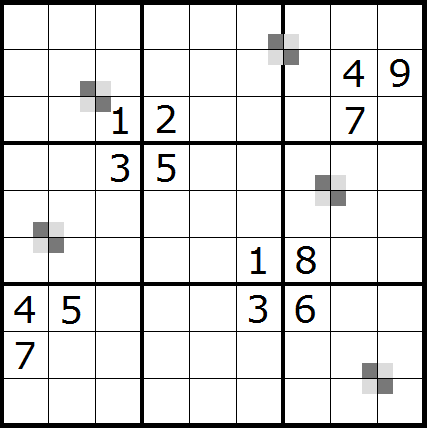
Another week, another Sudoku. This week a small twist on the Clone Sudoku genre. Normally the Clone Sudoku has the same digits in the same places for equal shapes. For this one the digits are consecutive in the same places instead. I think it makes the solve a bit trickier than normal. It definitely made the construction a bit more confusing. It took me a few tries to get a puzzles out with valid solutions, after which a few of those ended up not being unique because I had eliminated digits I shouldn't have.
I find designing Sudokus like these harder in general. I'm usually better with a more influential rule, which I can then exploit. That's why I generally prefer designing Sudokus that require no or only little givens in the grid. That's why in these types of Sudokus, I usually give it many tries, till I get a puzzle I'm happy with. I tend to be a bit picky about my puzzles and often rewrite and edit already nice puzzles, because a part of it doesn't come out the way I had planned to. So I change them to highlight it. In this one I had started with two extra cloned shapes, but then I thought it would be nicer to just have the same shapes for givens as Cloned areas. The second try ended up with one extra digit in the center. I liked it and it solved nicely. But still I really wanted that middle digit gone too, so I gave it another go. And eventually this was the result. This solves nicely and is in my opinion the nicest of the three. It shouldn't be too hard, but of course there's always the challenge of adapting to a new rule set. My Quad Second Sudoku had some people struggling to overcome not solving it as a Quad Max, so here people might get stuck looking at it as a regular Clone Sudoku. So try not to do that. Enjoy.
For anyone interested, you are still free to join the Daily League Group or you can request access to the Google Spreadsheet from Rishi Puri. You can also solve all puzzles the day after at SudokuCup.
Recap of the last week:
Sunday: Non-Consecutive Sudoku by Seungjae Kwak
Monday: Double Extra Regions Sudoku by Fred Stalder
Tuesday: Outside or Skyscraper Sudoku by Prasanna Seshadri
Wednesday: 2 Even 2 Odd Sudoku by Bastien Vial-Jaime
Thursday: Killer Sudoku by Rishi Puri
Friday: Palindrome Sudoku by Tom Collyer
Daily League PDF:
Week 13
Lastly, if anyone is interested in contributing for the Daily League, now is the perfect time. Many of our regular authors are busy with their National Championships and other obligations. So anyone interested in jumping in and writing a Sudoku for the Daily League, give it a try.
Rules for Sudoku
In this Sudoku, digits in the same place in both grey figures have to be consecutive.
Saturday, 20 April 2013
Saturday, 13 April 2013
Daily League Sudoku #12: Frameless Sudoku
This week again one of my own ideas for the Daily League. I have posted a few of these already on my blog. I came up with this type as a response to the repetetiveness of Frame Sudokus. I always enjoyed solving Frame Sudokus, but after a while they get a bit the same. This rule set adds to the diversity of the solve as you now have more ways of creating openings and keeping the solving path narrower.
This puzzle is easier than the other Frameless Sudokus I have made, to make it more suitable for speedsolving. The path is solving path is still narrow, but you get a few easy digits to start off with. I think the equal sums on the left and right side are a nice touch. I was planning on making two sequences at the top and bottom too. Except the 16 and 18 clues wouldn't work in order with the other clues, but did work switched. So I figured that would be good enough. This puzzle can also be used as practise for the upcoming Serbian Round of the WPF Sudoku Gran Prix held from April 20th-April22nd, which features a Frameless Sudoku.
Recap of the last week:
Sunday: Prime Number Sudoku by Seungjae Kwak
Monday: Untouch diagonal Sudoku by Fred Stalder
Tuesday: XV Sudoku by Prasanna Seshadri
Wednesday: Sudokurve by Bastien Vial-Jaime
Thursday: Non-Consecutive Sudoku by Rishi Puri
Friday: Classic Sudoku by Tom Collyer
Daily League PDF:
Week 12
Rules for Sudoku
The numbers on the outside indicate the sum of the first digits encountered in that row or column from that side. The amount of digits can differ from sum to sum and can be only one digit.
This puzzle is easier than the other Frameless Sudokus I have made, to make it more suitable for speedsolving. The path is solving path is still narrow, but you get a few easy digits to start off with. I think the equal sums on the left and right side are a nice touch. I was planning on making two sequences at the top and bottom too. Except the 16 and 18 clues wouldn't work in order with the other clues, but did work switched. So I figured that would be good enough. This puzzle can also be used as practise for the upcoming Serbian Round of the WPF Sudoku Gran Prix held from April 20th-April22nd, which features a Frameless Sudoku.
Recap of the last week:
Sunday: Prime Number Sudoku by Seungjae Kwak
Monday: Untouch diagonal Sudoku by Fred Stalder
Tuesday: XV Sudoku by Prasanna Seshadri
Wednesday: Sudokurve by Bastien Vial-Jaime
Thursday: Non-Consecutive Sudoku by Rishi Puri
Friday: Classic Sudoku by Tom Collyer
Daily League PDF:
Week 12
Rules for Sudoku
The numbers on the outside indicate the sum of the first digits encountered in that row or column from that side. The amount of digits can differ from sum to sum and can be only one digit.
Saturday, 6 April 2013
Daily League Sudoku #11: Windoku
This week a Windoku. It will probably be one of the easiest puzzles I have made for the league. I like Windoku puzzles. I always prefer the puzzles that don't have any clues in the 4 extra windows. I had actually written this puzzle a while back, but I haven't used or posted it anywhere. As I like how it looks and solves, I'm using it for the league. I hope you enjoy it too.
Recap of last week:
Sunday's Little Addition or Multiplication Killer Sudoku by Seungjae Kwak
Monday's Knightly Non-Consecutive Sudoku by Fred Stalder
Tuesday's Disjoint Groups Sudoku by Prasanna Seshadri
Wednesday's Extra Regions with Mirrored Cells Sudoku by Bastien Vial-Jaime
Thursday's Diagonally Non-Consecutive Sudoku by Rishi Puri
Friday's Classic Sudoku by Tom Collyer
Sudoku Pdf:
Week 11
Rules for Sudoku
In this Sudoku, you also have to place digits 1~9 once in every grey 3x3 square.
Recap of last week:
Sunday's Little Addition or Multiplication Killer Sudoku by Seungjae Kwak
Monday's Knightly Non-Consecutive Sudoku by Fred Stalder
Tuesday's Disjoint Groups Sudoku by Prasanna Seshadri
Wednesday's Extra Regions with Mirrored Cells Sudoku by Bastien Vial-Jaime
Thursday's Diagonally Non-Consecutive Sudoku by Rishi Puri
Friday's Classic Sudoku by Tom Collyer
Sudoku Pdf:
Week 11
Rules for Sudoku
In this Sudoku, you also have to place digits 1~9 once in every grey 3x3 square.
Saturday, 30 March 2013
Daily League Sudoku #10: Average Sudoku
Another week, another Sudoku. This week an Average Sudoku. I like the idea. It's similar to Arrow Sudoku, except the digit is the average instead of the sum of the digits. I think enough can be done with it. I'm not sure if this idea has been done before, but I can't imagine it hasn't been. But I have that idea with any Sudoku Variant I come up with as there are already so many out there. But people constantly come up with new variants.
This Sudoku shouldn't be too hard. It has, like most my variants, a pretty narrow opening. But I think it should be clear where it lies this time. If you understand the basics of this variant it should go pretty smoothly. There's no real difficult steps in this puzzle, but you just have to go through them in the right order. I'm hoping this will have a bit faster times than my previous ones though. But I'm never sure how they'll turn out.
A recap of the last week's Daily Sudokus: Sunday's Outside Sudoku by Seungjae Kwak, Monday's Sum or Product Frame Sudoku by Min Young Yoo, Tuesday's Consecutive Sudoku by Prasanna Seshadri, Wednesday's Irregular Sudoku by Bastien Vial-Jaime, Thursday's Palindrome Sudoku by Rishi Puri, Friday's Tens Sudoku by Tom Collyer.
Daily League PDF file:
Week 10
Rules for Sudoku
In this Sudoku a digit in a circle is the average of the digits in all cells connected to it with a line.
This Sudoku shouldn't be too hard. It has, like most my variants, a pretty narrow opening. But I think it should be clear where it lies this time. If you understand the basics of this variant it should go pretty smoothly. There's no real difficult steps in this puzzle, but you just have to go through them in the right order. I'm hoping this will have a bit faster times than my previous ones though. But I'm never sure how they'll turn out.
A recap of the last week's Daily Sudokus: Sunday's Outside Sudoku by Seungjae Kwak, Monday's Sum or Product Frame Sudoku by Min Young Yoo, Tuesday's Consecutive Sudoku by Prasanna Seshadri, Wednesday's Irregular Sudoku by Bastien Vial-Jaime, Thursday's Palindrome Sudoku by Rishi Puri, Friday's Tens Sudoku by Tom Collyer.
Daily League PDF file:
Week 10
Rules for Sudoku
In this Sudoku a digit in a circle is the average of the digits in all cells connected to it with a line.
![]() |
| Click to enlarge |
Saturday, 23 March 2013
Daily League Sudoku #9: Kid Sudoku
This week's Sudoku is a Kid Sudoku. When I first saw the idea, I just thought it was a funny idea. I don't remember where I first saw it though. I tried googling for other examples, but that proved to be unsuccesful. Apparently there are A LOT of websites with Sudokus for kids. I'm generally a fan of Sudokus with summed clues, so this was right up my alley for design. I wrote this puzzle in an hour long train ride back home. The opening was set up pretty quickly. I had an idea, it worked and as this type only clues in one direction, I knew I could always make the rest of the puzzle work. The center 99999 clue was something I wanted to keep in and in continuing the design it worked nicely with the clues. Finishing the puzzle took me a few tries so that there were no obvious new openings. I'm not sure how hard this puzzle is, but I suspect it to again be on the harder side. Hope everyone still enjoys it though.
A recap of the last Daily Week: Sunday's Rossini with Disjoint Groups Sudoku by Seungjae Kwak Monday's Irregular Sudoku by Fred Stalder, Tuesday's Weighted Killer by Prasanna Seshadri, Wednesday's Thermo Sudoku by Bastien Vial-Jaime, Thursday's Even/Odd Skayscraper Sudoku by Rishi Puri, Friday's Twodoku by Tom Collyer.
Pdf files of the last 2 weeks:
Week 8
Week 9
Rules for Sudoku
The clues on the outside are given by a kid that can't count past 9. He adds up all digits in each row from left to right. Every time the sum would go over 9 he restarts. So for example the clue for the row 154638279 would be 649899.
A recap of the last Daily Week: Sunday's Rossini with Disjoint Groups Sudoku by Seungjae Kwak Monday's Irregular Sudoku by Fred Stalder, Tuesday's Weighted Killer by Prasanna Seshadri, Wednesday's Thermo Sudoku by Bastien Vial-Jaime, Thursday's Even/Odd Skayscraper Sudoku by Rishi Puri, Friday's Twodoku by Tom Collyer.
Pdf files of the last 2 weeks:
Week 8
Week 9
Rules for Sudoku
The clues on the outside are given by a kid that can't count past 9. He adds up all digits in each row from left to right. Every time the sum would go over 9 he restarts. So for example the clue for the row 154638279 would be 649899.
![]() | |
| Click to enlarge |
Thursday, 21 March 2013
UK Puzzle Championship 2013
Today my puzzles for the UK puzzle championships. The UK Puzzle and Sudoku championships were held last weekend. Tom Collyer won the UK Sudoku championship and Neil Zussman won the UK Puzzle championship. My puzzles were the last individual round of the championship. It featured a relay, with 9 puzzles that have to be solved in order. Each puzzle solution would in some way transfer to the next, so that this puzzle would become solvable. I will be posting all puzzles and relay tags below, but to see how everything works, you can check the instruction booklet for this round here.
The original idea for this round came from the 2003 WPC in Arnhem. I have made a round like this before for another online competition. I used similar relays in that round as well. As that round wasn't done on time, I wasn't sure how many of these relays would work on time. Some relays are good without time, but things like copying the shapes of a Fillomino solution are very annoying in my mind for a speed contest.
The first puzzles I wrote were the Snake and Nurikabe puzzles, as I had used the Snake to Nurikabe relay before and liked it. I wrote a Snake puzzle with few clues, so that I could easily write a puzzle that had these clues inside the grid, which could then be transferred to the side. I then opted writing a Kakuro puzzle as the opening puzzle, as most solvers are familiar with that. With this the first 3 puzzles were all types that most people in the puzzling community have done multiple of. The next part of the design was getting from Nurikabe somehow back to number clues. I then found the combination Yin Yang/Hiroimono, which I thought was a nice transition, with a few less familiar puzzles. I did have to figure out how to properly write Hiroimono puzzles without any given clues as I had never done that before. From here I opted to write a Doppelblock puzzle. It was easiest to write this puzzle without any repeating clues as this would make the relay the smoothest. It was a bit hard to get it right, as some clues are just more conductive in this puzzle type. I was planning on writing a Minesweeper puzzle next, and figured I could easily relay it to any puzzle type. That's why I chose to write a Magnets next, which could transfer to a Battleships puzzle. I wrote a Magnets puzzle with missing clues, which I have written many of. I chose a smaller size as they are generally viewed as hard to many people. I had to make sure the remaining clues were under 20 as that's the max number of ship segments a standard Battleships puzzle has. It worked out perfectly and the Battleships construction was really easy to finish. When I went back, I couldn't get the Minesweeper in a way that the relay to it and from it was nice. That's why I tried a number of other puzzle types. Then I tried Country Road, which caused an odd design experience. I tried to write them normally, except I couldn't get it so it would transfer to the already written Magnets puzzle, so that's why I changed it around. I first marked a bunch of empty squares so that it would transfer properly to the Magnets puzzle, and then reversely engineered the regions so a solvable valid puzzle would exist which has those empty squares in those places. I think the result is nice and I doubt anyone would expect it was designed that way from the solve. I thought 9 puzzles would be enough, even though I had originally planned on making 10 puzzles. I just think some of the relays would take more time than others, so I thought this would make a long enough round for the championship.
The puzzles can be found below.
The original idea for this round came from the 2003 WPC in Arnhem. I have made a round like this before for another online competition. I used similar relays in that round as well. As that round wasn't done on time, I wasn't sure how many of these relays would work on time. Some relays are good without time, but things like copying the shapes of a Fillomino solution are very annoying in my mind for a speed contest.
The first puzzles I wrote were the Snake and Nurikabe puzzles, as I had used the Snake to Nurikabe relay before and liked it. I wrote a Snake puzzle with few clues, so that I could easily write a puzzle that had these clues inside the grid, which could then be transferred to the side. I then opted writing a Kakuro puzzle as the opening puzzle, as most solvers are familiar with that. With this the first 3 puzzles were all types that most people in the puzzling community have done multiple of. The next part of the design was getting from Nurikabe somehow back to number clues. I then found the combination Yin Yang/Hiroimono, which I thought was a nice transition, with a few less familiar puzzles. I did have to figure out how to properly write Hiroimono puzzles without any given clues as I had never done that before. From here I opted to write a Doppelblock puzzle. It was easiest to write this puzzle without any repeating clues as this would make the relay the smoothest. It was a bit hard to get it right, as some clues are just more conductive in this puzzle type. I was planning on writing a Minesweeper puzzle next, and figured I could easily relay it to any puzzle type. That's why I chose to write a Magnets next, which could transfer to a Battleships puzzle. I wrote a Magnets puzzle with missing clues, which I have written many of. I chose a smaller size as they are generally viewed as hard to many people. I had to make sure the remaining clues were under 20 as that's the max number of ship segments a standard Battleships puzzle has. It worked out perfectly and the Battleships construction was really easy to finish. When I went back, I couldn't get the Minesweeper in a way that the relay to it and from it was nice. That's why I tried a number of other puzzle types. Then I tried Country Road, which caused an odd design experience. I tried to write them normally, except I couldn't get it so it would transfer to the already written Magnets puzzle, so that's why I changed it around. I first marked a bunch of empty squares so that it would transfer properly to the Magnets puzzle, and then reversely engineered the regions so a solvable valid puzzle would exist which has those empty squares in those places. I think the result is nice and I doubt anyone would expect it was designed that way from the solve. I thought 9 puzzles would be enough, even though I had originally planned on making 10 puzzles. I just think some of the relays would take more time than others, so I thought this would make a long enough round for the championship.
The puzzles can be found below.
Tuesday, 19 March 2013
Polish Puzzle Championships 2013
This week is a week full of puzzles on my blog. That is because the last two weekends there were two championships to which I contributed puzzles. Today I will post all puzzles from the Polish Puzzle Championship and Thursday will feature my puzzles for the UK Puzzle Championship.
The Polish Sudoku and Puzzle Championships were held in the weekend of 9 and 10 of March. Jan Mrozowski became the Polish Sudoku Champion. Przemysław Dębiak won the Polish Puzzle Championship. The puzzles for the Polish Sudoku Championship can be found here; the puzzles for thePolish Puzzle Championship can be found here. My puzzles were round 5 of the Puzzle championship. I also found a video of the Polish Puzzle Championship on Serkan Yurekli's blog. In the beginning you can see puzzlers working on my puzzle set. The end is the finals.
For the Polish Championship I employed a copycat theme. The puzzles came in pairs and each pair of puzzles had a similarity in the layout. Most of these types are very closely related in the puzzle type. The only pair that really isn't very close to the other were the Star Battle and Heyawake. I was happy to see that the puzzles were printed on bordering pages in the puzzle booklet, so solvers might notice the similarity.
The idea somewhat accidentally happened. I had made an easy Akari puzzle and wanted to make a harder regional Akari and opted to make one with the same black squares. When I finished those I wondered if I could keep doing that and went with a Liar Loop/Maxi Loop combo as that seemed most easily acchieved. And I'm pretty comfortable designing those, so made two with the same regions. The next puzzles I made were the Capsules and Ripple Effect puzzles, I posted earlier which ended up testing too hard. I really like constructing Ripple Effect puzzles, but clearly not that skilled at making them competition difficulty. I looked through my Double Trouble collection and thought Turning Fences and Slitherlink should be easily made look similar. I chose the same clue positions and about half the clues are the same. I already had 4 Loop puzzles, so that was all of those I could put in. I made a Tapa and Nurikabe with the same clue positions. I at first tried to also make the Nurikabe clues to be the sum of the Tapa clues, but that didn't prove to be very fruitful. I then started doodling a bit and made a Small Regions Star Battle and wondered what type I could use these cages for. I eventually settled on Heyawake as that would allow me to add some clues and see where it goes. The regions were still very restrictive on the Heyawake genre, but managed to push it out with just 2013 as clues. Lastly I needed some Magic Square genres. I thought first about doing Skyscraper/Haido, but figured with multiple similar types, maybe I should try a more different type. So I made a Skyscraper puzzle, to which I added a number of clues to turn it into an Easy as Japanese Sums puzzle. I felt I was somewhat missing a division type puzzle, but I couldn't find a nice way to make 2 that fit into the theme. And when I had the puzzles tested it seemed like there was enough to fill the hour slot already.
I also wrote a LITS puzzle to be used for the finals, except that one wasn't used. It willbe posted at the end of this post.
Puzzles can be found below.
The Polish Sudoku and Puzzle Championships were held in the weekend of 9 and 10 of March. Jan Mrozowski became the Polish Sudoku Champion. Przemysław Dębiak won the Polish Puzzle Championship. The puzzles for the Polish Sudoku Championship can be found here; the puzzles for thePolish Puzzle Championship can be found here. My puzzles were round 5 of the Puzzle championship. I also found a video of the Polish Puzzle Championship on Serkan Yurekli's blog. In the beginning you can see puzzlers working on my puzzle set. The end is the finals.
For the Polish Championship I employed a copycat theme. The puzzles came in pairs and each pair of puzzles had a similarity in the layout. Most of these types are very closely related in the puzzle type. The only pair that really isn't very close to the other were the Star Battle and Heyawake. I was happy to see that the puzzles were printed on bordering pages in the puzzle booklet, so solvers might notice the similarity.
The idea somewhat accidentally happened. I had made an easy Akari puzzle and wanted to make a harder regional Akari and opted to make one with the same black squares. When I finished those I wondered if I could keep doing that and went with a Liar Loop/Maxi Loop combo as that seemed most easily acchieved. And I'm pretty comfortable designing those, so made two with the same regions. The next puzzles I made were the Capsules and Ripple Effect puzzles, I posted earlier which ended up testing too hard. I really like constructing Ripple Effect puzzles, but clearly not that skilled at making them competition difficulty. I looked through my Double Trouble collection and thought Turning Fences and Slitherlink should be easily made look similar. I chose the same clue positions and about half the clues are the same. I already had 4 Loop puzzles, so that was all of those I could put in. I made a Tapa and Nurikabe with the same clue positions. I at first tried to also make the Nurikabe clues to be the sum of the Tapa clues, but that didn't prove to be very fruitful. I then started doodling a bit and made a Small Regions Star Battle and wondered what type I could use these cages for. I eventually settled on Heyawake as that would allow me to add some clues and see where it goes. The regions were still very restrictive on the Heyawake genre, but managed to push it out with just 2013 as clues. Lastly I needed some Magic Square genres. I thought first about doing Skyscraper/Haido, but figured with multiple similar types, maybe I should try a more different type. So I made a Skyscraper puzzle, to which I added a number of clues to turn it into an Easy as Japanese Sums puzzle. I felt I was somewhat missing a division type puzzle, but I couldn't find a nice way to make 2 that fit into the theme. And when I had the puzzles tested it seemed like there was enough to fill the hour slot already.
I also wrote a LITS puzzle to be used for the finals, except that one wasn't used. It willbe posted at the end of this post.
Puzzles can be found below.
Saturday, 16 March 2013
Daily League Sudoku #8: Sum Sandwich Sudoku
Next week will be Richard Stolk's third LMI Sudoku test. The test is named V2V or Variations to Variations. It features 14 Sudoku puzzles, which consist of 7 Sudoku Variants and a variation of each. This week's Sudoku will be one of the V2V puzzle types.
I've chosen Sum Sandwich Sudoku as this week's puzzle type. I was debating between Rank Killer Sudoku and Sum Sandwich Sudoku, but I feel I generally design better Sudokus with outside clues. That's why I chose Sum Sandwich Sudoku. My first thought was to see if I could make one without any inside clues. But to set that up I was doing a lot of analysis of the interaction between clues, which I figure was making it a bit too hard. So I figured I'd probably better just make a more solvable Sudoku. So I set up the nice diagonal line of clues and started with the design. It still turned out a bit on the harder side, even though the all numbers are given did lead to a few unintended outside clues. But they don't ruin the opening, so I'm happy with the result. Enjoy.
It is now also possible to solve the Daily League puzzles on SudokuCup. The puzzles will appear there one day after they appear in the group and on the respective blogs.
A recap of the last week of the Daily League: Seungjae Kwak's Odd Sudoku, Fred Stalder's Diagonally Non-Consecutive Sudoku, Prasanna Seshadri's Galloping Horses Sudoku, Bastien Vial-Jaime's Figures Sudoku, Rishi Puri's Anti-Knight Sudoku and Tom Collyer's Diagonal Sudoku.
Rules for Sudoku
In this Sudoku for each row and column all digits are given that are sandwiched by two digits whose sum is equal to itself.
I've chosen Sum Sandwich Sudoku as this week's puzzle type. I was debating between Rank Killer Sudoku and Sum Sandwich Sudoku, but I feel I generally design better Sudokus with outside clues. That's why I chose Sum Sandwich Sudoku. My first thought was to see if I could make one without any inside clues. But to set that up I was doing a lot of analysis of the interaction between clues, which I figure was making it a bit too hard. So I figured I'd probably better just make a more solvable Sudoku. So I set up the nice diagonal line of clues and started with the design. It still turned out a bit on the harder side, even though the all numbers are given did lead to a few unintended outside clues. But they don't ruin the opening, so I'm happy with the result. Enjoy.
It is now also possible to solve the Daily League puzzles on SudokuCup. The puzzles will appear there one day after they appear in the group and on the respective blogs.
A recap of the last week of the Daily League: Seungjae Kwak's Odd Sudoku, Fred Stalder's Diagonally Non-Consecutive Sudoku, Prasanna Seshadri's Galloping Horses Sudoku, Bastien Vial-Jaime's Figures Sudoku, Rishi Puri's Anti-Knight Sudoku and Tom Collyer's Diagonal Sudoku.
Rules for Sudoku
In this Sudoku for each row and column all digits are given that are sandwiched by two digits whose sum is equal to itself.
![]() |
| Click to enlarge |
Saturday, 9 March 2013
Daily League Sudoku #7: Ten Box Sudoku
I know there haven't been many puzzles from me lately, but my puzzle creating has been directed at other projects. A number of Puzzle Championships are coming up to which I contributed and I'm also working on contributing to Thomas Snyder's puzzle project. This all means there will be that eventually I will be posting a lot of puzzles after this is all over.
I'm still finding some time to make a Sudoku each week as that is a welcome break from making puzzles. For me in general designing a Sudoku just feels a bit different than designing any other puzzle. Although my puzzle mind still drives itself through in my Sudoku sometimes. This leads to me putting some more puzzly deductions in a Sudoku that I find very simple. For last week's Sudoku this was oriented around R5C5. I thought the deduction for that cell was pretty obvious, except I think that deduction got a lot of people very stuck and led to much slower times than I had expected.
This week I made a Ten Box Sudoku, which is a nice variation of the Toroidal Sudoku. I remember this variant from the WSC 2010. I liked that puzzle. It was also in the round I did best in. I still have a certificate from that round, showing that I was the best puzzler not in the top 10 in that round. It's not that hard a puzzle, but the variant has some tricks that really suit me so I'm reserving judgement on the actual times of the league's competitors.
In the last week we've seen the following Sudokus: Seungjae Kwak's Magic Summer Sudoku, Fred Stalder's Arrow Sudoku, Prasanna Seshadri's Search 9 Sudoku, Bastien Vial-Jaime's Renban Groups Sudoku, Rishi Puri's Even Odd Chessdoku, Tom Collyer's Number 8 Still Alive Sudoku.
Lastly, the PDF of week 7.
Rules for Sudoku
This Sudoku is made up of 10 rows, 10 columns and 10 3x3 boxes. Some of the boxes wrap around the edges of the grid.
I'm still finding some time to make a Sudoku each week as that is a welcome break from making puzzles. For me in general designing a Sudoku just feels a bit different than designing any other puzzle. Although my puzzle mind still drives itself through in my Sudoku sometimes. This leads to me putting some more puzzly deductions in a Sudoku that I find very simple. For last week's Sudoku this was oriented around R5C5. I thought the deduction for that cell was pretty obvious, except I think that deduction got a lot of people very stuck and led to much slower times than I had expected.
This week I made a Ten Box Sudoku, which is a nice variation of the Toroidal Sudoku. I remember this variant from the WSC 2010. I liked that puzzle. It was also in the round I did best in. I still have a certificate from that round, showing that I was the best puzzler not in the top 10 in that round. It's not that hard a puzzle, but the variant has some tricks that really suit me so I'm reserving judgement on the actual times of the league's competitors.
Lastly, the PDF of week 7.
Rules for Sudoku
This Sudoku is made up of 10 rows, 10 columns and 10 3x3 boxes. Some of the boxes wrap around the edges of the grid.
![]() |
| Click to enlarge |
Saturday, 2 March 2013
Daily League Sudoku #6: Quad Second Sudoku
First off, yesterday the Puzzle Marathon on Logicmasters India started. It is a puzzle test which features 12 large puzzles by 12different authors. The contest will run from March 1st-March 10th. You can solve each puzzle seperately over the course of the week. This test features a Maxi Loop puzzle by me. Everyone should try to compete as there will definitely be some very nice puzzles. Even if you can only manage to solve a few of the puzzles, it should be worth the time.
Now back to this week's Daily League Sudoku. The last week has featured a nice Multiplication Table Sudoku by Seungjae Kwak, an easy Killer Pair Sudoku by Fred Stalder, a challenging but fun Point to the Next Sudoku by Prasanna Seshadri, a very hard Greater than Killer by Bastien Vial-Jaime, a Non-Consecutive Anti-Knight Sudoku by Rishi Puri and a Classic Sudoku by Tom Collyer.
This time I've made a Quad Second Sudoku, which is a twist on the Quad Max Sudoku. As far as I know it's an original variant. I think it changes the solve of a Quad Max enough to make for a fun new variant. For me personally this is my favourite puzzle I have made for the League so far. I think I got the right difficulty with this puzzle compared to some of my earlier puzzles. Hope enjoy it.
Lastly, here are the link to the PDF of Week 6.
Rules for Sudoku
In this Sudoku an arrow points at the second highest digit in the four cells around it. Digits may repeat around an arrow, but the second highest digit is always unique.
Now back to this week's Daily League Sudoku. The last week has featured a nice Multiplication Table Sudoku by Seungjae Kwak, an easy Killer Pair Sudoku by Fred Stalder, a challenging but fun Point to the Next Sudoku by Prasanna Seshadri, a very hard Greater than Killer by Bastien Vial-Jaime, a Non-Consecutive Anti-Knight Sudoku by Rishi Puri and a Classic Sudoku by Tom Collyer.
This time I've made a Quad Second Sudoku, which is a twist on the Quad Max Sudoku. As far as I know it's an original variant. I think it changes the solve of a Quad Max enough to make for a fun new variant. For me personally this is my favourite puzzle I have made for the League so far. I think I got the right difficulty with this puzzle compared to some of my earlier puzzles. Hope enjoy it.
Lastly, here are the link to the PDF of Week 6.
Rules for Sudoku
In this Sudoku an arrow points at the second highest digit in the four cells around it. Digits may repeat around an arrow, but the second highest digit is always unique.
![]() |
| Click to enlarge |
Saturday, 23 February 2013
Daily League Sudoku #5: Scattered Sudoku
This is my fifth Sudoku for the Daily Sudoku League. The last week so far has featured a Counting on Line Sudoku by Seungjae Kwak, an Equal Sudoku by Christoph Seeliger, a Between 1and 9 Sudoku by Prasanna Seshadri, a Fortress Sudoku by Bastien Vial-Jaime, a Little Killer by Rishi Puri and an Odd Sudoku by Tom Collyer.
This week I've gone for a simpler and more familiar variant. Scattered Sudoku is just a Jigsaw Sudoku with one non-contiguous region. The puzzle has only 17 clues, which is what I like about Jigsaw Sudokus. I like to get the amount of clues down to 20 or less, which is something I wouldn't get done in Classic Sudokus. The solve gets a bit trickier towards the end, but nothing overly difficult. It's in my opinion easier than the last two Sudokus I have posted. Hope you all enjoy them
Lastly, here is the latest PDF-file.
Week 5
Rules for Sudoku
This Sudoku has one non-contiguous 9 cell region, marked by the grey cells.
This week I've gone for a simpler and more familiar variant. Scattered Sudoku is just a Jigsaw Sudoku with one non-contiguous region. The puzzle has only 17 clues, which is what I like about Jigsaw Sudokus. I like to get the amount of clues down to 20 or less, which is something I wouldn't get done in Classic Sudokus. The solve gets a bit trickier towards the end, but nothing overly difficult. It's in my opinion easier than the last two Sudokus I have posted. Hope you all enjoy them
Lastly, here is the latest PDF-file.
Week 5
Rules for Sudoku
This Sudoku has one non-contiguous 9 cell region, marked by the grey cells.
Thursday, 21 February 2013
Puzzle #159: Capsules
This is a simple puzzle idea that can leave for really tricky puzzles. Most puzzles use similar techniques, except the way you employ them can make a puzzle far trickier. The grid size is a bit limited as the total number of cells has to be divisable by 5. But you can easily change certain sizes in nice ways to valid size. Leave out the center cell in a 9x9 grid, or the four corner squares in a 7x7 or 8x8 grid.
The last puzzle I post here was meant for a puzzle championship, but tested too hard, just like Tuesday's Ripple Effect puzzle. As this would be the first one I posted here, I added two extra smaller puzzles just to prepare people for the harder logic in the last puzzle. Both these smaller puzzles use a key part of the solving logic for the larger puzzle. Hopefully they help and you will enjoy all puzzles.
Rules for Capsules
The last puzzle I post here was meant for a puzzle championship, but tested too hard, just like Tuesday's Ripple Effect puzzle. As this would be the first one I posted here, I added two extra smaller puzzles just to prepare people for the harder logic in the last puzzle. Both these smaller puzzles use a key part of the solving logic for the larger puzzle. Hopefully they help and you will enjoy all puzzles.
Rules for Capsules
Puzzle #1
Puzzle #2
Puzzle #3
Rules: Capsules
Place the digits 1~5 once in every blackbordered region. No two equal digits can touch eachother, not even diagonally.
Tuesday, 19 February 2013
Puzzle #158: Ripple Effect
This is a puzzle originally intended for a puzzle competition, but testing came up with too high times so I'm posting it here now. I know it's different from my normal clueless ones, but there's a reason they were there. You might be able to figure out why later in the week. I think it still solves really nicely and has its tricky spots. A lot of the solve is very similar to my previous puzzles andthere is still a very directed path to the puzzle. I think I will always have trouble writing Ripple Effect puzzles that are more suitable for competition as there is a lot of fun logic to exploit, which is pretty tricky. I could of course put in far more smaller cages, except that is really not very fun to write for me. Anyways, enjoy the puzzle.
Rules for Ripple Effect
Labels:
Nikoli,
Puzzle,
Ripple Effect
Saturday, 16 February 2013
Daily League Sudoku #4: V-Day Sudoku
This week was Valentine's Day, which has influenced a lot of puzzles this week.
My Sudoku is inspired by the abbreviation for Valentine's Day, which seems to be used more often these days, namely V-Day. That's why my Sudoku is themed around the number 5 or V in Roman numerals. It's basically a simple variation of XV Sudoku, except I changed the X pairing of a sum of 10 to a pairing of a difference of 5. The only real difference in the solve is that you don't know whether a mark is a sum of 5 or a difference of 5. As a further theme, the givens spell out the date of Valentine's day: 14-2. For Americans who feel the date is written wrong, you could rotate the grid 180 degrees and spell out 2-14 in the same squares that are filled now and still solve it in the same way. The switching of the places for 1 and 4 doesn't matter and keeps the puzzle unique, but the solution does change a bit.
The puzzle is moderately difficult. Not too difficult, but you have to remember well that all hearts are given.
Rules for Sudoku
Everywhere two adjacent digits have a sum or a difference of 5 a heart is given.
My Sudoku is inspired by the abbreviation for Valentine's Day, which seems to be used more often these days, namely V-Day. That's why my Sudoku is themed around the number 5 or V in Roman numerals. It's basically a simple variation of XV Sudoku, except I changed the X pairing of a sum of 10 to a pairing of a difference of 5. The only real difference in the solve is that you don't know whether a mark is a sum of 5 or a difference of 5. As a further theme, the givens spell out the date of Valentine's day: 14-2. For Americans who feel the date is written wrong, you could rotate the grid 180 degrees and spell out 2-14 in the same squares that are filled now and still solve it in the same way. The switching of the places for 1 and 4 doesn't matter and keeps the puzzle unique, but the solution does change a bit.
The puzzle is moderately difficult. Not too difficult, but you have to remember well that all hearts are given.
Rules for Sudoku
Everywhere two adjacent digits have a sum or a difference of 5 a heart is given.
Thursday, 14 February 2013
Puzzle #157: Tapa Special
As I've mentioned before, each year I make a special puzzle for my girlfriend for our anniversary. Earlier examples include my Quattro Stagione and LITS Cube puzzles. This year I went for a big Tapa puzzle. It's her favourite puzzle type, so I thought I'd have a go at it. It was an ambitious project that didn't go without its problems. The first draft ended up having about 8 errors in various places. I eventually removed all but one when I had it tested, which brought about one last bad deduction on my part, which I had missed. Eventually I got it fixed and this is the result. My girlfriend is currently still working on it, but she gave permission to share it with you today.
I've made it available as a PDF through Google docs. This is because I'd advice printing it and I scaled it down in the pdf so it prints easily. It also includes all rules and the layout, to make the solving easier. It's a challenging puzzle and I think it helps being able to visualise the whole puzzle.
Below will be the same information as in the PDF, for anyone preferring to solve it on the computer. This includes a full size image. If there are any questions about the rules, please feel free to ask.
I've made it available as a PDF through Google docs. This is because I'd advice printing it and I scaled it down in the pdf so it prints easily. It also includes all rules and the layout, to make the solving easier. It's a challenging puzzle and I think it helps being able to visualise the whole puzzle.
Below will be the same information as in the PDF, for anyone preferring to solve it on the computer. This includes a full size image. If there are any questions about the rules, please feel free to ask.
Tuesday, 12 February 2013
Polish Online Qualifiers: Magnets and Yajilin
The Polish online qualifiers were held December last year. You can find the puzzles and sudokus here: Puzzle Set 1, Puzzle Set 2, Sudoku Set 1, Combination Set. I'm not sure on the details what each set was used for as I can't read Polish. I contributed 2 puzzles, which can be found in the first Puzzle Set. They are a Yajilin and a Magnets puzzle. I tried to make them easy, but I was told after the testing that the Magnets puzzle still wasn't very easy. I seem to not able to write easy Magnets puzzles. I'm guessing some of the deductions just come standard to me but they don't come standard to others. They're both still nice puzzles, so hope you enjoy them too.
Rules for Yajilin
Rules for Magnets
Rules for Yajilin
Rules for Magnets
Saturday, 9 February 2013
Daily League Sudoku #3: Battenburg Sudoku
Last week I didn't provide a puzzle as Stefan Heine had a puzzle ready, so I gave up my Saturday spot. This week there is another Sudoku by me. This is a Battenburg Sudoku, which is a Sudoku type I came up with. The name comes from the Battenburg markings, although it stays more in my mind for Battenberg cake, which is a checkerboard pattern. In this puzzle everywhere 2 odd and 2 even digits form a checkerboard pattern, a mark is given. The opening of the puzzle I have in mind is a bit puzzly and might trick up some Sudoku-solvers. That's why I have made a second puzzle that should help you realise part of the logic involved in the opening, which is posted here. I hope you enjoy it, it was fun to make at least.
Lastly I'll provide three links for the puzzle files of the last three weeks.
Week 2
Week 3
Week 4
Rules for Sudoku
In this Sudoku, everywhere 2 odd and 2 even digits form a 2x2 checkerboard pattern, a Battenburg marking is given.
Lastly I'll provide three links for the puzzle files of the last three weeks.
Week 2
Week 3
Week 4
Rules for Sudoku
In this Sudoku, everywhere 2 odd and 2 even digits form a 2x2 checkerboard pattern, a Battenburg marking is given.
![]() |
| Click to enlarge |
Friday, 8 February 2013
Puzzle #156: Battenburg
This puzzle is as preperation for my next Daily League Sudoku. I was a bit afraid part of the logic might trick up some people, so I figured I'd make something nice to practise it with. I think the puzzle turned out really nicely, with the asymmetric clues. It should be fun to solve, even though the logic might be a bit repetitive.
Rules for Battenburg
Place 5 black circles and 4 white circles in every row, column and marked 3x3 area. Everywhere 2 black and 2 white circles form a 2x2 checkerboard pattern a Battenburg marking is given. Some circles are already placed.
Rules for Battenburg
Place 5 black circles and 4 white circles in every row, column and marked 3x3 area. Everywhere 2 black and 2 white circles form a 2x2 checkerboard pattern a Battenburg marking is given. Some circles are already placed.
Labels:
Puzzle
Saturday, 26 January 2013
Daily League Sudoku #2: No Ten Sudoku
This is my second contribution to the Daily Sudoku League. This week so far featured a Killer Sudoku by Fred, a Queen Sudoku by Prasanna, a Diagonal Sudoku by Bastien, a Non-Consecutive Jigsaw Sudoku by Rishi and a Jigsaw Sudoku by Tom.
My puzzle will be a No Ten Sudoku. It is similar to Non-Consecutive and XV Sudoku, where no two neighbouring cells add to 10. It's a bit of a troubling type to design by hand as it's hard to judge in advance if you can still create a valid solution from this point on. This is also the reason it's almost impossible to design a Nonconsecutive Sudoku by hand. Usually they are designed with the help of a computer program, to make sure your currently set up Sudoku still has a valid solution. Too bad I didn't have a program to verify a solution for this variant. Although I usually design my puzzle progressively, I did create a valid solution first for this puzzle and then worked out how to turn that solution into a unique and logically solvable puzzle.
A little bit more on the league. We're using this Google Doc to keep track of the solving times. You can request access to it, even if you're not on facebook. You can add your name to the excel sheet and post your own times here for each puzzle. You can still add your times till a week after the end of a week to be considered for the Hall of Fame.
At the end of a puzzle week, Tom will create a Pdf with all puzzles of the week. This Pdf will contain the puzzles, the best solving time and an estimated time for intermediate and novice solvers. The Pdf of Week 1 is available in the Facebook group or as a Google Doc. The Pdf for week 2 is currently only available in the facebook group.
In case you're interested in creating a puzzle for the Daily League, feel free to let us know in the facebook group. More constructors are always welcome.
Rules for Sudoku
In this Sudoku no two adjacent digits may add to 10.
My puzzle will be a No Ten Sudoku. It is similar to Non-Consecutive and XV Sudoku, where no two neighbouring cells add to 10. It's a bit of a troubling type to design by hand as it's hard to judge in advance if you can still create a valid solution from this point on. This is also the reason it's almost impossible to design a Nonconsecutive Sudoku by hand. Usually they are designed with the help of a computer program, to make sure your currently set up Sudoku still has a valid solution. Too bad I didn't have a program to verify a solution for this variant. Although I usually design my puzzle progressively, I did create a valid solution first for this puzzle and then worked out how to turn that solution into a unique and logically solvable puzzle.
A little bit more on the league. We're using this Google Doc to keep track of the solving times. You can request access to it, even if you're not on facebook. You can add your name to the excel sheet and post your own times here for each puzzle. You can still add your times till a week after the end of a week to be considered for the Hall of Fame.
At the end of a puzzle week, Tom will create a Pdf with all puzzles of the week. This Pdf will contain the puzzles, the best solving time and an estimated time for intermediate and novice solvers. The Pdf of Week 1 is available in the Facebook group or as a Google Doc. The Pdf for week 2 is currently only available in the facebook group.
In case you're interested in creating a puzzle for the Daily League, feel free to let us know in the facebook group. More constructors are always welcome.
Rules for Sudoku
In this Sudoku no two adjacent digits may add to 10.
![]() |
| Click to enlarge |
Saturday, 19 January 2013
Daily League Sudoku #1: Distance Sudoku
This puzzle is part of the Daily Sudoku League. It's league for Sudoku solvers to test their skills against eachother on handmade Sudokus. It features puzzles by Rishi Puri, Tom Collyer, Fred Stalder, Prasanna Seshadri, Bastien Vial-Jaime and Seungjae Kwak. I will also be contributing puzzles to the league. Each day a Sudoku will be posted in the group and on the blogs of the respective author. At the end of the week a PDF will be released with all Sudokus of that week. The league is free to enter for anyone by joining the facebook group. So if you feel like testing your solving skills against others, please join.
For my first puzzle in the league, I have chosen a Distance Sudoku. It's a type I always like to solve. I have never made one before. I would rate it hard, as I would rate most my Sudoku variants. The little bit of aestetic in the puzzle can be found in the fact that the digits are built up of 4 sets of 1~9. I think it worked out well and gives for a challenging solve. I'm hoping it's not too hard for the general level aimed at for the Daily League, but I will find out after the first people have solved it. It should be fun to solve either way.
[Edit: I adjusted the image to conform with previous puzzles]
Rules for Sudoku
Outside each row and column the distance between two digits in that row or column is given. The order of the digits is top to bottom and left to right.
For my first puzzle in the league, I have chosen a Distance Sudoku. It's a type I always like to solve. I have never made one before. I would rate it hard, as I would rate most my Sudoku variants. The little bit of aestetic in the puzzle can be found in the fact that the digits are built up of 4 sets of 1~9. I think it worked out well and gives for a challenging solve. I'm hoping it's not too hard for the general level aimed at for the Daily League, but I will find out after the first people have solved it. It should be fun to solve either way.
[Edit: I adjusted the image to conform with previous puzzles]
Rules for Sudoku
Outside each row and column the distance between two digits in that row or column is given. The order of the digits is top to bottom and left to right.
![]() |
| Click to enlarge |
Labels:
Daily League,
Puzzle,
Sudoku
Friday, 4 January 2013
Puzzle #155: Yajilin
This puzzle has an opening that I like. It's probably been used before by others as it fits very well in a standard grid size. I tried to keep it symmetric, but after working through a big part of the puzzle it wouldn't get unique symmetrically without sacrificing some of the previous logic. As I liked everything I had put in till that point, I went looking for a fun way to finish it. I think I acchieved what I wanted in the end. Hope you enjoy it too.
Rules for Yajilin
Rules for Yajilin
![]() |
| Click to enlarge |
Tuesday, 1 January 2013
Puzzle #154: Turning Fences
Here's a 2013 inpired Turning Fences puzzle. You can find 2013 8 times in the grid. It's probably the easiest Turning Fences on this blog so far, so it's probably good practise for people new to this genre. When I had put all numbers in, it sadly turned out to have 8 solutions, but I really liked the way it looked. So I fixed it with a few crosses, just to make it unique. They don't change the solve in the slightest, so it seemed like an acceptable compromise. Enjoy.
Rules for Turning Fences
The loop can't go through crosses.
Rules for Turning Fences
The loop can't go through crosses.
Puzzle #153: Shakashaka
Happy New Years to most of Europe and Africa. Gelukkig nieuwjaar voor alle Nederlanders.
Again this is the last post in the countdown. So here's a future new year's wish for people on a later time zone.
Happy New Years to the UK, USA and Canada when the time comes.
As last year, 0 was a tough option to do something with. As I didn't want to have repeat genres, I didn't want to choose Heyawake, which I thought would be the easiest option. Eventually I tried Shakashaka, as a 0 actually gives a lot of information in this genre.
The puzzle is pretty easy, just like last year's Akari. It's a good way to lead in the New Year.
0 - Shakashaka
Rules for Shakashaka
Again this is the last post in the countdown. So here's a future new year's wish for people on a later time zone.
Happy New Years to the UK, USA and Canada when the time comes.
As last year, 0 was a tough option to do something with. As I didn't want to have repeat genres, I didn't want to choose Heyawake, which I thought would be the easiest option. Eventually I tried Shakashaka, as a 0 actually gives a lot of information in this genre.
The puzzle is pretty easy, just like last year's Akari. It's a good way to lead in the New Year.
0 - Shakashaka
Rules for Shakashaka
Monday, 31 December 2012
Puzzle #152: International Borders
Happy New Years India
As you might have noticed, this set contains far more new genres than my first set. I just wanted to avoid repeats of previous genres as much as possible. So I went on a long look through websites, looking for genres that might work with some of the numbers. From Palmer Mebane comes the puzzle type International Borders. During his LMI test, Puzzle Zoo, was the first time I came across it. I solved both of these puzzles during competition. I was hoping this genre would lend itself for a single digit puzzle, as it was different from most puzzle types. I first tried the number 0, but didn't like anything that came out of it, so I changed to the number 1. I found a simple opening and some interesting steps with only using 1's. I had to give in a bit to get it unique though. This isn't the best puzzle in the set, but I think it's still enjoyable. I might try this another time with more numbers, because it was pretty fun to try and design one of these.
It's probably and easy/medium puzzle. It might just take a while to get used to the genre.
1 - International Borders
Colour some squares without circles black, so that the grid is split into 2 seperate orthogonally connected areas. Circles of the same colour should be part of the same area, different colours should belong to different areas. Grey circles can be part of either area. Numbers in the grid indicate how many of the four orthogonally adjacent cells have to be coloured black. All black cells should share a border with both areas.
As you might have noticed, this set contains far more new genres than my first set. I just wanted to avoid repeats of previous genres as much as possible. So I went on a long look through websites, looking for genres that might work with some of the numbers. From Palmer Mebane comes the puzzle type International Borders. During his LMI test, Puzzle Zoo, was the first time I came across it. I solved both of these puzzles during competition. I was hoping this genre would lend itself for a single digit puzzle, as it was different from most puzzle types. I first tried the number 0, but didn't like anything that came out of it, so I changed to the number 1. I found a simple opening and some interesting steps with only using 1's. I had to give in a bit to get it unique though. This isn't the best puzzle in the set, but I think it's still enjoyable. I might try this another time with more numbers, because it was pretty fun to try and design one of these.
It's probably and easy/medium puzzle. It might just take a while to get used to the genre.
1 - International Borders
Colour some squares without circles black, so that the grid is split into 2 seperate orthogonally connected areas. Circles of the same colour should be part of the same area, different colours should belong to different areas. Grey circles can be part of either area. Numbers in the grid indicate how many of the four orthogonally adjacent cells have to be coloured black. All black cells should share a border with both areas.
Puzzle #151: Sandwich
Happy New Years Indonesia and China
I went on the hunt for some puzzle genres I had never done for this set. One of the places this regularly leads me is of course Naoki Inaba's site. There seem to have been a few changes to his site. You can now copy all Japanese characters and some of the puzzle types have English translations added to it from the Naoki-Projekt on Logic Masters Deutschland. When I saw this type, I figured it could be a good genre to use the number 2 on. It took a while to get it unique. The opening is a bit standard, but in the end it gets a bit trickier, but there was no better way to force it unique. The name of the genre comes from google translate. It translated the puzzle name as "Santoitchi" but suggested I might mean the Japanese for Sandwich. It might have an alternative meaning but I got persuaded to just name it Sandwich. I have no real clue why it would called this though and I guess I could just stick with Santoitchi, as many Japanese puzzle types keep their original Japanese name.
The puzzle is medium/hard difficulty. There's a logic path to the end, but for a new genre it might be a bit trickier. It might help to try some of Naoki's at first.
2 - Sandwich
Colour some cells black, so that the remaining area can be split up into triminoes. No two black cells can share an edge. Each trimino must contain a number. A number indicates how many black cells share an edge with that trimino.
I went on the hunt for some puzzle genres I had never done for this set. One of the places this regularly leads me is of course Naoki Inaba's site. There seem to have been a few changes to his site. You can now copy all Japanese characters and some of the puzzle types have English translations added to it from the Naoki-Projekt on Logic Masters Deutschland. When I saw this type, I figured it could be a good genre to use the number 2 on. It took a while to get it unique. The opening is a bit standard, but in the end it gets a bit trickier, but there was no better way to force it unique. The name of the genre comes from google translate. It translated the puzzle name as "Santoitchi" but suggested I might mean the Japanese for Sandwich. It might have an alternative meaning but I got persuaded to just name it Sandwich. I have no real clue why it would called this though and I guess I could just stick with Santoitchi, as many Japanese puzzle types keep their original Japanese name.
The puzzle is medium/hard difficulty. There's a logic path to the end, but for a new genre it might be a bit trickier. It might help to try some of Naoki's at first.
2 - Sandwich
Colour some cells black, so that the remaining area can be split up into triminoes. No two black cells can share an edge. Each trimino must contain a number. A number indicates how many black cells share an edge with that trimino.
Puzzle #150: Lighthouses
Happy New Years Japan, South Korea and the rest of Australia
I tried a whole bunch of puzzle variants for the number 3. Slitherlink, Corral, Tren and Minesweeper were a few of the puzzle types. As I already had enough Loop Puzzles and not really any placement puzzles, I tried to find a genre that might work. Lighthouses was one of these puzzle types. The puzzle isn't very special, but I think it turned out okay.
This is an easy puzzle, probably the easiest in the set. Shouldn't take people too much time.
3 - Lighthouses
Place a number of 1 cell ships in the grid, so that no two ships touch eachother, not even diagonally. There are a few lighthouses in the grid. The lighthouses can see horizontallyand vertically. The numbers indicate how many ships can be seen in all four directions. No ships can touch the lighthouses, not even diagonally. Squares with water can't contain any ships.
I tried a whole bunch of puzzle variants for the number 3. Slitherlink, Corral, Tren and Minesweeper were a few of the puzzle types. As I already had enough Loop Puzzles and not really any placement puzzles, I tried to find a genre that might work. Lighthouses was one of these puzzle types. The puzzle isn't very special, but I think it turned out okay.
This is an easy puzzle, probably the easiest in the set. Shouldn't take people too much time.
3 - Lighthouses
Place a number of 1 cell ships in the grid, so that no two ships touch eachother, not even diagonally. There are a few lighthouses in the grid. The lighthouses can see horizontallyand vertically. The numbers indicate how many ships can be seen in all four directions. No ships can touch the lighthouses, not even diagonally. Squares with water can't contain any ships.
Puzzle #149: Bosnian Road
Happy New Years Australia.
This is one of the new types to my blog in this set. I hadn't made any of these puzzles before this one. Again my first choice of digit worked out. I had seen Prasanna Seshadri make some good use of the number 4 in one of his puzzles, so figured this number might work. Took a while to get it right though as the number didn't let itself be unique that easily. It's the number which has the most possible configurations in this genre. It took a while to get the end right, but I thought the opening was really solid, so I wasn't going to give up on the opening and eventually i found a nice way to get it unique.
It's easy/medium difficulty. The opening is fairly standard, but it has a few trickier steps in the middle. Just for the fun of it, count the length of the loop in the end. It's purely coincidental, but I thought it was funny none-the-less.
4 - Bosnian Road
Draw a single closed one-cell wide loop, that doesn't touch itself, not even diagonally. The loop doesn't go through clue cells. The clues indicate how many of the 8 cells around it are used by the loop
This is one of the new types to my blog in this set. I hadn't made any of these puzzles before this one. Again my first choice of digit worked out. I had seen Prasanna Seshadri make some good use of the number 4 in one of his puzzles, so figured this number might work. Took a while to get it right though as the number didn't let itself be unique that easily. It's the number which has the most possible configurations in this genre. It took a while to get the end right, but I thought the opening was really solid, so I wasn't going to give up on the opening and eventually i found a nice way to get it unique.
It's easy/medium difficulty. The opening is fairly standard, but it has a few trickier steps in the middle. Just for the fun of it, count the length of the loop in the end. It's purely coincidental, but I thought it was funny none-the-less.
4 - Bosnian Road
Draw a single closed one-cell wide loop, that doesn't touch itself, not even diagonally. The loop doesn't go through clue cells. The clues indicate how many of the 8 cells around it are used by the loop
Puzzle #148: Tapa; Make Room for Pentapa
Happy New Years Samoa and New Zealand.
The number 5 again had to be a pentomino puzzle for me. Last year's comined it with Nurikabe, where this puzzle combines it with Tapa. Other variants like Pentapa and Tapa Pentapool didn't really lend itself well for all 5 clues, but the added region constraint for Pentapa made it easier. I think it worked out well in the end and fits in well with the 5 theme this way.
This puzzle is again medium/hard. There's 2 important steps in the design, although the genre is pretty restrictive, so there might be other ways to the solution.
Rules for Tapa
Follow normal Tapa rules. Additionally, the Tapa wall is made up of 11 of the 12 pentominos (as the P-pentomino breaks a Tapa rule). Each blackbordered region contains exactly one pentomino.
The number 5 again had to be a pentomino puzzle for me. Last year's comined it with Nurikabe, where this puzzle combines it with Tapa. Other variants like Pentapa and Tapa Pentapool didn't really lend itself well for all 5 clues, but the added region constraint for Pentapa made it easier. I think it worked out well in the end and fits in well with the 5 theme this way.
This puzzle is again medium/hard. There's 2 important steps in the design, although the genre is pretty restrictive, so there might be other ways to the solution.
Rules for Tapa
Follow normal Tapa rules. Additionally, the Tapa wall is made up of 11 of the 12 pentominos (as the P-pentomino breaks a Tapa rule). Each blackbordered region contains exactly one pentomino.
Puzzle #147: All Seeing Snake
This puzzle came about after the For-Smarts Anniversary contest on LMI, where it was one of the puzzle types. I figured the rules had enough constraints to make a unique digit puzzle possible. As I needed a few puzzles with higher digits, I opted to try a puzzle with all 6 digits, as any higher would probably be too difficult. Played a bit with the grid sizes to see what would work best. Eventually this puzzle popped out. When I noticed it would have to be a 67 cell snake to make it unique, I opted to add an empty cell marked with an X, so the length would be 66 cells, as I thought that would fit in nicely with the 6 theme of the puzzle.
The puzzle is of medium/hard difficulty. Make sure to remember to make the Snake the right length.
6 - All Seeing Snake
Draw in the grid a snake of 66 cells. The body of the snake cannot touch itself, not even
diagonally. Numbers indicate how many segments of the snake are “seen” from this cell, not
counting the cell itself. Snake always makes a turn in the cells with numbers. The head and
the tail are not given and are subjects to determine. Cells with X remain empty.
The puzzle is of medium/hard difficulty. Make sure to remember to make the Snake the right length.
6 - All Seeing Snake
Draw in the grid a snake of 66 cells. The body of the snake cannot touch itself, not even
diagonally. Numbers indicate how many segments of the snake are “seen” from this cell, not
counting the cell itself. Snake always makes a turn in the cells with numbers. The head and
the tail are not given and are subjects to determine. Cells with X remain empty.
Puzzle #146: Maxi Loop
This is one of my favourite puzzles in the set. I hadn't before made any Maxi Loop puzzles with larger cages, but I figured it was worth a shot. I chose 7 cells in 10 cell cages for my first try. I thought this would be the highest percentage of cells to be part of the clue to keep the puzzles interesting. If this wouldn't work out I always had the option to go 6 out of 10 or 7 out of 11. But tmy first try with this worked out really nicely. the solve is logical, but still challenging and I managed to get all cages to a 7.
I think this puzzle is a medium/hard difficulty, so it will probably take a bit more effort to solve. As always with a bit more unfamiliar genre, people might have some more trouble.
7 - Maxi Loop
Rules for Maxi Loop
I think this puzzle is a medium/hard difficulty, so it will probably take a bit more effort to solve. As always with a bit more unfamiliar genre, people might have some more trouble.
7 - Maxi Loop
Rules for Maxi Loop
Puzzle #145: Regional Yajilin
The higher numbers are always a bit trickier to find genres for. Last year's Island puzzle was a rare spark of genius as a choice, in my opinion. This year it's a Regional Yajilin. I spend a while looking for a good opening for this genre with the number 8. A few options didn't really lead to any good puzzles, but I think this one really worked very well.
I'm really happy with how it turned out. It's probably a bit challenging, because people aren't as used to how the black squares can be placed in this genre.
8 - Regional Yajilin
Rules for Regional Yajilin
I'm really happy with how it turned out. It's probably a bit challenging, because people aren't as used to how the black squares can be placed in this genre.
8 - Regional Yajilin
Rules for Regional Yajilin
![]() |
| Click to enlarge |
Puzzle #144: Thermo Sudoku
The 9 was one of the tougher numbers to get a good genre for. I experimented with a few other genres, but many didn't work out. Some others worked better with other numbers, and I used those instead. Eventually I settled on a Sudoku as that seemed to work well with the number 7 last year. I used two 9 clues and part of the thermometers together form two 9's, so I think I put enough of the number in it, to warrant it a place in this countdown.
I think the puzzle turned out well. Not too hard, but some nice steps in there none-the-less.
9 - Thermo Sudoku
Rules for Sudoku
In this Sudoku, along a thermometer digits are always increasing, starting from the circle.
I think the puzzle turned out well. Not too hard, but some nice steps in there none-the-less.
9 - Thermo Sudoku
Rules for Sudoku
In this Sudoku, along a thermometer digits are always increasing, starting from the circle.
Puzzle #143: Sum Skyscrapers
This year we're starting the countdown with an easier puzzle than last year. The Killer Sudoku then was probably the hardest in the set. This time it's another sum variant, except this time it's a Skyscraper. This puzzle was again the first one I made. It was just one I made quickly about a month back and figured I should give this thing another go. I thought I might get things done in time this time, but in the end a lot of postponing and doubt on the genres to use, made me still trying to construct puzzles the last days before New Year's. I guess I work better with an imminent deadline.
The puzzle is easy/medium difficulty. Hope you enjoy it.
10 - Sum Skyscrapers
Rules for Skyscrapers
This skyscraper uses the digit 1~6. The numbers outside indicate the sum of the visible digits.
The puzzle is easy/medium difficulty. Hope you enjoy it.
10 - Sum Skyscrapers
Rules for Skyscrapers
This skyscraper uses the digit 1~6. The numbers outside indicate the sum of the visible digits.
Sunday, 30 December 2012
New Year's Countdown 2013
The end of the year always seems to be my least active period in posting puzzles. To make up for it there will be another puzzle countdown to New Year's. The concept will be the same. 11 puzzles between 12am CET December 31st and 12am CET January 1st 2013.
So if you have some time to pass till New Year's, check my blog during New Year's Eve. For everyone else, I hope they will be a good start to 2013.
Thursday, 6 December 2012
Puzzle #142: Killer Sudoku
I've been a bit busy with other things, so hadn't had that much time to write puzzles for my blog. So here's a nice Killer Sudoku to pass the time. I wrote this one a while back but I think it's a nice one. I like Killer Sudokus without any 2 cell cages and this cage pattern works really well for such a puzzle. I hope you enjoy it.
Rules for Sudoku
In this Sudoku the given numbers are replaced by dashed cages. The number in the cage indicate the sum of the digits within that cage. Digits can't repeat within a cage.
Rules for Sudoku
In this Sudoku the given numbers are replaced by dashed cages. The number in the cage indicate the sum of the digits within that cage. Digits can't repeat within a cage.
![]() |
| Click to enlarge |
Thursday, 22 November 2012
Puzzle #141: Japanese Sums
This weekend is the Japanese Sums Contest on Logic Masters Deutschland. It will feature 14 different Japanese Sums puzzles, one standard and 13 variants. All puzzles will use a 1~6 digit subset, instead of the 1~9 digit set I prefer. the 1~6 digit subset is most likely chosen as this leaves for puzzles that can be solved far quicker as Japanese Sums puzzles tend to take relatively long to solve. My puzzle therefore will not be the best practise for this test as it uses digits 1~9 but it's fun to solve.
On an unrelated note, all puzzle sets from the 24 hour puzzle championship are available on the WPF-forum. So if you have nothing to, that should give you plenty of puzzles to solve.
[Edit: Misclued number fixed in column 8]
Rules for Japanese Sums
On an unrelated note, all puzzle sets from the 24 hour puzzle championship are available on the WPF-forum. So if you have nothing to, that should give you plenty of puzzles to solve.
[Edit: Misclued number fixed in column 8]
Rules for Japanese Sums
Rules: Japanese Sums
Place the digits 1-9 in some of the squares, so that no digit is repeated in any row or column. Sums on the outside indicate the sums of consecutive digits in that row or column. Each sum is seperated by at least one empty square.
Tuesday, 20 November 2012
Puzzle #140: Broken Sudoku
At first I had tried to find a subset of 10 different pentominoes to create two 5x5 squares, but I wasn't able to do it. I'm not sure if it is even possible. It wouldn't be the first time I've tried to do something which wasn't possible at all. I think though that repeated shapes make it a bit more interesting as that gives more options for the 2 puzzles. The puzzle isn't too hard, but you have to remember that shapes can be rotated and mirrored, so you can't be sure of the placement of some numbers as certain pieces have symmetry. For 5x5 Sudokus I think they're pretty nice this way.
Rules for Sudoku
Fit the 10 pentomino pieces in the two 5x5 grids without overlapping. Pieces can be mirrored and rotated. Then solve the resulting Jigsaw Sudokus.
Rules for Sudoku
Fit the 10 pentomino pieces in the two 5x5 grids without overlapping. Pieces can be mirrored and rotated. Then solve the resulting Jigsaw Sudokus.
Thursday, 15 November 2012
Puzzle #139: ABC Decoder
This weekend is the Word Show test on Logic Master India, written by Nikola Zivanovic. It features 12 different puzzle types which all involve words. It includes standard puzzles types like Scrabble and Word Search, but also common puzzle types featuring words, like Word Nurikabe, Full Tapa and Sigma Snake. there are a few examples of some types on my blog. There's a Full Tapa in my TVC XI practise set, a Snail's Nest in my European Championship set (although the actual one will probably be more like the one featured at this year's USPC) and a Word Nurikabe from last year's 24 Hour Puzzle Championship, which I haven't seen anywhere else.
Today's puzzle will be an ABC Decoder. It's a type I always really enjoy. Part of the reason is that Richard Stolk always makes really nice ones. These feature often in Breinbrekers. They always have some nice theme going on in the words. I've made a few of these puzzles before, one of them featured in my LMI Hybrids test. It was made a bit easier so it would be more suitable for a puzzle competition. This puzzle features all puzzle genres. It is most likely harder than the one that will feature on the test, but it will still be good practise on how to solve these types of puzzles.
Rules:
Every letter is encoded with a different integer from 1~26. In the given set of Puzzle Genres all letters occur except the letter Q. The numbers behind the words indicate the sum of the value of each letter in each word. Determine the value of all letters.
Today's puzzle will be an ABC Decoder. It's a type I always really enjoy. Part of the reason is that Richard Stolk always makes really nice ones. These feature often in Breinbrekers. They always have some nice theme going on in the words. I've made a few of these puzzles before, one of them featured in my LMI Hybrids test. It was made a bit easier so it would be more suitable for a puzzle competition. This puzzle features all puzzle genres. It is most likely harder than the one that will feature on the test, but it will still be good practise on how to solve these types of puzzles.
Rules:
Every letter is encoded with a different integer from 1~26. In the given set of Puzzle Genres all letters occur except the letter Q. The numbers behind the words indicate the sum of the value of each letter in each word. Determine the value of all letters.
Tuesday, 13 November 2012
13th 24 Hour Puzzle Championship
The 13th 24 Hour Puzzle Championship was held last weekend. Nikola Zivanovic was the winner, with a close margin over Florian Kirch in second place. Peter Hudak completed the podium finishing third. Full results can be seen here.
I think this set worked out better than last year's. The topscorer in my set was Florian Kirch with 845/1000 points and everyone solving scored at least 100 points.
Opposed to last year, I will release my entire set in a single post. Last year I was still trying to keep up one post a day, but I've let that go for a while now. The post will not contain any examples, but you can see examples of each genre in the instruction booklet. My set is the 12th set, so you'll have to scroll down a bit. The puzzles have their value listed and are valued at about 10 points per minute.
Puzzles can be found below.
I think this set worked out better than last year's. The topscorer in my set was Florian Kirch with 845/1000 points and everyone solving scored at least 100 points.
Opposed to last year, I will release my entire set in a single post. Last year I was still trying to keep up one post a day, but I've let that go for a while now. The post will not contain any examples, but you can see examples of each genre in the instruction booklet. My set is the 12th set, so you'll have to scroll down a bit. The puzzles have their value listed and are valued at about 10 points per minute.
Puzzles can be found below.
Labels:
24 Hour Puzzle Championship,
Battleships,
Double or Nothing,
Easy as ABC,
Fillomino,
Hexagonal,
Magnets,
Maxi Loop,
Myopia,
Naoki,
Paint-by,
Pentomino,
Puzzle,
Puzzle Sets,
Sudoku,
Tapa,
Tents and Trees,
Word
Thursday, 8 November 2012
Puzzle #138: Pentopia
This seems to be one of the puzzle types I come back to regularly. I just like constructing them. People seem to generally like the type and it's hard to find any of them anywhere else. Last year there was a one on the World Puzzle Championships made by Zoltan Horvath. Another one will feature in this weekend's 24 Hour Puzzle Championhip made by Prasanna Seshadri. These puzzles both need all 12 pentominos to be used, which is something I tend to steer clear of. I think the highest I ever went to was 11. I'd probably could make puzzles of size 13x13 or 14x14, which use all pentominos. But then it still wouldn't be a rule that you'd have to.
Rules for Pentopia
Rules for Pentopia
![]() |
| Click to enlarge |
Tuesday, 6 November 2012
Puzzle #137: Crossword
The instruction booklet for the 24 Hour Puzzle Championship is out. My puzzle set will be the second to last set that is solved. Some of my puzzle examples are worth solving in my opinion. I'd especially single out the Battleships Observer, Killer Sudoku and Complementary Hexa Sudoku examples.
This Crossword puzzle is the last puzzle I made that won't appear in the set. I am not very strong at creating logic Word puzzles. I am not totally sure how to approach them. The way I do it, is that I create a grid with words and then check if it solves uniquely in a logical way. I've seen similar layouts for Crossword puzzles like mine before and I always approach them in the same way. That's how I made sure this one solved logically. I'd love to hear from other puzzle makers how they general go about creating logic Word puzzles as that's something I'd like to get the hang of at some point.
This puzzle is challenging. I'd love to hear what people think of it though.
Rules:
Place all but 3 of the given words in the grid, so that they can be read left to right or top to bottom. Every cell will contain one letter.
This Crossword puzzle is the last puzzle I made that won't appear in the set. I am not very strong at creating logic Word puzzles. I am not totally sure how to approach them. The way I do it, is that I create a grid with words and then check if it solves uniquely in a logical way. I've seen similar layouts for Crossword puzzles like mine before and I always approach them in the same way. That's how I made sure this one solved logically. I'd love to hear from other puzzle makers how they general go about creating logic Word puzzles as that's something I'd like to get the hang of at some point.
This puzzle is challenging. I'd love to hear what people think of it though.
Rules:
Place all but 3 of the given words in the grid, so that they can be read left to right or top to bottom. Every cell will contain one letter.
Example
Puzzle
![]() |
| Click to enlarge |
Thursday, 1 November 2012
Puzzle #136: Paint-by-Frame
A lot of puzzling done last weekend. Two hours at Logic master India with Fillomino Fillia 2 and four time ninety minute at the Halas League tournament. It was overall an average performance by me.
Fillomino Fillia got mostly stunted by me ignoring a single outside clue on the Skyscraper Fillomino. I also forgot to enter 2 answer keys, but that seems to happen more often lately. I need to get better organised with my puzzle sheets.
Halas League Tournament went pretty well. The worst for me was the classic/classic variant sudoku part, which was to be expected. It also had my only answer key typo, that i didn't correct. The less familiar variants went a lot better, although I probably shouldn't have attempted the Sudoku Ball last. The puzzle parts went pretty well. I hadn't looked at the point distribution for the first round and started the Sudokuros too late and missed out on some of the higher value puzzles that way. On the second part I got a bit unlucky on the highest value Sum Between/Doppelblock with a small calculation error and thus finishing a few seconds late. Overall the puzzle tests were maybe a bit Latin Square heavy for me, especially the highest valued puzzle types.
Now to the actual puzzle. I also made it for my 24 Hour Puzzle Championship set. This one came out too hard as well. I actual had testers wondering if the puzzle even had a solution. This puzzle type was my favourite new genre from the last WPC. I thought the logic works nicely. I wanted to use some different tricks than my first puzzle, which I made as practise for the WPC. But clearly in doing that, the puzzle became more challenging. I still think it worked out nicely and hope you enjoy it.
Rules:
Paint some cells black. Numbers on the outside indicate the amount of cells that are framed by the other colour in that row or column. Framed cells do not need to be consecutive.
Fillomino Fillia got mostly stunted by me ignoring a single outside clue on the Skyscraper Fillomino. I also forgot to enter 2 answer keys, but that seems to happen more often lately. I need to get better organised with my puzzle sheets.
Halas League Tournament went pretty well. The worst for me was the classic/classic variant sudoku part, which was to be expected. It also had my only answer key typo, that i didn't correct. The less familiar variants went a lot better, although I probably shouldn't have attempted the Sudoku Ball last. The puzzle parts went pretty well. I hadn't looked at the point distribution for the first round and started the Sudokuros too late and missed out on some of the higher value puzzles that way. On the second part I got a bit unlucky on the highest value Sum Between/Doppelblock with a small calculation error and thus finishing a few seconds late. Overall the puzzle tests were maybe a bit Latin Square heavy for me, especially the highest valued puzzle types.
Now to the actual puzzle. I also made it for my 24 Hour Puzzle Championship set. This one came out too hard as well. I actual had testers wondering if the puzzle even had a solution. This puzzle type was my favourite new genre from the last WPC. I thought the logic works nicely. I wanted to use some different tricks than my first puzzle, which I made as practise for the WPC. But clearly in doing that, the puzzle became more challenging. I still think it worked out nicely and hope you enjoy it.
Rules:
Paint some cells black. Numbers on the outside indicate the amount of cells that are framed by the other colour in that row or column. Framed cells do not need to be consecutive.
Example
Puzzle
Subscribe to:
Posts (Atom)