Tuesday, 23 October 2012

Puzzle #133: Magnets

I've taken a short break from blog posts since the World Puzzle Championships. But I figured the 40 WPC puzzles make up for that. This is mainly caused by me working on a 24 Hour Puzzle Championship set. Creating these sets always takes up more time for me than I expect. In the upcoming weeks I'll be posting some remnants from constructing that didn't end up going into the test.
Today I'll be posting some puzzles that I made for Akil Oyunlari Issue 78. This issue featured two Dominoes puzzles and two Magnets puzzle by my hand. The two Dominoes puzzles were the same variation I had made for the Zagreb Open. The two Magnets puzzles were both puzzles with missing information, like I've constructed before on puzzle picnic, here and here. I also sent some regular magnets puzzles to go along with them, but they weren't published. So I'm posting them here.
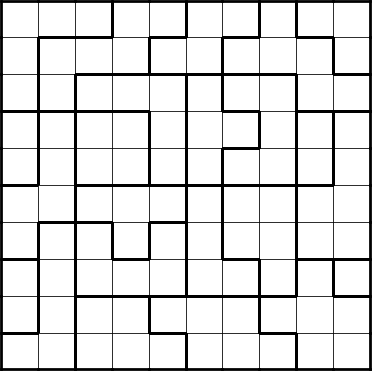
There's one medium difficulty 10x10 magnets puzzle and two very hard 12x12 puzzles. The 10x10 puzzle has one of those standard openings I really like to put in Magnets puzzles. It's pretty easy to find, if you understand how to work this part of Magnets logic. The two 12x12 puzzles were my attempt to introduce some trickier openings into Magnets puzzles that I haven't seen before. The first 12x12 puzzle is actually the second I made. It's an easier version of the opening in the second puzzle, because I basically knew the first one would never be published in Akil Oyunlari.. Both puzzles use multiple rows and columns to force the first placements. You have to really understand how different rows and columns can influence eachother to get started. Both openings are perfectly logically deducable, but you do need to work a bit more for it than usual.
I hope you all enjoy the puzzles and the challenge.

Ruels for Magnets


Medium Puzzle

Click to enlarge

Very Hard Puzzle 1

Click to enlarge

Very Hard Puzzle 2

Click to enlarge

Friday, 5 October 2012

World Puzzle Championship 2012: Round 12 Half Dominoes

This round contains a single puzzle for which we have 50 minutes to solve. This seems like a considerable time, but we'll see how it works out. It seems finishable.
The puzzle is a Samurai Half Dominoes, where the rows and columns are counted as a whole. So if it's on the same height but different 9x9 grids, they still cant repeat. It's an interesting variation and funnily enough it doesn't even mean you need a lot more clues than normal. Just as a note, the Half Dominoes are a seperate image as that was easier.

12 Half Dominoes:

Rules:
Place the given Half Dominoes in each 3x3 square so that each of the five 9x9 grids contains each half domino once. No Half Domino can be repeated in any row, column or main diagonal, even if they are in seperate 9x9 grids. Numbers on the outside indicate the amount of dots in that complete row, column or diagonal. Arrows with numbers indicate the direction of possibly ambiguous clues.


Click to enlarge


World Puzzle Championship 2012: Round 11 Something Newish

The round name says it all. There's some new puzzles or variations. We have an hour to solve 9 puzzles. This leaves chances for bonuses.
My favourite are the Domino Arrows and Fishermen, although they both would be nicer by removing one of the clue types. I didn't do that in my puzzles though. I figured I'd stick as close to the instructions as possible.
The Domino Arrows puzzle is a challenging puzzle. This is partly caused by its size. The logic isn't overly difficult, but you have to understand some of the tricks. This can be hard as it's a new genre. The Fishermen puzzle isn't too hard. It's basically an Anglers puzzle, with size 2 fishermen. The third puzzle I made was a Rural Tourism. I mainly made that one to completely understand the rules. It has a complex rules set. But once you figure it out, the puzzle solves nicely, although a bit challenging.
There's one more puzzle to come later today. Enjoy.

Puzzles can be found below.

World Puzzle Championships 2012: Round 10 Anthology

This round seems to be a dedication to previous championships. There's no actual explanation given, but it seems to be the fairest guess. You can see a bit of development in the type of puzzles over the years. From more observation and word types to the now more common logic types. I'm not exactly sure on why certain types were chosen.Types like Yajilin and Corral can't be that specific to a championship. A few of the ones from championships I've been to are easier to understand. The round will last 90 minutes for 20 puzzles, which is a pretty high average per puzzle.
I've only made 3 puzzles because many of the puzzle types I either don't really find interesting to construct or too hard to construct. The first puzzle I made is a Hiroimono. It's nothing new and many people will have come across it a few times. I'd just never tried it and wondered how it's done. I haven't really figured out how to best make them and I don't think it's too hard. At least I learned a bit about some of the tricks of the genre with it though. The Jumping Crossword I wanted to try to make for a while but I never find my results at all interesting. I don't really think this one is anything special either. I'm not sure how to make them turn out great but that's a general problem with word puzzles for me. The last one is a Tetrascope. I like polyomino genres, so I figured I'd give it a try. It's not really hard but then again I don't really think they can be.
Enjoy.

Puzzles can be found below.

World Puzzle Championship 2012: Round 9 Metropolis

This round features seven Skyscrapers puzzles. One standard and six variants. A few new variants and a few more common variants. I think this puzzle should be fun. I think I can do well in it.
This was my favourite round to design. That's why I designed an example of each variant. At first I was planning to do only 3, but I couldn't really choose which ones. So in the end I ended up making one of each. The Dubai puzzle is medium to hard. The normal way of thinking is changed a bit by the extra number. New York makes this even a little harder, because one cell remains empty. This increases the amount of possibilities for each clue. This puzzle is my favourite in the set. Toronto isn't that hard a puzzle. It's the most common variant in the bunch. The Sydney puzzle has very little clues and I think it worked out really nicely. Tokyo I thought would be hardest to design, but it actually went pretty well. The first try ended up correct and I think the puzzle is fun. Sao Paulo isn't too hard. I like how the idea works as it's different from other variants seen before.
Hope you enjoy them as much as I did making them.

Puzzles can be found below.

World Puzzle Championship 2012: Round 8 Assorted Puzzles

This round lasts one hour and features mostly new puzzle types. Most are small variations or hybrids on known puzzle types. It's hard to judge how this round will go. We will see in about an hour.
The puzzles I made an example of were Pipeline, which is a U-bähn variant, Russian Field, which is a simple division puzzle, Coded Tetramino, a tetramino division variant and Squares, a possibly annoying squares placement puzzle. I chose these ones, because I had some idea of what to put in these puzzles. Another possibly challenging one was Dominoes in the Water, but I had no real idea how this would look and thus how to construct an example.
The Pipeline puzzle is pretty simple once you get the basics. The Russian Field is relatively tricky as it features a silly trick. But the small size should compensate. The Coded Tetramino should be somewhat challenging. I employed one possible opening in the puzzle. Also the easiest to build in. The Squares puzzle is pretty easy. I am not that handy in constructing this type.
Have fun with them.

Puzzles can be found below.

World Puzzle Championship 2012: Round 7 Lines and Arrows

The first round this morning is based around, well, lines and arrows. Drawing loops, lines and placing and following arrows. It will bean hour long round with a considerable amount of puzzles. From the values of the puzzles, there don't seem to be any really hard puzzles. There's two higher scoring puzzles but other rounds have had far bigger values puzzles.
As practise puzzles I made an example of each of the types: one loop puzzle, one line puzzle, one arrow placing puzzle and one arrow following puzzle. For the Loop puzzle I chose one of the easy types: Looking for the Loop. It doesn't leave very much room for freedom as the clues are not very restricting. So to make it unique, you basically end up with an easy puzzle. For the Line puzzle I chose Pipes, which is basically an Anglers puzzle, except multiple fishermen can catch the same fish. It's not very challenging. I think they can become difficult in a larger size with higher numbers, just like with Anglers. The Arrow placement puzzle is Pointing at the Treasure. It's a twist on Marbles puzzles where you place marbles, so that each marble is pointed at by one arrow and each arrow points at one marble. Except now the Marbles are placed and you have to place the arrows. This is my favourite puzzle in this set of four. I really like how it worked out. Lastly there's an Arrow Maze puzzle, which is more often known as 1~36(or whatever the end number is). I think my puzzle is relatively tricky. I like the end result as it has very few given numbers and is far more path based than number based.
Hope this second day is as enjoyable as the first day.

Puzzles can be found below.

Thursday, 4 October 2012

World Puzzle Championship 2012: Round 5 Black and White

This is the last individual round of the day, which is 90 minute round. The round is based around binary determination. A cell is either coloured or empty, a cell is either black or white. There's a few common puzzle types, a few new ideas and a few small variants on common puzzle types. I'm not really sure how this round will go for me as there are many types where the contrustion of the puzzle can really make a difference.
I prepared 3 new types and 2 more common types as practise puzzles. The White Pentamino puzzle is nothing spectacular but I think it's a fun solve. The no mirroring rule is not technically necessary for my puzzle. It still has the standard somewhat innate difficulty pentomino puzzles generally have. The Paint-by variants worked out really nicely in my opinion. It helped me a lot in seeing how these types work. The Tapa and Corral aren't anything spectacular. They were being very stubborn in construction and in the end I decided to just go for something simple.
Hope they are enjoyable.

Puzzles can befound below.

World Puzzle Championship 2012: Round 4 Easy as ABC

Here we start with the round of the first day that I expect is best suited for me. I never used to consider myself particularly strong in Easy as ABC puzzles, but the longer I've been solving online, the more I see that years of Breinbrekers practise has made me much stronger than I thought. I guess that's understandable, considering the amount of exposure I've had. The same goes for Nikoli subscribers with Nikoli genres.
This round won't feature any standard Easy as ABC puzzles though. There will be three Easy as ABC Crosswords, three Easy as ABC Snakes and three Hexagonal Easy as ABC puzzles in three different styles.
I will have an example of each of the three types. The Crossword is not difficult but pretty fun. The Snake I find the trickiest of the three genres and had some trouble constructing. The Hexagonal puzzle is my favourite of the three. Hexagonal Easy as ABC's always have far fewer clues than you'd expect. This is caused because the outside rows contain most the letters and thus there are far less solutions than a normal grid. I think these three puzzles should be fun.

Puzzles can be found below.

World Puzzle Championship 2012: Round 3 Twisted Puzzles

The third round of the WPC feature a number of classic puzzle type, with a slight twist. This slight twist usually means one of the main rules of the genre is broken and can't be applied while solving till you've fixed the twist. The twists in the puzzles not featured in this post are are an Easy as ABC clue in a Skyscraper puzzle, extra numbers in a Domino puzzle, empty cells in Kakuro and Arrows puzzles, 2 touching ships in a Battleships puzzle and an incorrect clue in a Four Winds puzzle.
I opted to design a Worms, Star Battle, Ariadne's Thread, Tents and Trees and Magnets variant. These were chosen for different reasons. Worms and Ariadne's thread I had never made myself and wanted to see how they are constructed and what the impact of the extra rule was. Star Battle I saw as the most dangerous twist to make a mistake in and construction clearly showed I was right as my first 2 attempts were broken as I had messed up with the twist somewhere. The Tents and Trees isn't so much different, but it was important to get one automatic solving technique out. the Magnets was just because I like designing Magnets and that was all for my own constructing pleasure.
I hope they are enjoyable, I surely enjoyed constructing them.

Puzzles can be found below.

World Puzzle Championship 2012: Round 2 Blackjack

The second round we are facing consists of twenty-one puzzles around a twenty-one theme as it is the twenty-first World Puzzle Championship. This is one of the larger mixed rounds, lasting 2 hours, which generally means far too many puzzles for the amount of time. So, a lot of options to choose from and hopefully make the right choices in which puzzles to start with, getting all the big pointers done in the middle and finishing on some quick low pointers to get those last extra points in and not end up leaving 25 points out by just running 30 seconds short on solving the puzzle. Usually my timing and puzzle choices are pretty good. This was shown best at the 2010 WSC, where I managed to put the last digit in exactly when the timer ran out. I was sitting near the spectators, who could see me solving and got a congratulatory pat on the back for finishing so nicely within the time limit.
This post will feature five puzzles from the twenty-one genres featured in this round.

Puzzles can be found below.

World Puzzle Championship 2012: Round 1 Domino Hunt

Good morning everyone. Here is the first "live" post from the WPC. The first round of the WPC will feature eight Domino puzzles. Except in the puzzles some of the numbers are missing. You'll have to restore them and fix the puzzle. It doesn't make a whole lot difference in the solving process, except that you have to watch out that you don't think a domino has only one place to go.
At the release of this post all WPC-participants should be bent over a booklet solving these puzzles if everything runs smoothly. This post contains only a single puzzle for you to solve. Enjoy!

Rules:

A complete 0-6 set of dominoes has been placed in the grid. Then all the borders were removed. accidentally also some of the numbers were removed. Restore the numbers and the borders of the dominoes.


Monday, 1 October 2012

World Puzzle Championship 2012: Live Puzzle Release

I will be traveling with many others to Croatia today for the World Sudoku and World Puzzle Championships in Kraljevica. I will be aiming to repeat last year's performance by qualifying for the playoffs in the WPC and finishing on the first page of the WSC.
Last year this meant a hiatus of puzzles on my blog. This year this means the opposite. I wrote a big set of practise puzzles for the WPC for my Dutch compatriots this year. I will be sharing these puzzles on my blog during the championship. The puzzles will be posted while the WPC is going on. All puzzles will be posted "live" on my site. This means that every set of puzzles from a particular round will be posted at the time the round begins at the championship, so you can solve the same types of puzzles at the same time as the WPC competitors. Each puzzle in a round will be accompanied with the number it has in the round. If you would like to see an example of a puzzle before attempting it, you can easily check it in the instruction booklet.
Over Thursday and Friday everyone can thus get a taste of the puzzle types featured at the World Puzzle Championships. There will be 40 puzzles released from the 11 individual rounds at the WPC. Hope you all will enjoy them.

Thursday, 27 September 2012

Puzzle #132: Complimentary Hexa Sudoku

Before the Sudoku craze Hexa number place was my favourite variant. I like how it didn't have all numbers in every row and the 3 direction configuration led to some fun interactions. I haven't really seen many of these in a while though as most people have gotten to writing Sudoku variations in standard grids. I recently tried to write some again and this is one of the results.
I combined this puzzle with a variant I saw while test solving the Hungarian Sudoku Championship. Those were my favourite sudoku puzzles I tested. I thought it worked well together in a Honeycomb grid.

Rules:

Place the digits 1~9 in every cell, so that no digit is repeated in any row in any of the three directions. When a dot is given between three cells, it means that two of the digits add to the third digit. Not all dots are given.


Click to enlarge


Tuesday, 25 September 2012

Puzzle #131: Masyu: Not Alone and No Touch

The reason there are two puzzles today is because I started designing the Not Alone Masyu and noticed that the same placement actually also makes a nice opening for a No Touch Masyu. So after completing the Not Alone Masyu I also used the opening to make a No Touch Masyu.
The Not Alone variation is based on the Not Alone genre. It uses similar logic as the alternating Masyu variation, where the loop has to alternate between black and white circles. In this type the loop isn't allowed to alternate between white and black circles. In other words, every circle is preceded or followed by at least one circle of the same colour. I think it works nicely in this puzzle and decreases the amount of circles necessary.
The No Touch variant was seen first on Palmer Mebane's blog. It has seen some appearance in other people's blogs and the Indian Puzzle Championship as well. It was mere coincidence that I spotted that the opening worked just as nicely for this variant. I couldn't just let it go and worked with the same opening to create a second puzzle. I think it worked out well.

Rules for Masyu

Not Alone Masyu:
Follow regular Masyu rules. Additionally the loop may never alternate between black and white circles. In other words, every circle is preceded or followed by at least one circle of the same colour.


No Touch Masyu:
Follow regular Masyu rules. Additionally, no two unused squares may share a border.


Saturday, 22 September 2012

Hungarian Puzzle Championship: Doppelblock

The last set of puzzles I provided to the Hungarian Puzzle Championship were four Doppelblock puzzles. They featured in the non-classics round.
I've recently started to construct these puzzles and having fun with them. It's one of the few suggestions I had for the non-classics round and this one fitted in best. As this is an uncommon genre I didn't have to put much difficult in but could keep the puzzles fairly standard.
The first puzzle is a 6x6 puzzle based around larger numbers. The placement of the black squares can be derived without placing any numbers. Nothing challenging about this puzzle.
The second puzzle is a 6x6 puzzle built around the number 0. The black square placement is a bit trickier than the first puzzle. Overall it shouldn't cause much problems though.
The third puzzle is a 7x7 puzzle. The increased size of the puzzle is mainly what makes the puzzle trickier. I like how the puzzle worked out. Especially the 2 column finish was really nice.
The last puzzle is an 8x8 puzzle. The clues are split between odd and even clues for rows and columns. The puzzle has a very narrow opening, which makes the solve tricky. I really think though that the logic and layout worked out very well.
Overall I think these four puzzles showed very well what's possible with this genre. So far I have limited to 8x8 puzzles, but I'm going to try to extend it to 9x9 and bigger as well. But I'm not sure if its possible to create them without giving clues in the grid as well.

Rules for Doppelblock

Puzzles can be found below.

Thursday, 20 September 2012

Hungarian Puzzle Championship: Star Battle

Today will feature 4 Star Battle puzzles I contributed to the Hungarian Puzzle Championship. The Star Battle puzzles also featured in the Classics round.
Designing Star Battle puzzles in the 10 minute time limit is easier than Kakuro puzzles, because the average solving time for a Star Battle puzzle is much lower than a Kakuro puzzle. So puzzles don't have to be overly easy to have a solving time of 1-2 minutes for the best solvers.
For the two easier puzzles I wanted two different types of openings.Most Star Battle puzzles employ one of these two openings. The first one is the easiest of the two. It revolves around a single star that can be directly placed. From there the puzzle quickly resolves.
The second puzzle has a different standard opening, although maybe in a not so standard place. I do think it stands out among the other areas. This puzzle resolves a bit slower than the first puzzle as it has a few key points in the middle of the solve to make progress.
The third puzzle has the type of opening I like to do. At first sight, neither of the standard openings seem to apply but with a simple deduction one appears. It's a bit harder in this puzzle to keep making progress as there are a few key deductions that have to be made in order.
The fourth puzzle has a more atypical opening. I've used a similar one before in my other Star Battle puzzles. The opening doesn't stand out instantly but it should be clear how it works none-the-less. I think this puzzle is the hardest because it employs the most obscure opening and the way to make progress afterwards is hardest among the four puzzles.
I've added a fifth puzzle that wasn't used in the championship, but I constructed for it though. It was actually the first puzzle I constructed, using three cages that spell out HUN, that was meant as the hardest puzzle of the four. But after making three others I found it was too hard to be included in a set of three other puzzles, I made an extra one that is a bit easier to solve. To solve this one you need to see how different cages work together far more than the other puzzles. This makes the solve far trickier than any of the other four puzzles.

Rules for Star Battle

Puzzles can be found below.

Rules: Star Battle

Place 2 stars in every row, column and black bordered area. The stars can't touch eachother, not even diagonally.

The example uses only 1 star.


Tuesday, 18 September 2012

Hungarian Puzzle Championship: Kakuro

At the request of Zoltan Horvath I contributed some puzzles to the Hungarian Puzzle Championship held this weekend. I will post all puzzles this week. The general requirements were 2-4 puzzles for a solving time of 10-15 minutes. The test consisted of a classics and non-clasics round. Today we start with Kakuro, which was featured in the classics round.
I've always liked writing Kakuro puzzles, but I generally tend to write difficult puzzles. So my first goal was to write 2 easy puzzles with all basic deductions, with openings in multiple places. It took me a while to get that done actually as I automatically tend to put in harder things without thinking about it. I made 2 easy puzzles which turned out well. In hindsight it would have probably been better to make them a bit smaller to make the solving time less. But I figured they'd both fall between 1-3 minutes in solving time for the fastest solvers. The first one was just a simple circular pattern you can almost go in on big haul around the track. The second puzzle was a bit more open pattern, with a few more places where the puzzle can open up. I had the first one tested to see if this was actually enough on the easy path, as I find it hard to actually judge difficulty of Kakuros and it seemed to be okay.
The third puzzle I wrote had a few harder deductions, but the main thing that made it harder is that is has a single opening from which you have to work through the puzzle. It turned out to really not be anything special. It was one of those puzzles I have written many of.
The fourth puzzle I wrote is actually one of my favourite Kakuros I have written ever. It was built around a pattern which employed eight interlocked 8-cell sums. I made them all a different value. Because of the many  larger sums it uses certain techniques which you don't normally encounter much in Kakuro puzzles. It has some similarities in layout and solving to another puzzle I have written before. I think this one turned out better.
During testing of course it again turned out that my judging of Kakuro difficulty was far off the norm and instead of four puzzles, only two of the puzzles were used. Only the second and third puzzle ended up in the championship but I'm still posting all four puzzles in this post.

Rules for Kakuro

Puzzles can be found below

Rules: Kakuro

Fill every cell with a digit from 1-9. Numbers above a diagonal line indicate the sum of the digits in the consecutive white cells immediately to its right. Numbers below a diagonal line indicate the sum of the digits in the consecutive white cells immediately below it. No digit can be repeated within a single sum.


Thursday, 13 September 2012

Double Trouble #8: Skyscrapers and Haido

Haido is a puzzle type that I've recently come across a few times again. It showed up in a recent Skyscrapers contest hosted on Logic Masters Deutschland and the latest Akil Oyunlari magazine. All puzzles I've recently solved were really nice. So I tried making a few and found them more interesting to make than I at first thought they would be. When I saw the results, I thought they all look exactly like normal Skyscrapers puzzles. But they never solve uniquely as a skyscrapers puzzle. Usually they don't even have a valid solution.
So this led me to try to design one that worked as both. I found it hard to find an opening that worked nicely for both. so I cheated a bit with introducing a 6 clue for the skyscrapers puzzle, which is meaningless in the Haido puzzle. I like how they both turned out, although they are challenging.

Rules for Skyscrapers

Rules for Haido

Firstly this puzzle can be solved as a regular Skyscrapers puzzle. This is a hard puzzle.

Secondly it can be solved as a Haido puzzle. It is harder than the skyscrapers puzzle. I haven't solved any that are this difficult.


Rules: Haido

Haido is a genre based on the Skyscrapers genre.

Place the digits in the given range once in every row and column. The digits represent skyscrapers of that height. The clues on the outside indicate that the building of this height is visible in that row or column from that side. Larger skyscrapers block the view of smaller ones.

The example uses the digits 1-4.


Tuesday, 11 September 2012

Puzzle #130: Pentomino Areas

Pentomino puzzles I have slowly grown into. When I first started puzzling, I always had a lot of trouble solving them. In my early Breinbrekers issues, pentomino were the ones that were most often left unsolved. I prefer the placement type pentomino puzzles over the packing type. I've never been very good at packing problems. I've gotten more proficient at pentomino puzzles over time and now usually enjoy them.
Pentomino puzzles were the first type I regularly contributed to Breinbrekers, where I would write 18x18 Battleship-like puzzles, which used all Pentominos twice. I haven't written them in a while though. They take a while to get unique and solvable.
This pentomino type will appear in the upcoming LMI-test Borders & Beyond written by Prasanna Seshadri, which I was a test solver for. The type can sometimes get me stuck badly. The last time that happened was at the Dutch Puzzle Championship in '06, when it was featured in the semifinals and I couldn't get it done and ended up guessing my way through. Luckily I could catch up on the second puzzle and still qualify for the finals then.
This puzzle has a feature I like to use in puzzle types as all areas are the same size, which isn't common in this puzzle type. I have done the same in LITS as well, although there it was only on an 7x7 and 8x8 size.

Rules:

Place all 12 pentominos once in the grid so they don't touch eachother, not even diagonally. Each blackbordered area contains one pentomino.


Click to enlarge

Thursday, 6 September 2012

Puzzle #129: Contact

I've given this genre another go. I think the 1 through 7 theme worked out pretty nicely. The opening of the puzzle is easy, but it gets a bit harder towards the end.
For everyone who's been trying to get to this post yesterday from other blogs, I'm sorry. I accidentally forgot to add the scheduled time.

Rules for Contact


Tuesday, 4 September 2012

Puzzle #128: Expanded Sudoku

I have played around with this idea a bit already before. When it popped up in the US Sudoku Qualifiers under the name Sudoku stairscases, I figured I'd give it another go. I prefer Expanded Sudoku as Sudoku Staircases really only work for one layout. I made the first ones back in early 2010. There'd been other Sudokus with gaps in rows, but I hadn't seen them with the standard 3x3 blocks. My first puzzles are puzzle #1695 and #1703 on PuzzlePicnic. Later on I tried to make them with irregular cages too, namely puzzle #2584 and #2607. The logic in them isn't any harder than any normal Sudoku, but I still think the increased size adds a bit of an extra challenge.
This puzzle isn't any harder than the other puzzle. I like how it looks though. This puzzle has one more challenging step that stayed in the puzzle while maintaining uniqueness.

Rules for Sudoku

In this puzzle the rows and columns continue over empty space.


Thursday, 30 August 2012

Puzzle #127: Easy as ABC; Regional

With this puzzle it is back to old school puzzling for me. Easy as ABC puzzles are one of the first puzzle types I solved. They used to appear as an extra puzzle in Logiquiz magazine. These were my real introduction to logic puzzling. This was before I started buying Breinbrekers. They appeared under the name Letterraam, which is a name for an old tool to help kids learn to read in Dutch. Without these puzzles I would have probably never bought Breinbrekers.
These puzzles uses two common variations on the genre. Firstly they don't use the standard "first seen" clues, but indicate the position of the letter when looking from that side. So A3 means that A is the third letter when looking from that side. This variation makes constructing larger grids much easier as large grids tend to get uniqueness problems in the centre, where your clues don't have any effect. Secondly they have regions that function just like a Sudoku. This helps reduce the number of clues necessary to make it unique.

Rules for Easy as ABC

Fill the letters A~E (A~G in the larger puzzle) once in every row, column and black bordered region. Otherwise follow Easy as ABC rules.

Medium Puzzle


Hard Puzzle

Click to enlarge
 

Tuesday, 28 August 2012

Puzzle #126: Tapa; Mastermind: Tapa/Knapp Daneben Tapa

At first I was trying to make a Knapp Daneben Tapa that looks exactly like a normal Tapa. That wasn't as easy as I hoped it would be. So I changed my approach and added the Mastermind component to it. This made it far easier to construct. The puzzle itself is pretty tough though.

Rules for Tapa

Tapa Mastermind:
The gray numbers between corresponding rows represent Mastermind clues. The numbers indicate how many squares in the same position are coloured in both grids.

Knapp Daneben Tapa:
Follow regular Tapa rules. Additionally all given digits are wrong. They are all either 1 higher or 1 lower than the given value. This means a 1 can possibly turn into a 0.


Click to enlarge

Thursday, 23 August 2012

Puzzle #125: Ripple Effect

Here's another Ripple Effect puzzle. It's been a while since I posted one. this is mostly caused by the fact that I've been writing Ripple Effect puzzles for Breinbrekers as well. It's not always easy to find good openings for clueless grids. It also helps to not make any errors. The construction took a while as I had made a mistake very early on and didn't notice after finishing the puzzle on my fifth try. Took me another four attempts to fix that mistake correctly. But in the end I think the puzzle worked out well. I have used a similar opening before. It's moderately hard, as most my Ripple Effect puzzles are.

Rules for Ripple Effect


Tuesday, 21 August 2012

Puzzle #124: Doppelblock

I'm back again to posting. Hopefully for a while. The Olympics were the main contributing factor to me not posting. I spend most my free time watching the Olympics. I didn't really find the time to create puzzles then.

Today we have three Doppelblock puzzles. It's originally from Naoki Inaba, I'm going with the German name from crocopuzzle. Simple name, but it sounds nice. Serkan Yurekli gave it an English name in Smashed Sums, but I didn't particularly like that name.
When I first saw this genre on crocopuzzle, I liked it. Although crocopuzzle regularly has this small minimal puzzle that is a bit annoying to solve as it's too had to discover the logical path. The larger ones are always nicer, but tend to have givens in the middle. This makes them a bit less elegant to me. It feels a bit similar as givens in skyscraper grids.
I think the puzzles worked out well. Nothing too difficult, but something to keep you busy for a little while. This puzzle type will also appear in the UK Puzzle Championship over the upcoming weekend, so it will be nice practise in this genre for those competing. It was merely a coincidence though. I had made these puzzles before the instruction booklet came out.

Rules for Doppelblock


Easy Puzzle


Medium Puzzle


Hard Puzzle


Rules: Doppelblock

This genre was developed by Naoki Inaba,

Colour 2 squares black in every row and column. Fill the remaining white squares with the digits 1~N, so that each digit appears once in every row and column. N equals the size of the grid minus 2 (e.g. for the example N = 3). The numbers on the outside indicate the sum of the digits in between the 2 black squares in that row or column.


Tuesday, 24 July 2012

Puzzle #123: Parquet

Here's again one of Naoki Inaba's genres. It has some similarities to the Windows genre, which featured in the WPC, which can also be found on Naoki Inaba's website. It's known as conect on his website, but I don´t find that a very nice name. I changed it to Parquet as the grids reminded me of the Parquet Sudokus.
The puzzle worked out really nicely in my opinion, utilising all rules as well as possible on a 10x10 grid.

Rules for Parquet


Rules: Parquet

This genre was developed by Naoki Inaba.

Colour one of two regions in every blackbordered 2x2 area to form a single contiguous shape. This shape doesn't have any 2x2 coloured sections anywhere. Also this shape doesn't form any loops anywhere.


Thursday, 19 July 2012

LMI Practise : Logirace

A recent comment on my blog mentioned how Loop genres feature prominently on my blog. It's somewhat true as I am better at finding interesting things to do with loop genres. This weekend happens to be a puzzle test on Logic Master India named Logirace. This test features nothing but loop genres. Half of them are Nikoli Loop genres(Corral, Country Road, Masyu, Slitherlink and Yajilin), 3 less familiar genres (Dutch Loop, Tapa Loop and Dotted Loop) and 2 that are new to me(Border Loop and Comet). I figured I'd try to make a few examples of the less familiar ones. Some puzzles worked out better than others. I didn't like working with some of the genres so much. Hard to get them unique and nice. Especially the Comet and Dotted Loop have issues of there being a unique solution a lot in construction. But I think each puzzle will help a bit in preparing for the test, if that's what you're interested in. Otherwise just solve them for fun. It's what puzzling is really about.


You can find the puzzle below. If you want to see smaller examples, check the instruction booklet.

Tuesday, 10 July 2012

Puzzle #122: Shakashaka

I haven't seen how the Nikoli puzzles of this genre tend to look like, but I expect mine are a bit different. I prefer to keep the amount of clues as low as possible and make the open areas resolve themselves. I figure my puzzles tend to be on the harder side because of that. I like how it turned out. I was planning on doing a 1-2 antisymmetric clue pattern, except the 3 forced itself and I liked how the puzzle went till that point. So this is how it ended up.

Rules for Shakashaka


Thursday, 5 July 2012

Puzzle #121: Heyawake; Symmetry

I had first seen this variant on Mathgrant's blog. I thought it worked nicely. So I figured I'd give it a go too. It wasn't the easiest to start as Symmetry is always a weakness for me when solving. It doesn't really register with me too well, usually. But then I got the idea to bring back the Antisymmetry label, which I had added to Puzzle #1, but hadn't used since. I always like to build in some kind of antisymmetry in the givens of my puzzles, except it somehow had never come back in any of my puzzles for my blog. So for this puzzle rotationally symmetrical cages with clues have the opposite clues given. This doesn't hold for cages without givens. It would have been cool if it did, but I think that would be awfully difficult to accomplish.
I think the puzzle worked out in the end. The one cell pairs were to fix uniqueness issues, which didn't really bother the solving path. Enjoy.

Rules for Heyawake

Follow normal Heyawake rules. Additionally, this puzzle has no numbers as clues. Instead the clues indicate if a room has 180 degree rotational symmetry or not. An S indicates that the room has 180 degree rotational symmetry. An A indicates that the room does not have 180 degree rotational symmetry.


Tuesday, 3 July 2012

Puzzle #120: Line of Sight

I still enjoy making these puzzles. It's not the easiest to create openings, so they end up somewhat similar. But once you get going, it's really fun to play around with. This puzzle is of medium difficulty. I've made a few harder ones, but still some trickier points.

Rules for Line of Sight


Saturday, 30 June 2012

Puzzle #119: Magnets; Construction

I've said before I liked Magnets puzzles. So I've tried to experiment with them a bit. The Tapa inclusion worked really nicely. For this one I went another way.
I came across the Tateyoko puzzle on Naoki Inaba's website. Here the goal is to divide the grid into Domino regions. An O on a border indicates that the lengths of the sides touching there are the same length. An X on a border indicates that the lengths of the sides touching there are of a different length. I then realised, basically you are building Magnets puzzle grids. So I figured it would be worth trying to combine them.
I first started with a 10x10 grid and found a bit of a start. But I realised this way it would turn out far too hard. So I scaled it down to an 8x8 puzzle. It's still not particularly easy, but it's more doable than the 10x10 opening. I'd advice getting some practise with the Tateyoko part of the puzzle by going to the link given above.

Rules for Magnets

Follow normal Magnets rules. Additionally in this puzzle, the domino regions in which the magnets go aren't given yet. Instead you have to construct them. Some borders between domino regions are already given. If there is an O on a border, it indicates the lengths of the sides touching there are of equal length. If there's an X on a border, it indicates the lengths of the sides touching there are of unequal length.


Rules: Magnets

The grid is divided into domino regions. Place some magnets into these regions. Each magnet consists of a + pole and a - pole. Equal poles aren't allowed to touch by a side. The numbers on the outside indicate how many of each symbol are located in that row or column.


Thursday, 28 June 2012

Puzzle #118: Pentopia

This is the first 12x12 Pentopia puzzle I've made that only has 10 clues. Most of my puzzles have 12 given clues. That just seems the total that's mostly needed to make the puzzle unique. Just like that most my 10x10 Yajilin puzzles use 10 clues. The opening to this puzzle is tricky, but after that it shouldn't cause too many problems.

Rules for Pentopia


Click to enlarge

Tuesday, 26 June 2012

Puzzle #117: Masyu; In and Out

There's been a few Masyu variants done with optional Black and White circles. Here's another one, with a extra twist. The twist is taken from the Castle Wall genre. I think the puzzle worked out nicely. The optional quality makes the puzzle a bit trickier. Maybe the next time I'd make the puzzle a bit bigger, to make the twist play out more.
I know I've been making more variants the last few weeks. That's why I've added an extra tag for all puzzle variants and hybrids to find them easier on the blog. I've left the variant tag off the Sudokus as every Sudoku is a Sudoku variant. If people think I should also add it to them, I will.

Rules for Masyu

Follow normal Masyu rules. Additionally, not every black and white circle has to be visited by the loop. If a black circle isn't visited, it will be located outside the loop. If a white circle isn't visited, it will be located inside the loop.


Rules: Masyu

This genre was developed by Nikoli.

Draw a single closed loop connecting the centres of cells horizontally and vertically. The loop
doesn't touch or cross itself anywhere. The loop runs through all black and white circles. The loop
turns in every black circle and goes straight through both adjacent squares. The loop goes straight
through every white circle and turns in at least one of both adjacent squares.


Saturday, 23 June 2012

Puzzle #116: Tapa; Borderline

This a variant I thought of myself. I checked the TVC booklet and it didn't appear in it. So as far as I know it's original. It is a simple variant that I had attempted before. I couldn't make it work then. I think I wanted to make it too difficult then and couldn't get it to work. This one worked out. It's still tricky though. This one has all clues on a border between 2 cells. I do think it's just as easily possible to put the clues on nodes between four cells. I figured having to choose between 2 cells for the first one is difficult enough.

Rules for Tapa

Use standard Tapa rules. Additionally, each Tapa clue is located on a border between multiple cells. This Tapa clue belongs in one of these cells. Determine which cell the clue belongs in and solve the puzzle.


Thursday, 21 June 2012

Puzzle #115: Regional Akari

I've never really been a fan of Akari puzzles. The easy ones I find just go too quickly to really enjoy. The harder ones I feel like I'm just using trial and error. That's mostly why I haven't really made many of them. When I saw the regional variant on Naoki Inaba's site, I figured I'd give this a try in construction. I think it turned out okay. Nothing too difficult.

Rules for Regional Akari


Rules: Regional Akari

This genre was developed by Naoki Inaba.

Place one lightbulb in each blackbordered region, so that every cell in the grid is illuminated by at least one lightbulb. Lightbulbs illuminate all cells they can see in a horizontal and vertical direction. Black cells block their sight. No two lightbulbs can illuminate eachother.


Tuesday, 19 June 2012

Double Trouble #7: Liar Loop and Maxi Loop

I guess this twin isn't very surprising. I did create the Liar Loop genre from the Maxi Loop genre. It has been the hardest one to acchieve so far though. I had attempted this a few times already, but it always lead nowhere. For this one I finally found a solid opening, that lead to good progress in both genres. Finishing it succesfully took some effort though. The puzzles both turned out well and I like the way clues keep helping in both genres.

Rules for Liar Loop

Rules for Maxi Loop

This puzzle can be solve as a Liar Loop puzzle. This one is the harder of the two puzzles. But that's mostly because Liar Loop is inheritently hard. It's a bit of a challenge to create really easy ones.
This puzzle can also be solved as a Maxi Loop puzzle. It's a bit easier than the Liar Loop puzzle. Main reason for this, is that I couldn't avoid using 1 clues for the Liar Loop puzzle.


Thursday, 14 June 2012

Puzzle #114: Corral; Crates

I liked the Crates variation when I first saw it on Palmer's blog. I didn't like the red numbers so much though. That's why I preferred the one puzzle without red numbers. Last year's USPC also featured a Corral Crates puzzle without red numbers. So my puzzle also doesn't contain any red numbers.
This puzzle originally didn't start out as a crates puzzle, except the five 17s and the antisymmetric pairs of 7's and 10's on the outside made a valid corral loop very difficutl to acchieve. I constantly ran into the problem of having no possible valid loop when designing. So I tried to switch to a Corral Crates design instead. It did make the opening a bit harder. I edited out a harder spot in the middle, but kept the opening in as I had already found it a nice way to make the five 17s work in earlier design attempts.

Rules for Corral

In this puzzle there can be isolated loops on the inside the bigger loop. These isolated sections always form a 1x1 square. Different loops don't touch eachother, not ever by a corner. These isolated loops block the sight of the numbers.


Click to enlarge

Tuesday, 12 June 2012

Puzzle #113: Easy as Japanese Sums

I encountered this puzzle type the first time when test solving Serkan Yurekli's puzzle set for last year's 24 hour puzzle championship. I really liked them, although they caused more trouble than you'd expect for their size. Even though the puzzle idea is very similar to Japanese Sums puzzles, the Latin Square component in this genre makes solving a lot different though. Only later I found that the genre also existed on Naoki Inaba's website.
This is the first time I tried to create one myself. I like how it turned out. It's moderately difficult.

Rules for Easy as Japanese Sums

This puzzle uses the digits 1-5.


Rules: Easy as Japanese Sums

This genre was invented by Naoki Inaba

Place the digits in the given range once in every row and column. The numbers on the outside indicate the sum of the first digits seen from that side till encountering an empty square.
The example uses the digits 1-3.


Friday, 8 June 2012

European Championship Football

A while back at a Dutch championship we had a round inspired by the World Football Championship that had started that weekend, so I've written a few puzzles using the teams in each group. They're not very hard. One of them is a simple score deduction puzzle. The standings are purely fictional, nothing intended. The second is a logic puzzle, which includes the game scores. I hope you like my awesome drawing. The third is a path puzzle using the country names. The fourth is a Four Snails puzzle using the country names.

Group A: Final standings

Part of the final standings of group A are given. Fill out the rest and deduce the match results. For those not knowledgable of football, a win gives you 3 points, a tie gives you 1 point, a loss gives you 0 points.
G = Matches played, W = Matches won, T = Matches tied, L = Matches lost, P = points score, GF = Goals scored, GA = Goals conceded.


Click to enlarge
Group B: Logiquiz

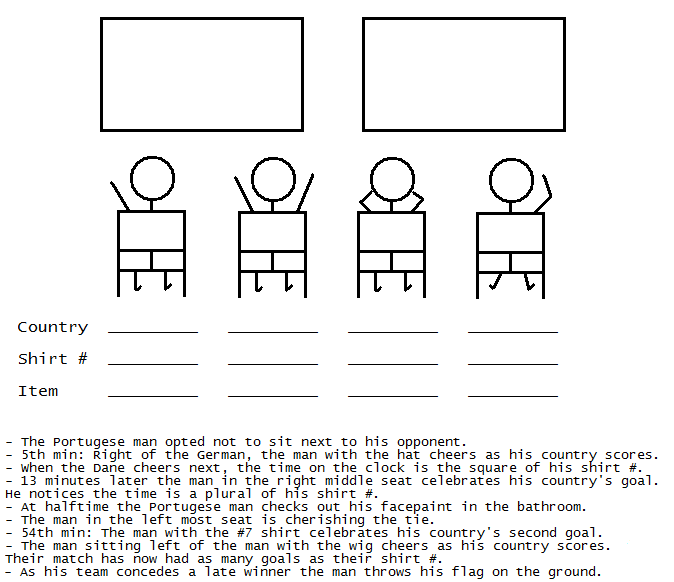
Sunday 17th of June, 20:45. A Dutchman, German, Portugese and Dane have come together to watch their group's final matches. They're each wearing their countries shirt with a different number. They also brought another item to dress themselves up. Figure out who sat where, what number they had and what item they brought.
All clues are given in chronological order.


Click to enlarge

Group C: Country path

Draw a path from the first letter to the last letter of each country in order. The path doesn't rouch or cross itself. Different paths can't touch or cross eachother, except in a cell with a letter. If two paths both go through a cell with a letter they have to both go straight through it.


Click to enlarge
Group D: Four Snails

Write all countries in one of the four spirals. Write the letters in order from the opening inwards. No letter may repeat in any row or column.


Thursday, 7 June 2012

Puzzle #112: LITS; Inversed

Today's puzzle is a variant on the LITS genre. I don't remember seeing it before. Constructing it went smoothly, although there were some points at the end where it caused trouble to keep it unique. Hope you all like it.

Rules for LITS

Colour some squares to form a single contiguous wall. The wall has no 2x2 coloured areas anywhere. In each blackbordered region a shape of 4 orthogonally connected squares remains empty. Identical shapes in different regions can't touch eachother by a side. Rotations and reflections are considered the same shape.


Wednesday, 6 June 2012

Croatian Puzzle Set

I had been asked to write a puzzle set for a competition in Zagreb last weekend. I wrote a set of puzzles which was a mix of Dutch and Japanese, familiar and unfamiliar, classic and simple variations. There's a lot of puzzle types in here that I havent actually posted on my blog before. The timing of the set was set at 75 minutes, which was longer than the fastest testing. But I have learned from earlier experiences that testing times don't always measure up to the actual test solving. I've added the scores for each puzzle, which equal to 2 points per minute. I think it worked out well, with a mix of easier and harder puzzles. If anyone actually solved them in copetition, I'd love to hear about it.

So here's 14 puzzles in a single post, the most I have done so far. I hope this makes up a bit for the hiatus of a month before. It would of course be easiest to just upload the PDF, but blogspot doesn't seem to offer that option. So instead this post will have all puzzles below.

Tuesday, 5 June 2012

Puzzle #111: Tapa; Magnetic

This variant was my favourite in constructing during the whole TVC practise series. This was because I was able to do the most with it. I have always loved Magnets puzzles. The first time I encountered them in the Dutch magazine Breinbrekers, I instantly liked how the logic worked. Somehow it just clicked for me. I always have fun constructing them as well. You can have fun with them, especially if you leave out clues like in these puzzles I put on PuzzlePicnic: #1242 and #2160. The combination with Tapa makes for a whole different way of construction. But I liked them best where the Magnets clues lead to the most deductions, instead of the Tapa part.
I think the puzzle worked out well. I wanted to make a 111 themed puzzle and I think it worked out well. It's made in a 11x11 grid. There is one single 111 Tapa clues. It is almost perfectly themed with the magnets clues as well. Each side has 6 1 clues. Just couldn't get the columns set as a three 1 clues for both plus and minus. But I like how it turned out in the end.

Rules for Tapa

Follow regular Tapa rules. Additionally the grid is made up of magnetic and non-magnetic plates. The Tapa wall is made up of non-magnetic plates. Each magnetic plate has a positive (+) and negative (-) side. Sides with the same symbol can't be orthogonally adjacent. The numbers outside the grid indicate how many of the indicated symbol appears in that row or column.


Click to enlarge

Saturday, 2 June 2012

Puzzle #110: Star Battle; Clone

This week's puzzle making has been one big stretch of it-just-will-not-work. About every puzzle I tried to make, wouldn't work the way I wanted. When you add to that a bit (or a lot) of stubbornness and I end up restarting a lot of designs and constantly coming to the same conclusion and having to restart.
This puzzle hasn't been any different. I had a certain idea but every time I tried to execute it, I would be forced to break the opening and thus had to restart. So eventually I made it slightly different and an easier version of it. This is the result. I like the opening. I haven't fully checked if there are other ways to open it up, but I like where the intended one is located and how it runs the rest of the puzzle. The puzzle isn't easy, but I wouldn't say overly challenging. Just keep track well in all grids and you should be able to solve it.

Rules:

Place 3 stars in every row, column and boldly marked area. All grids have the same solution. You'll need to use all grids to get to the solution.


Click to enlarge

Wednesday, 30 May 2012

Puzzle #109: Camping

Yesterday's puzzle was scrapped at the last moment. the puzzle was not unique as I had made a flaw in the opening, so the whole puzzle didn't work anymore. There was really no saving it. I didn't want to just make a quick puzzle and instead moved the posting up a day.

This weekend I won my first LMI monthly puzzle test. I hadn't expected it when I finished it, with how disappointing the last 40 minutes went. In the first 80 minutes I had brushed off all puzzles besides the two "no numbers" genres. I thought it would be best to try to solve both No Number Field puzzles and leave the easy loop for the end. But after really struggling through that easy one, I quickly switched to the loop. The easy one I liked, although I struggled with it a little. I managed about half the second No Numbers Loop in the last 10 minutes. I made a mistake and it took me over 10 tries afterwards to discover what I was doing wrong.
Through Saturday it became clear though that I wasn't the only one who struggled with a few of the puzzles. In the end the top mostly solved the same puzzles, with the big difference being that I did manage to solve the second Synchronised Maze.

Today's puzzle is very old school to me. It was a standard puzzle in Breinbrekers when I first started buying the magazine. It has some similarities to Tents and Trees. The name of the puzzle was "Huisje, Boompje, Beestje" which is a Dutch saying that literally translates to "little House, little Tree, little Animal". The puzzle layout featured a house, a tree and a heart. Because the saying doesn't really translate to English in a way that it's applicable to a puzzle type, I changed the idea a bit. Instead it's represented by a camping ground.
When I first got the magazine this puzzle type always broke me up. I hardly ever managed to solve the puzzles. Then when I first started making puzzles, I tried making one of these. And all of the sudden I was able to solve them. It was the first time I noticed that trying to design a puzzle helps with solving a puzzle type.
There are 2 puzzles. One is a small easy one to help learn a few of the tricks involved. The second one is a normal sized puzzle. It's harder, but completely logically solvable. Hope you guys enjoy them.

Rules for Camping

Easy Puzzle


Hard Puzzle


Click to enlarge